

Nylas pricing in 2026 runs on four plans, Free, Essentials, Pro and Enterprise, and every one includes the same product set: email, calendar, Notetaker meeting bots and Agent Accounts for AI mailboxes. Free costs nothing and covers 5 connected accounts. Essentials starts at $15 a month for 10 accounts. Pro starts at $49 a month on monthly billing or $43 a month on annual billing, both for 25 accounts, with every account past the included volume billed as overage at a published rate. Enterprise has no listed number.
This guide is for a developer or technical founder who needs the real monthly bill at a specific account count, not just the headline price. We work through Nylas's overage math at 25, 50, 100 and 500 connected accounts, show exactly where Essentials stops being the cheaper choice, and explain what Pro Annual buys beyond a lower sticker price. We also flag why older guides to Nylas pricing quote numbers that no longer exist, and where a mailbox and calendar API like Nylas stops and a LinkedIn outreach system starts.
How does Nylas pricing work in 2026?
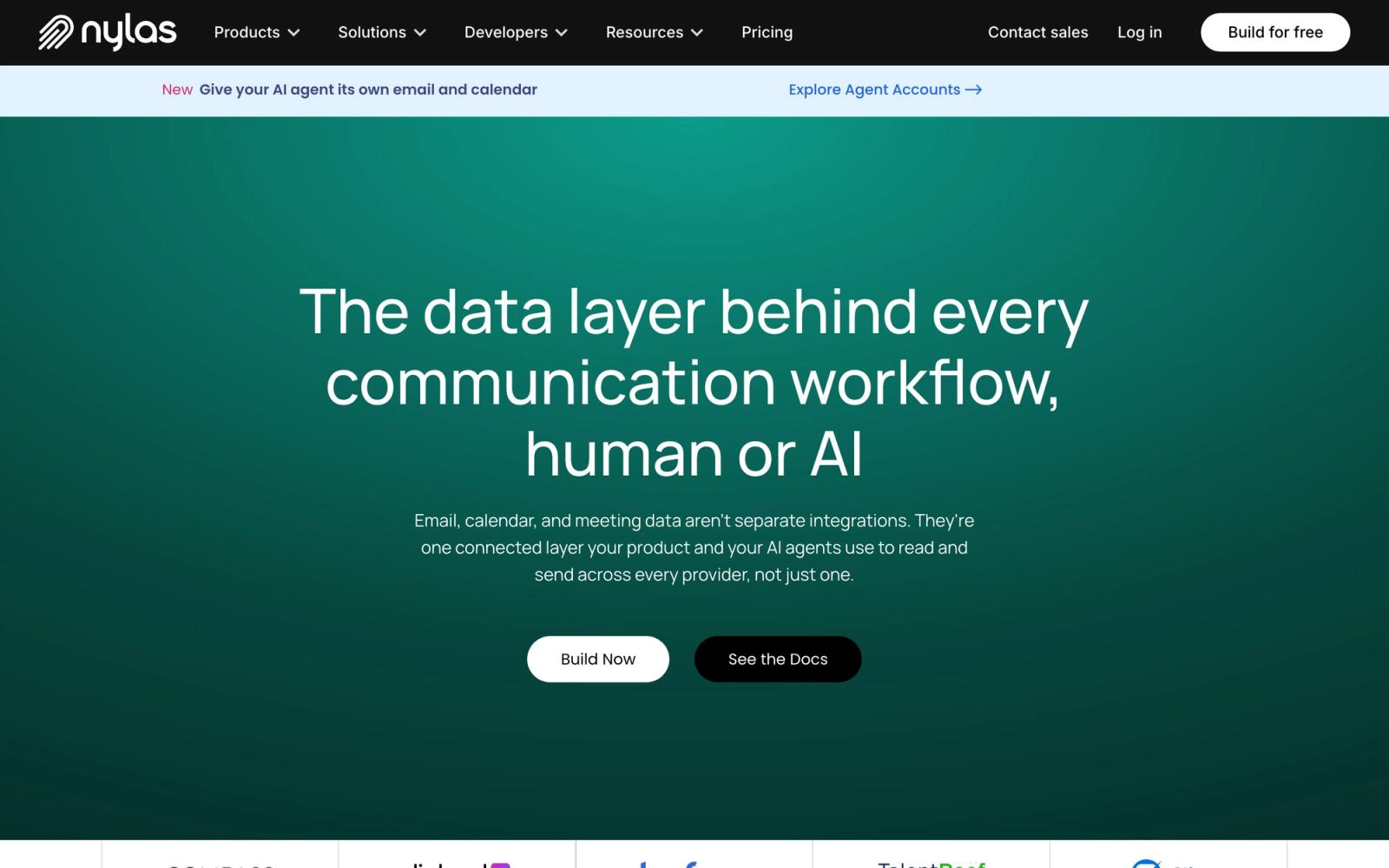
Nylas pricing works on a single model applied to every plan: each tier includes every product, meaning email and calendar connectivity, Notetaker bot hours, and Agent Accounts for AI mailboxes all ship on Free, Essentials and Pro alike. What changes between plans is how much of each resource is included before overage kicks in, and how much that overage costs per unit. Nylas's own pricing page states plainly that "all prices are listed in USD," and its FAQ confirms the rule for what happens past the included volume: "most usage simply keeps running, and anything extra is billed at the rates shown on your plan each month." There is no hard wall on paid plans, except on Free, where the FAQ says "a few limits are fixed, like on the Free plan, and upgrading raises them right away."
That overage-first design is why a flat headline number rarely matches what a team actually pays. Essentials advertises $15 a month, but a team connecting 30 mailboxes on Essentials is really paying $15 plus 20 accounts of overage, not $15 flat. The table below lays out the base fee, the included account volume and the overage rate for every plan, the foundation for every worked number later in this guide.
| Plan | Monthly base fee | Included email + calendar accounts | Overage per additional account |
|---|---|---|---|
| Free | $0 | 5 | Not applicable, fixed limits |
| Essentials | $15 | 10 | $2.25 |
| Pro (monthly billing) | $49 | 25 | $2.00 |
| Pro (annual billing) | $43 | 25 | $1.75 |
| Enterprise | Custom | Volume band pricing | Custom |
Essentials has no separate Monthly or Annual toggle on the page, so its $15 base fee and $2.25 overage rate are the only figures published for that tier. Pro is where the toggle matters most: annual billing lowers both the base fee, from $49 to $43, and the overage rate, from $2.00 to $1.75 per additional account, which compounds fast once a team connects more than a handful of extra mailboxes. Enterprise drops the per-account model entirely for volume band pricing that is not published on its pricing page, alongside HIPAA and HITECH BAA support, a guaranteed uptime SLA and app-level field filtering that none of the self-service plans mention.
What is a connected account in Nylas pricing?
A connected account, in Nylas's own words, "is any end-user mailbox or calendar your application links to Nylas, for example a Google or Microsoft account a customer authenticates." That definition matters because it is the unit every plan's overage rate is priced against: Essentials' $2.25 and Pro's $2.00 or $1.75 all apply per connected account past the included volume, not per user, per seat or per API call. A product syncing ten customer mailboxes is using ten connected accounts, regardless of how many people on the team have access to the Nylas dashboard.
Nylas prices two other resources on a related but separate basis. A bot hour is "one hour the Notetaker bot spends in a Google Meet, Teams, or Zoom meeting, recording, transcribing, and summarizing it," billed by meeting time rather than by account. An Agent Account is different again: it "gives your AI agent its own email inbox and calendar, hosted by Nylas," a full mailbox Nylas provisions for an autonomous agent, not a customer's own inbox being connected. Each of these three meters carries its own included volume and its own overage rate on every plan, so a full Nylas bill is really three calculations added together, not one number.
Building outreach on connected accounts, not just mailboxes?
Swarmhit runs LinkedIn campaigns, sender rotation, reply detection and safeguards behind one API with webhooks and MCP, on accounts your customers connect themselves.
Custom pricing. White-label available.
How much does Nylas cost at 25, 50, 100 and 500 accounts?
Nylas cost at any account count comes down to one calculation: base fee, plus accounts past the included volume, multiplied by the overage rate. Recomputing that formula at four common team sizes shows exactly where each plan wins.
| Accounts | Essentials | Pro (monthly) | Pro (annual) |
|---|---|---|---|
| 25 | $48.75 | $49.00 | $43.00 |
| 50 | $105.00 | $99.00 | $86.75 |
| 100 | $217.50 | $199.00 | $174.25 |
| 500 | Not a realistic fit | Not a realistic fit | $874.25 |
At 25 accounts, Essentials costs $15 plus 15 accounts of overage at $2.25 each, or $15 + $33.75 = $48.75, already close to Pro's flat $49 for the same 25 accounts with no overage at all. At 50, Essentials runs $15 + 40 x $2.25 = $105 a month, Pro monthly runs $49 + 25 x $2.00 = $99, and Pro annual runs $43 + 25 x $1.75 = $86.75, a gap that keeps widening: at 100 accounts, Pro monthly's $49 + 75 x $2.00 = $199 and Pro annual's $43 + 75 x $1.75 = $174.25 both undercut Essentials' $15 + 90 x $2.25 = $217.50. At 500, only Pro annual's formula is worth quoting: $43 + 475 x $1.75 = $874.25. Essentials and Pro monthly extend the same formula on paper, but 500 mailboxes is well into the range where Enterprise volume band pricing likely applies instead, and what that band charges is not published on Nylas's pricing page.
The break-even point between Essentials and Pro monthly lands at exactly 26 accounts. Setting Essentials' formula ($15 plus $2.25 per account past 10) equal to Pro monthly's ($49 plus $2.00 per account past 25) and solving gives n = 26: at 26 accounts, Essentials costs $15 + 16 x $2.25 = $51.00 and Pro monthly costs $49 + 1 x $2.00 = $51.00, an exact tie. One account earlier, Essentials is cheaper at $48.75 against Pro's $49.00; one account later, Pro monthly is cheaper at $53.00 against Essentials' $53.25. That crossover is a clean rule: below 26 accounts, Essentials wins; from 26 up, Pro is worth the higher base fee.
What does Pro Annual change beyond a lower base fee?
Pro Annual changes more than the sticker price: it lowers every overage rate at once, unlocks features Nylas gates specifically to annual billing, and requires a 12-month commitment in exchange. The base fee drops from $49 to $43 a month, but the more consequential change is the overage side: the per-account rate falls from $2.00 to $1.75, the calendar-only rate from $1.50 to $1.35, bot hours from $0.70 to $0.65 an hour, and Agent Accounts from $0.40 to $0.20 each, roughly half the monthly-billing rate. Custom sending domains also double, from 10 on Pro monthly to 20 on Pro annual.
Two features exist only on the annual tier: "Basic Support" and what Nylas calls the "Accelerator package," described on the monthly view as a "Google Shared App and Custom Auth Branding" and on the annual view as a "Shared Google App" plus "Custom Domain CNAME." Nylas's own FAQ is direct about the trade-off: choosing annual billing means "you commit for 12 months," which is also what unlocks "features reserved for annual plans, like Scheduler whitelabeling." Weighing Pro monthly against Pro annual really means weighing a lower ongoing bill and two extra features against a year of spend locked in up front.
How much do Notetaker bot hours and Agent Accounts cost?
Notetaker bot hours and Agent Accounts are priced separately from connected accounts, and both scale the same way: an included volume per plan, then a published overage rate. Free includes 5 bot hours and 3 Agent Accounts with 3,000 agent emails, 3 GB of storage and 3 GB of bandwidth a month, with no overage rate published on Free. Essentials includes 10 bot hours, billed at $0.80 an hour past that, and 10 Agent Accounts with 10,000 agent emails, 10 GB of storage and 10 GB of bandwidth a month, with no separate overage rate published for those Agent Account resources at that tier.
Pro is where every one of these meters gets its own published overage rate, and annual billing lowers each one:
| Meter | Pro included volume | Pro monthly overage | Pro annual overage |
|---|---|---|---|
| Notetaker bot hours | 70 a month | $0.70 per hour | $0.65 per hour |
| Agent Accounts | 50 | $0.40 each | $0.20 each |
| Agent Account storage | 50 GB | $0.40 per GB | $0.20 per GB |
| Agent Account bandwidth | 50 GB | $0.80 per GB | $0.50 per GB |
| Agent emails | 50,000 a month | $0.80 per 1,000 | $0.70 per 1,000 |
A product that joins every customer meeting to transcribe it will feel the bot hour meter first: 70 included hours on Pro covers roughly 17 hour-long meetings a week across a four-week month, and every hour past that adds $0.70 or $0.65 depending on billing cycle. A team building autonomous email agents instead will watch the Agent Account and agent email meters, since each hosted agent mailbox draws down both its own account slot and its share of the 50,000 included agent emails a month.
For the vendors that compete with Nylas on the email and calendar side, see our Nylas alternatives comparison, which uses the same September 2026 figures.
What is not on Nylas's pricing page?
Two things are conspicuously absent from Nylas's own pricing page. First, the feature checklist showing which API capabilities ship on which plan is rendered as checkmark icons rather than plain text, so we cannot state as fact that a specific feature is present or missing on a specific plan beyond the base fees, included volumes and overage rates already covered here. Second, and more relevant to anyone comparing channels, Nylas covers email, calendar, scheduling and meeting notetaking end to end, and nothing on its pricing page lists LinkedIn, WhatsApp or any other social messaging channel. Nylas is a mailbox and calendar API, not a multichannel outreach API, and its pricing page does not pretend otherwise.
That gap matters most for anyone evaluating Nylas next to a LinkedIn messaging API: no amount of reading Nylas's overage tables will surface a connection request or an InMail send, because Nylas's own pricing page lists no such action anywhere across its plans.
When is Nylas the wrong API for the job?
Nylas is the wrong API the moment a product needs to send or receive LinkedIn messages, connection requests or any other social outreach action, because its pricing page lists nothing beyond email, calendar, scheduling and Notetaker across every plan, from Free through Enterprise. There is also no path around that gap through LinkedIn's own official developer program. Its Microsoft Learn documentation states that "most permissions and partner programs require explicit approval from LinkedIn," and that "Open Permissions are the only permissions that are available to all developers without special approval," which cover signing in with LinkedIn and posting to a member's own feed, not messaging other members. Getting an official LinkedIn client ID and secret through the developer access process is not the same as being approved to automate outreach.
The Invitations API makes that restriction explicit rather than implicit. LinkedIn's own documentation is blunt about who can use it: "usage of this API is restricted to approved partners, subject to limitations via API agreement," and even an approved partner "can only send invites on behalf of the authenticated user," never on behalf of accounts that user does not control. A minimal request against that endpoint looks like this:
POST https://api.linkedin.com/v2/invitationsThe body carries an invitee URN, a person, an email address or a phone account, plus an optional message the docs say you can omit "to send the default message." Reading a member's own network runs through a separate, similarly restricted endpoint:
GET https://api.linkedin.com/v2/connections?q=viewer&start=0&count=50Even with that endpoint, the documentation is explicit that "you cannot 'browse connections,'" results cover only the authenticating member's own first-degree network, and second-degree connections "are not available from LinkedIn" at all. A team that wants raw account-level control anyway, prepared to build the sequencing, pacing and safety layer above it, can look at Unipile, which exposes connected-account actions directly rather than going through LinkedIn's restricted partner program. A team weighing whether to build that sequencer from scratch has a walkthrough in our guide to building a LinkedIn outreach tool, and what official access costs sits in our LinkedIn API pricing piece.
Is there a LinkedIn outreach alternative to Nylas?
Nylas and Swarmhit are not competitors, because they sit in different categories: Nylas is a mailbox and calendar API, and Swarmhit is a LinkedIn outreach system that runs campaigns on LinkedIn accounts a customer already owns and connects. Choosing between them is not comparing two vendors for the same job, it is deciding whether the job is email and calendar connectivity or LinkedIn sending, and the honest answer is usually both, handled by two separate tools.
Swarmhit's API exposes a working campaign sequencer with throttling, monitoring, retries, sender and organization limits, and safeguards for the account-safety edge cases that show up once real customer accounts run at scale, the category our outreach API comparison covers in more depth. Every connected sender gets a dedicated proxy, managed auto warmup, health checks and smart sending caps, with 250+ safeguards monitored around the clock, and replies land in one unified inbox with interest tags. Access runs through API, webhooks and an MCP server over the sequencer, senders, leads, inbox and events, with CRM connectivity through that same layer rather than a built-in sync. Developer access is scoped on an integration call rather than published as a per-sender number, and can run fully under a customer's own brand for teams that want the complete workspace rather than just the API underneath it.
The platform product itself, separate from that developer engine, runs from $29 per sender per month on annual billing ($39 on monthly billing), pay as you go per sender, for teams that would rather operate their own LinkedIn campaigns directly inside Swarmhit's own dashboard than build a product around the API.
Nylas at a glance
Pros
- Every plan, including Free, includes email, calendar, Notetaker and Agent Accounts, no feature-gated tiers to navigate
- Overage keeps usage running instead of hard-cutting service once a plan's included volume is used up
- Pro Annual lowers every overage rate at once, not just the base fee
- A genuinely free forever tier with no credit card required, enough to build and test an integration
Cons
- Essentials has no annual billing option shown on the page, unlike Pro
- Per-plan feature availability is shown as icons, not readable text, so exact feature gating cannot be stated with certainty
- No LinkedIn, WhatsApp or other social messaging channel listed on its pricing page
- Enterprise volume band pricing is not published, so costs above roughly 100 to 500 accounts are not quotable in advance
FAQ
What is Nylas pricing in 2026?
Nylas pricing in 2026 has four plans: Free at $0 for 5 connected accounts, Essentials at $15 a month for 10 accounts, Pro at $49 a month on monthly billing or $43 a month on annual billing for 25 accounts, and Enterprise at a custom, unpublished rate. Every plan includes the same product set, email, calendar, Notetaker and Agent Accounts, with usage past the included volume billed as overage rather than forcing an upgrade.
How much is Nylas API pricing per connected account?
Nylas API pricing scales per connected account once a plan's included volume runs out. Overage runs $2.25 on Essentials past 10 accounts, $2.00 on Pro monthly past 25, and $1.75 on Pro annual past 25, with no separate per-account rate below the included volume since the base fee already covers that first block outright.
Is the Nylas free plan enough to build and test an integration?
The Nylas free plan is enough to build and test a real integration, not just a demo, since it includes 5 email and calendar connected accounts, 5 Notetaker bot hours and 3 Agent Accounts with 3,000 agent emails a month, all at $0 with no credit card required. Nylas describes it as "free forever," and its own FAQ notes that only a few limits are fixed on that tier, with upgrading raising them immediately.
What is Nylas cost per connected account at scale?
Nylas cost per connected account falls as a plan's base fee rises, because a higher base buys a larger included volume before overage applies. At 50 accounts, Essentials averages $2.10 per account overall ($105 divided by 50), while Pro annual averages $1.74 per account ($86.75 divided by 50), and that gap widens further at 100 and 500 accounts as Pro annual's lower overage rate compounds.
Is Nylas worth it in 2026?
Nylas is worth it for a team that needs email, calendar, scheduling or Notetaker connectivity and wants one API and one bill covering all of them, with a free tier large enough for real testing before any payment starts. It is not worth it for a team whose core need is LinkedIn or other social messaging, since that channel is absent from every plan Nylas publishes, free through Enterprise alike.
How does Nylas pricing compare between Pro monthly and Pro annual?
Nylas pricing on Pro drops across the board on annual billing: the base fee falls from $49 to $43, the per-account overage rate from $2.00 to $1.75, and every other overage rate, bot hours, Agent Accounts, storage, bandwidth and agent emails, falls too, each by its own published rate shown in the table above rather than a single uniform cut. Annual billing also unlocks Basic Support and the Accelerator package, in exchange for a 12-month commitment Nylas states outright in its FAQ.
Is LinkedIn messaging listed on Nylas's pricing page?
Nylas's pricing page lists no LinkedIn messaging anywhere on it. Every plan from Free through Enterprise covers email, calendar, scheduling and Notetaker meeting bots, and no plan shows LinkedIn, WhatsApp or any other social messaging channel among its included products. A team that needs LinkedIn sending alongside Nylas's mailbox connectivity needs a separate, purpose-built tool for that channel.
What happens if a team exceeds the Nylas free plan's limits?
Nylas's own FAQ describes the free plan as carrying a few fixed limits, unlike the paid plans' overage model that lets usage keep running past the included volume, and says upgrading is what raises those fixed limits right away. What exactly happens in the moment a Free limit is hit is not detailed on Nylas's pricing page. In practice, growing past 5 connected accounts, 5 Notetaker bot hours or 3 Agent Accounts on Free means moving to Essentials or Pro rather than paying an overage fee on Free itself.
Can you estimate Nylas cost before signing up, the way a pricing calculator would?
Nylas cost can be estimated by hand using the published base fee and overage rate for each meter, the same method this guide uses throughout: multiply the accounts, bot hours or Agent Accounts past the included volume by that plan's overage rate, then add the base fee. At 50 connected accounts, that formula gives $105 on Essentials, $99 on Pro monthly and $86.75 on Pro annual, all recomputed directly from Nylas's published rates rather than a separate calculator tool.
Conclusion
Nylas pricing in 2026 rewards doing the overage math before picking a plan, not after. Against Pro monthly, Essentials wins below 26 connected accounts and Pro monthly wins from 26 up; Pro annual's lower base fee and lower overage rate overtake Essentials well before that same 26-account mark, not at it. Enterprise exists for the volume bands neither Essentials nor Pro publishes a rate for, and Free is generous enough to validate an integration before any of that math matters.
Nylas's pricing page never lists a way to send a LinkedIn message, on any plan or at any price, and that channel also sits outside LinkedIn's own official developer program for anyone without partner approval. A team that needs both mailbox connectivity and LinkedIn outreach is choosing two tools for two jobs, not one API stretched to cover both.


