Swarmhit vs Unipile
Unipile hands your team raw LinkedIn actions and leaves the sequencer, the safety judgment, and the inbox to you. Swarmhit is a Smart API: campaign engine, throttling, 250+ monitored safeguards, inbox API, and prospect data, driven through an API and webhooks. New to Unipile itself? Start with our full Unipile review.
- Sequencer built in
- 250+ safeguards monitored 24/7
- API and webhooks
Swarmhit
250+
Safeguards, monitored 24/7
Dedicated proxies, managed warmup, health checks and smart sending caps on every send.
Unipile
Transport-level
Protections only; pacing and LinkedIn-algorithm awareness are entirely on you.
Swarmhit
1 call
Carries the whole sequence
Steps, branching, delays and schedule in one POST /campaigns; add leads and set it active.
Unipile
None
No sequencer; you rebuild sequencing, scheduling and retries on raw calls.
Swarmhit
1B+
Contacts, 60M companies
Prospect database from third-party providers, refreshed weekly, plus Sales Navigator imports.
Unipile
No database
Only what connected accounts can fetch.
Swarmhit
$16.90
Per LinkedIn sender, tiered
Down to $6.90 as the fleet grows; sequencer, proxies and warmup included.
Unipile
From €49/mo
Up to 10 connected accounts, raw actions only; the outreach layer is your build.
How does Unipile compare to Swarmhit?
Raw messaging actions versus a managed outreach engine, feature by feature.
Swarmhit
Unipile
Build LinkedIn outreach into your product
Protect the accounts
Manage replies
API documentation
Pricing
Comparison data last verified on 5 October 2026.
3 reasons to choose Swarmhit over Unipile
Ship the feature, skip the build
If you are adding LinkedIn outreach to a CRM, an AI agent, or your SaaS, Unipile hands you raw actions and leaves the outreach product to you. Swarmhit exposes a working sequencer, inbox, and data layer through one API.
Safety someone actually operates
Driving raw LinkedIn actions without deep knowledge of LinkedIn's detection algorithms gets accounts restricted, and they are your customers' accounts. Swarmhit runs 250+ safeguards, monitored 24/7, on every sender.
No sequencer to rewrite
Sequencing, branching, scheduling, retries, warmup, deduplication: building that on raw actions realistically costs a tech team two to three months of testing and failing before it behaves. Ours is already in production: we do the sequencing work, you build the rest.
What does Swarmhit do differently?
A sequencer your product can call
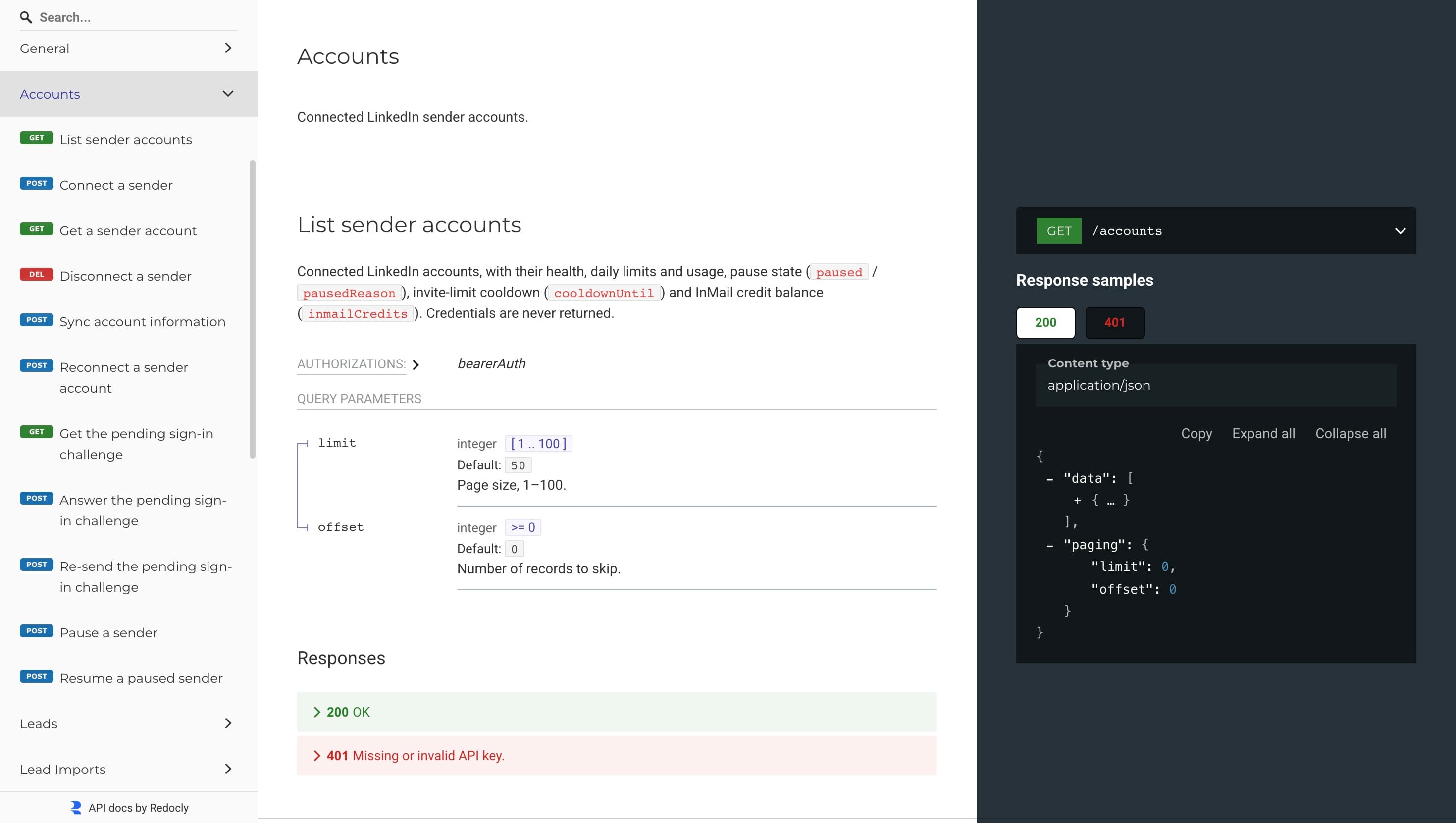
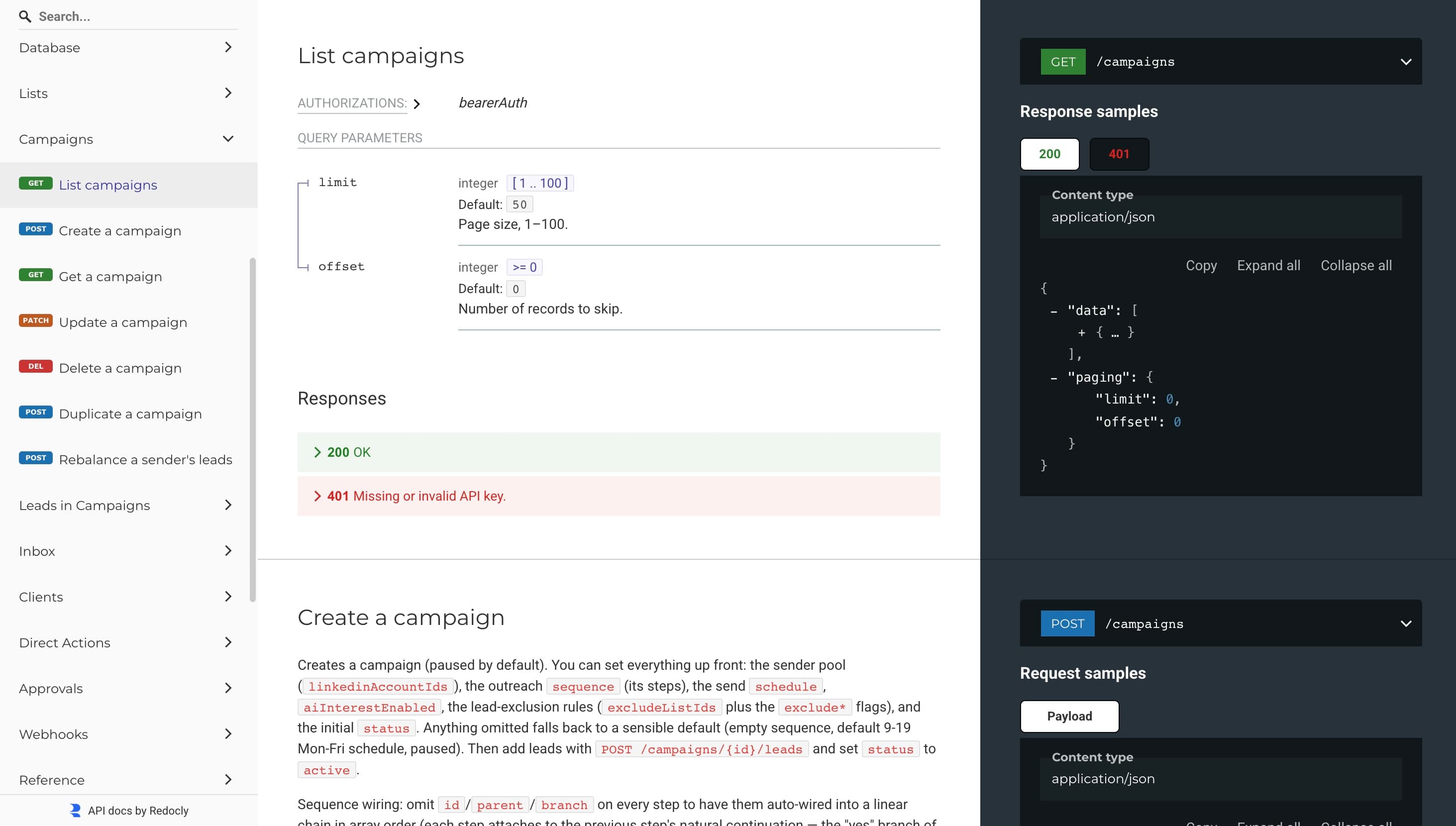
One POST /campaigns creates a campaign with its sender pool, sequence, schedule, and lead-exclusion rules; add leads and set it active. Branching, rotation, and retries are the platform's job, not your codebase's. The full surface is documented at developer.swarmhit.com.
More than 250 safeguards, monitored 24/7
Dedicated proxy per sender, managed warmup, live health checks, and smart sending caps are the visible part. Behind them, Swarmhit runs over 250 safeguards tuned to LinkedIn's behavior and monitored around the clock, so account health is engineering we operate, not judgment left to your roadmap; no automation is risk-free. Health, limits, and cooldowns surface directly in the API.
One inbox API for every sender
Every reply from every sender lands in one inbox, readable and answerable through the API, with AI interest classification and a message.received webhook, so there is no polling loop to write.
Senders connected through your product
Your users connect their own accounts through the API or a hosted connect link (beta, for API partners); adding their 2FA setup key makes an infinite-login sender that signs itself back in. Every sender inherits the full safeguard stack without a line of orchestration code.
When is Unipile the better fit?
A fair comparison cuts both ways. Here is when the messaging API is the right shape.
Multichannel messaging is your product
Unipile connects LinkedIn, WhatsApp, Instagram, Telegram, email, and calendars behind one schema. If your product is built around all of those channels, a messaging API is the right shape.
You have the team to own the layer above
If you are prepared to own sequencing logic, warmup, pacing, and LinkedIn safety judgment in-house, raw actions give you full control over every behavior your product ships.
You need transport, not outcomes
For products that only read and send messages, without campaigns, rotation, or an inbox workflow, Unipile's plumbing may be all the surface you need.
If the goal is a LinkedIn outreach feature that works and keeps your users’ accounts safe, Swarmhit gets you there without betting your roadmap on it: less a Unipile replacement than the layer you were otherwise going to build on top of it.
TL;DR verdict
If you are adding LinkedIn outreach to a product, a CRM, or a fleet of AI agents, Unipile gives you raw actions and a real problem: you must build the sequencer yourself and drive LinkedIn without deep knowledge of its detection algorithms, with your customers’ accounts on the line. Swarmhit is the Smart API those raw actions were missing: campaign engine, throttling, 250+ safeguards monitored 24/7, inbox API, and prospect data behind one API, with public pricing from $16.90 per sender. That is the real choice behind the comparison: build the outreach layer, or buy it.
When raw actions stop being enough
Nobody leaves Unipile because the API is bad. Teams start looking past it when they price what sits above it: a sequencer to design and maintain, warm-up and rate-limit logic to get right on someone else’s accounts, an inbox to build, a data source to integrate. The transport was the cheap part; the quarter of engineering on top is what triggers the search.
The comparison is also apples to oranges, which is worth being honest about. Unipile is a messaging API across six channels; Swarmhit is a Smart API with the outreach engine built in. Any list of options mixes both shapes, so decide first which product you are actually shopping for: raw actions to build on, or outcomes your product can call. The wider field is in our Unipile alternatives guide.
What does Unipile actually give you?
Unipile is a messaging API. It connects LinkedIn, WhatsApp, Instagram, Telegram, email, and calendars behind one schema, with hosted authentication, webhooks, and transport-level protections. For what it covers, it is solid plumbing. But plumbing is all it is: what comes out of it is raw actions, one message or one invite at a time. Everything that turns raw actions into an outreach feature, and everything that keeps the connected accounts alive while you do it, is explicitly your job.
How do the API docs compare?
Unipile’s documentation is thorough, and it deserves credit for it. Its OpenAPI file is public and current, matching the 94 operations in its reference one for one. Every reference page shows request snippets in Shell, Node, Ruby, PHP and Python, errors come in one envelope with 89 typed error codes, LinkedIn ones included, and there is a Node.js SDK, a changelog, and a page of LinkedIn limits that says plainly Unipile enforces none of its own.
The gaps are narrower, but they sit exactly where an outreach product breaks. Retry safety covers email only: email sends take an Idempotency-Key, held in memory for up to 24 hours, while messages, new chats and invitations take none, so a retried LinkedIn message has no protection against going out twice. Webhooks are not signed; the only way to authenticate a delivery is a static header you add yourself, and there is no delivery log or replay. A 429 carries no limit, remaining count or reset time to back off against. And the spec names only 4 component schemas, so shared types are defined inline, operation by operation, rather than reused.
Swarmhit publishes a current OpenAPI 3.1 file, version 1.7.0, with 133 operations and 107 schemas behind 13 guides. Campaign sends are paced and retried by the platform, and the sends your code triggers, such as inbox replies and direct actions, accept an Idempotency-Key, so a retry replays the first response instead of sending again. A sender-limit 429 tells your code the limit, how much of it is used, the window and, for daily and weekly caps, when it resets. Every webhook delivery is signed, logged and replayable. The full reference is at developer.swarmhit.com.
What are you signing up to build on raw actions?
Who builds the sequencer?
You do, and that is the real cost. Unipile's endpoints send messages and manage accounts; they do not know what a campaign is. Building LinkedIn outreach on raw actions means rebuilding a sequencer: multi-step sequences, branching on accepted or replied, sending windows, retries, deduplication, per-sender distribution. For a company whose actual product is a CRM or an AI agent, that is a disproportionate amount of roadmap for one feature, and it realistically takes a tech team two to three months of testing and failing before it behaves.
Is raw LinkedIn automation safe for your users' accounts?
This is the part that gets underestimated. LinkedIn's detection looks at pacing, action ratios, account age and warmup state, and behavior patterns, and none of that is documented anywhere. Driving raw actions without a precise working knowledge of those algorithms endangers every account you connect, and on an embedded feature those are your customers' accounts. Unipile provides transport-level protections, but it cannot decide how your product should behave. That judgment layer is exactly what you would be signing up to build and maintain.
Who builds the inbox and the team layer?
Unipile gives you the messages; it does not give your users a place to work. A unified inbox across senders, interest tagging, reply-on-behalf, client-facing views: each one is another sprint before your feature feels finished. Swarmhit ships the inbox layer through the API, with every sender's chats in one place, AI interest classification and reply webhooks.
Where does prospect data come from?
Unipile reads data through the accounts you connect. There is no prospect database behind it. Swarmhit has a searchable 1B+ contact database covering 60M companies, refreshed weekly and sourced through third-party providers, with free monthly credits then pay as you go, plus Sales Navigator imports, so the outreach feature you ship starts from an audience, not from an empty table.
Competitor pricing and documentation on this page were checked against the vendor’s own pricing page and developer docs on 5 October 2026. Vendors change prices without notice, so treat anything older than a month as indicative.
What does each option cost?
Unipile starts at €49 per month for up to 10 connected accounts, then per-account tiers. That price buys the raw actions. The sequencer, the safety judgment, the inbox, and the data source still have to be built and run by your team, and that is where the real cost of an API-only stack lives.
Swarmhit’s pricing is public: $16.90 per connected LinkedIn sender a month for the first 50, decreasing band by band down to $6.90 between 1,501 and 2,500 senders, and cold email from $59 a month for 50,000 sends. Each band of senders is priced at its own rate, so adding senders lowers what the next ones cost rather than repricing the fleet you already have. Above 2,500 senders, pricing is set with our team.
Why pay more than a raw API on smaller fleets? Because the price buys the work itself. Swarmhit absorbs LinkedIn’s weekly algorithm changes behind 250+ monitored safeguards and ships the campaign logic, so you build on a working foundation instead of spending two to three months rediscovering it with your clients’ accounts at risk. We do the sequencing work; you build the rest. See the integration models or book the call.
The real cost of raw actions: engineering time and risk
The subscription is the visible part of a LinkedIn API cost, and it is the small part. Unipile sells components; Swarmhit sells a system that already runs. Components are genuinely modular, but someone on your team has to assemble them into a sequencer, discover LinkedIn’s undocumented edge cases one restricted account at a time, and keep the assembly working as LinkedIn changes weekly. That labor is the real price tag, and it never appears on a pricing page.
What two to three months of engineering costs
Run the back-of-the-envelope math with your own numbers. Take a fully loaded senior engineer at around $200K a year in the US, roughly $100K in Europe: $16,700 or $8,300 a month. At the two to three months we estimate it takes to get sequencing, warmup, pacing, and retries behaving reliably on raw actions, the build alone is $33,000 to $50,000 in the US, or $17,000 to $25,000 in Europe, before a single campaign has run. And that engineer does not stop billing at launch: every LinkedIn change lands on your maintenance backlog, forever. For a wider market view of what LinkedIn APIs charge, see our LinkedIn API pricing breakdown and our comparison of outreach APIs.
The risk column nobody budgets
The money is recoverable; the risk is not. During those months of edge-case discovery, the accounts absorbing the mistakes belong to your customers, and a restriction wave is a churn event, not a bug ticket. There is also the roadmap cost: the quarter your team spends rebuilding outreach plumbing is a quarter not spent on the product your customers actually pay you for.
Swarmhit inverts that curve. You start on a working, configurable system, so the entry cost is a fraction of one month of that engineer’s time, and because pricing is tiered by band, the price per sender drops as your fleet grows, from $16.90 down to $6.90. Build-on-raw-actions is cheapest the day you sign and grows more expensive with every edge case; buying the engine is the opposite.
FAQ
Swarmhit vs Unipile, answered.
Build on the engine,
not on raw actions.
Get an API key and ship LinkedIn outreach without building the engine: the sequencer, safeguards, inbox API and data are already running.