Swarmhit vs Edges
Edges hands your team 77 raw LinkedIn actions with transparent quotas, and leaves the sequencer, the lead storage, the inbox, and live-mode pacing to you. Swarmhit is LinkedIn outreach infrastructure: campaign engine, 250+ monitored safeguards, unified inbox, and prospect data, driven through an API, webhooks, and MCP. New to Edges? Start with our full Edges review.
- Sequencer built in
- 250+ safeguards monitored 24/7
- API, webhooks, and MCP
Swarmhit
1 POST
To a live campaign
Sequencer built in: branching, delays, schedules, retries, multi-sender rotation.
Edges
77
Raw actions in live, async or scheduled mode; the sequencer is yours to build.
Swarmhit
250+
Safeguards, monitored 24/7
Dedicated proxies, managed warmup and adaptive caps on every send.
Edges
Smart Limits
Published quotas on async and scheduled runs; live-mode pacing is on you.
Swarmhit
Unified
Inbox with assignment and interest detection
White-label for agencies, all exposed via API.
Edges
Extract
Conversation and message actions; the inbox is your build, run data archived after 90 days.
Swarmhit
On a call
Developer pricing, scoped
Graduated by band with a minimum sender count; sequencer, proxies and warmup included.
Edges
$439/mo
50 identities at $8.79 each, before data credits or the accounts themselves.
How does Edges compare to Swarmhit?
77 raw actions versus a managed outreach engine, feature by feature.
Swarmhit
Edges
Build LinkedIn outreach into your product
Protect the accounts
Legal exposure
Manage replies
Integrations and events
Pricing
Comparison data last verified on 21 August 2026.
3 reasons to choose Swarmhit over Edges
Ship the feature, skip the build
Edges hands you 77 LinkedIn actions and a guide that teaches you to build your own sequencer: leads table, dedup logic, state machine, orchestrator. Swarmhit exposes a working sequencer, inbox, and data layer through one API.
Safety that covers every send
Edges paces async and scheduled runs with its Smart Limits, but its docs say live mode is your responsibility to rate-limit and sequence. On Swarmhit, per-sender limits are enforced server-side on everything, with warmup and 250+ monitored safeguards.
Your pipeline outlives 90 days
Edges archives run data after 90 days and tells you to store results in your own system; there is no lead resource. Swarmhit keeps leads, lists, campaigns, and conversation history as durable resources your product can query.
What does Swarmhit do differently?
A sequencer your product can call
One POST /campaigns creates a campaign with its sender pool, sequence, branching, schedule, and exclusion rules; add leads and set it active. Rotation, retries, and delays are the platform's job, not your codebase's. The full surface is documented at developer.swarmhit.com.
More than 250 safeguards, monitored 24/7
Dedicated proxy per sender, managed warmup, live health checks, and adaptive caps are the visible part. Behind them, Swarmhit runs over 250 safeguards tuned to LinkedIn's behavior and monitored around the clock. There is no mode where pacing becomes your problem.
One inbox for the whole team
Every reply from every sender lands in the Unibox with assignment and AI-detected interest, and the same chats are readable and answerable through the API, no polling loop to write. Agencies get white-label views without building a screen.
An MCP server that acts, not just documents
Edges ships an MCP that serves its documentation to your AI tools. Swarmhit's MCP server executes: Claude, ChatGPT, Clay, n8n, or Make can search the database, launch campaigns, and work the inbox through the same handlers as the REST API, with the same enforced limits.
When is Edges the better fit?
Data collection is the product
When LinkedIn data collection is the product and you have the team to own everything above the actions.
High-volume enrichment feeds your own pipeline
If your core need is high-volume enrichment and search, Sales Navigator list extraction, or signals feeding your own pipeline, metered credits with published quotas are a rational shape.
You want transparently documented limits
Edges documents its limits more transparently than most of the category.
If the goal is a LinkedIn outreach feature that works and keeps your users’ accounts safe, Swarmhit gets you there without betting your roadmap on it: less an Edges replacement than the layer you were otherwise going to build on top of it.
TL;DR verdict
If you are adding LinkedIn outreach to a product, a CRM, or a fleet of AI agents, Edges gives you well-documented raw actions and a real problem: its own guide teaches you to build the sequencer, its runs archive after 90 days, and live-mode pacing is contractually yours, with your customers’ accounts on the line. Swarmhit is the outreach infrastructure those raw actions were missing: campaign engine, 250+ safeguards monitored 24/7, unified inbox, and prospect data behind one API. That is the choice an Edges alternative search is really about: build the outreach layer, or buy it.
Before you build on it
Edges returns LinkedIn data without you connecting an account: “No cookies, no LinkedIn account, no warmup, no seats to babysit.” The reads run on what it calls “a managed session pool.” Its terms then make you indemnify Edges Labs, disclaim liability if you are “banned or sanctioned by Third-Party Services,” and cap its total responsibility at twelve months of fees. Swarmhit runs every action on an account your customer owns and connects. The detail is below.
Why teams look for an Edges alternative
Nobody leaves Edges because the API is badly built. Teams go looking for an alternative when they price what sits above it: a sequencer to design from the guide in its docs, a lead store to operate because run data expires at 90 days, an inbox to assemble from extract actions, and live-mode pacing judgment to get right on someone else’s accounts. The actions were the cheap part; the quarter of engineering on top is what triggers the search.
The comparison is also apples to oranges, which is worth being honest about. Edges is a LinkedIn actions and data API with unusually transparent quotas; Swarmhit is a LinkedIn outreach engine with an API. Decide first which product you are actually shopping for: raw actions to build on, or outcomes your product can call.
What does Edges actually give you?
Edges is a LinkedIn actions API. It exposes 77 operations across LinkedIn, Sales Navigator, and Recruiter Lite, each runnable live, async, or on a schedule, with automatic pagination, batching, retries, and published per-action quotas on managed runs. The connection machinery is serious: hosted login links, checkpoint resolution, per-identity dedicated IPs. For what it covers, it is capable plumbing. But plumbing is what it is: what comes out is raw actions, one call at a time. Everything that turns actions into an outreach feature, and everything that keeps accounts alive in live mode, is explicitly your job.
Where does Edges get the data, and who carries the risk?
One structural question outranks every feature row on this page, and it is not about the sequencer. It is where the profile data comes from, and whose name is on the contract when someone objects.
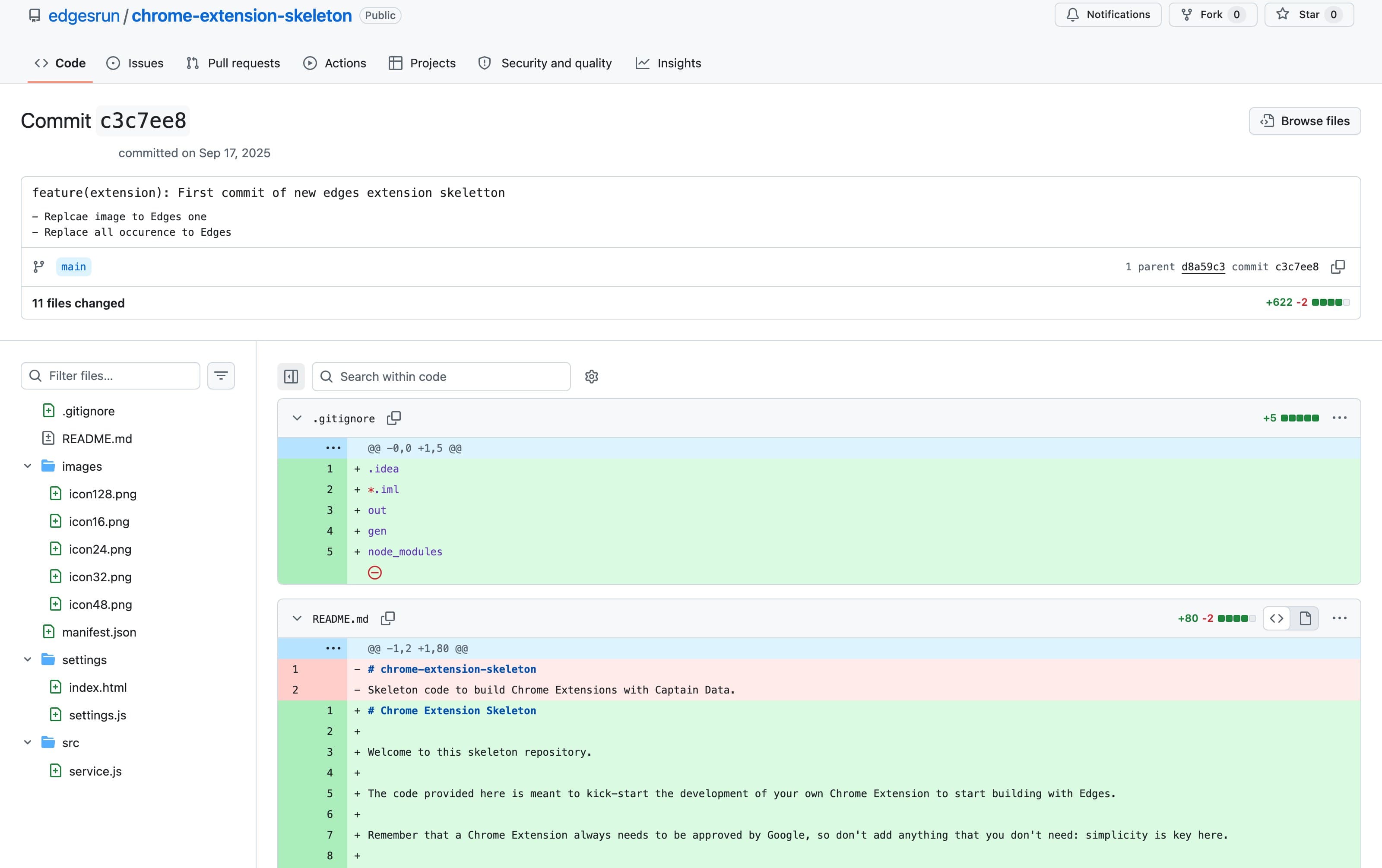
Edges is built by the team behind Captain Data, the French B2B intent data company, under a new brand and a new US entity. The artifact is public: the Edges GitHub organisation, linked from Edges’ own homepage, published its first repository on 17 September 2025 with a README that read, in full, “Skeleton code to build Chrome Extensions with Captain Data.” Twelve minutes later the same repository was rewritten to name Edges instead, in a commit sent from a captaindata.co address belonging to a Directeur Général of Captain Data SAS. Captain Data continues to trade separately in France. What is new is the entity carrying the risk: Edges Labs LLC, a Delaware company at a registered-agent forwarding address in Dover, whose public footprint begins in August 2025.
Edges does not need you to connect a LinkedIn account to return LinkedIn data. Its homepage sells that as the headline benefit: “No cookies, no LinkedIn account, no warmup, no seats to babysit.” The mechanics are described the same way: “Access health, rotation and pacing are handled on our side. You never touch a cookie or a credential.” On its own Proxycurl comparison page it names the model directly, “Reads on a managed session pool,” reserving connected seats for outreach rather than for reads.
That is cookie-less collection at scale, and it is the architecture that ended the last company to sell it. In January 2025 LinkedIn and Microsoft sued Proxycurl, its Singapore parent Nubela Pte Ltd, and both founders personally in the Northern District of California, with claims including breach of contract and the Computer Fraud and Abuse Act. The defendants settled, Proxycurl shut down on 4 July 2025, and the court entered a permanent injunction requiring deletion of the LinkedIn data. Edges describes that case accurately on its own site: “The lawsuit alleged scraping behind fake LinkedIn accounts. That architecture is what enforcement targeted.” It also states that nobody who touches LinkedIn data can promise immunity from LinkedIn’s terms, and puts itself inside that sentence.
Then read the contract. Edges Labs LLC is a Delaware limited liability company registered at 3500 South DuPont Highway, Dover, DE 19901, the same jurisdiction that heard the Proxycurl case. Its terms state that Edges Labs “DOES NOT CARRY OUT ANY VERIFICATION” and that the client is “RESPONSIBLE FOR VERIFYING THAT IT HAS THE RIGHTS AND/OR AUTHORIZATIONS REQUIRED.” The client agrees to “indemnify and hold Edges Labs harmless” from third-party claims. Edges “will not be liable if the Client is banned or sanctioned by Third-Party Services.” And total liability “WILL IN NO EVENT EXCEED THE AMOUNT PAID BY THE CLIENT DURING THE TWELVE (12) LAST MONTHS.”
Put those together and the deal is legible: the supplier operates the collection, the customer signs for the consequences, and the ceiling on compensation is one year of invoices. If you are embedding this in a product, the failure mode is not a degradation you migrate away from over a quarter. It is a supplier that stops, with your customers’ campaigns inside it, under a contract saying the exposure was always yours. Proxycurl’s customers got an announcement on 4 July 2025 and no service after it.
Swarmhit does not operate a read pool and does not sell cookie-less scraping, which we consider illegal. Every action, data collection included, runs on a LinkedIn account your customer owns and has connected, on a dedicated proxy, under caps we enforce: 2,500 Sales Navigator profiles a day and 1,000 from standard search. We do not resell data, and we vet who gets access before onboarding rather than selling to anyone with a card. That is a lower ceiling than a managed pool can quote you, and it is deliberate.
What are you signing up to build on raw actions?
Who builds the sequencer?
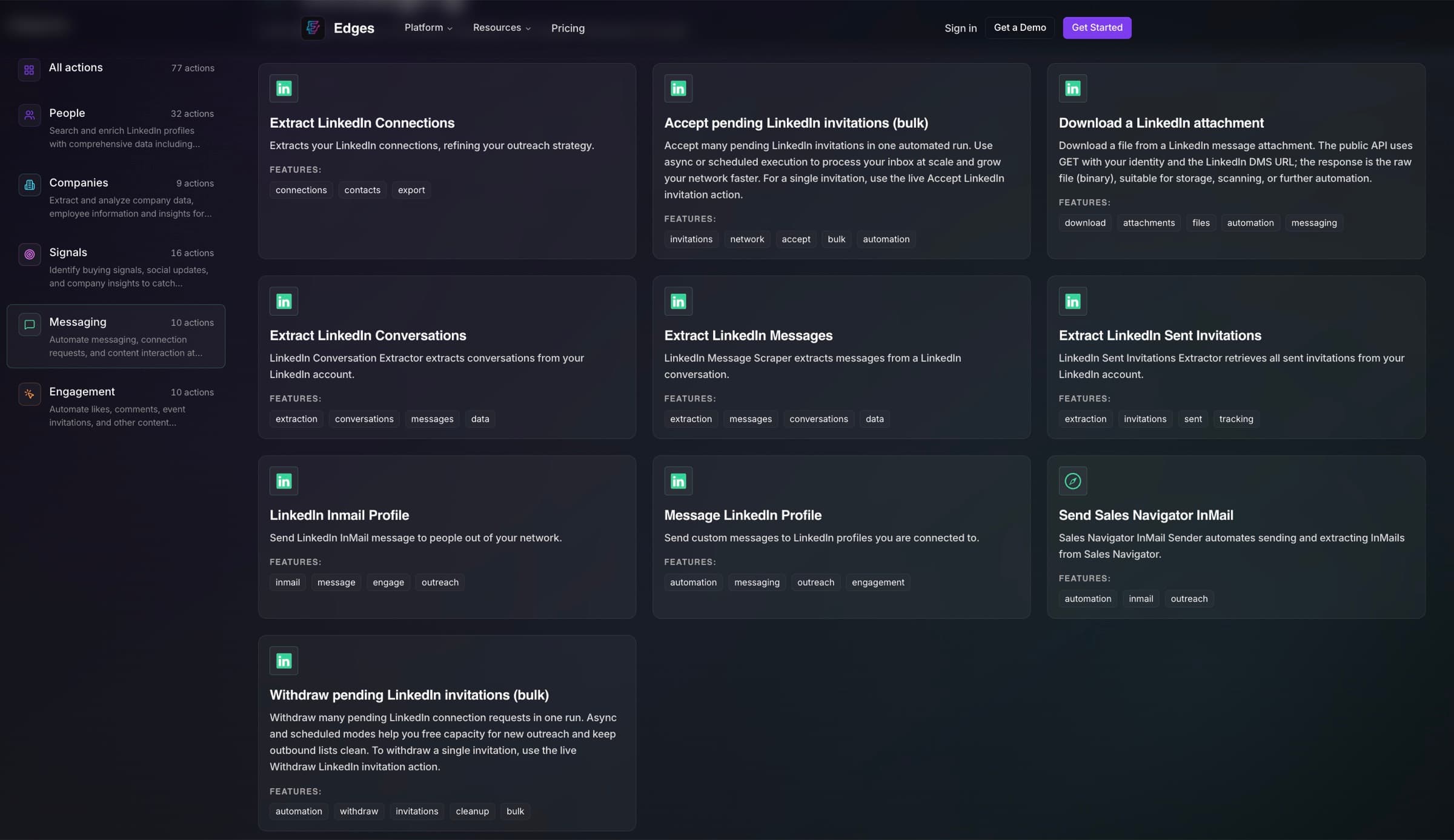
You do, and Edges says so with unusual honesty. The word campaign does not appear anywhere in its documentation; what it offers instead is a long guide to building a LinkedIn outreach sequence on top of the actions, complete with a leads table to design, deduplication logic, a lead-lifecycle state machine, business-hours scheduling, identity-failure recovery, and a full orchestrator example. That is a competent engineering spec for the product you thought you were buying. For a company whose actual product is a CRM or an AI agent, it is a quarter of roadmap spent rebuilding what a sequencer platform ships on day one.
What happens to your outreach data?
It expires unless you keep it. Edges archives run data after 90 days and its FAQ tells you to store results in your own system; there is no lead object, no list resource, no durable conversation history. Every audience you build and every reply you extract lives in your database, which means your team is also building and operating that database. On Swarmhit, leads, lists, campaign membership, and inbox threads are the platform's resources, queryable through the same API that runs the outreach.
Is live mode safe for your users' accounts?
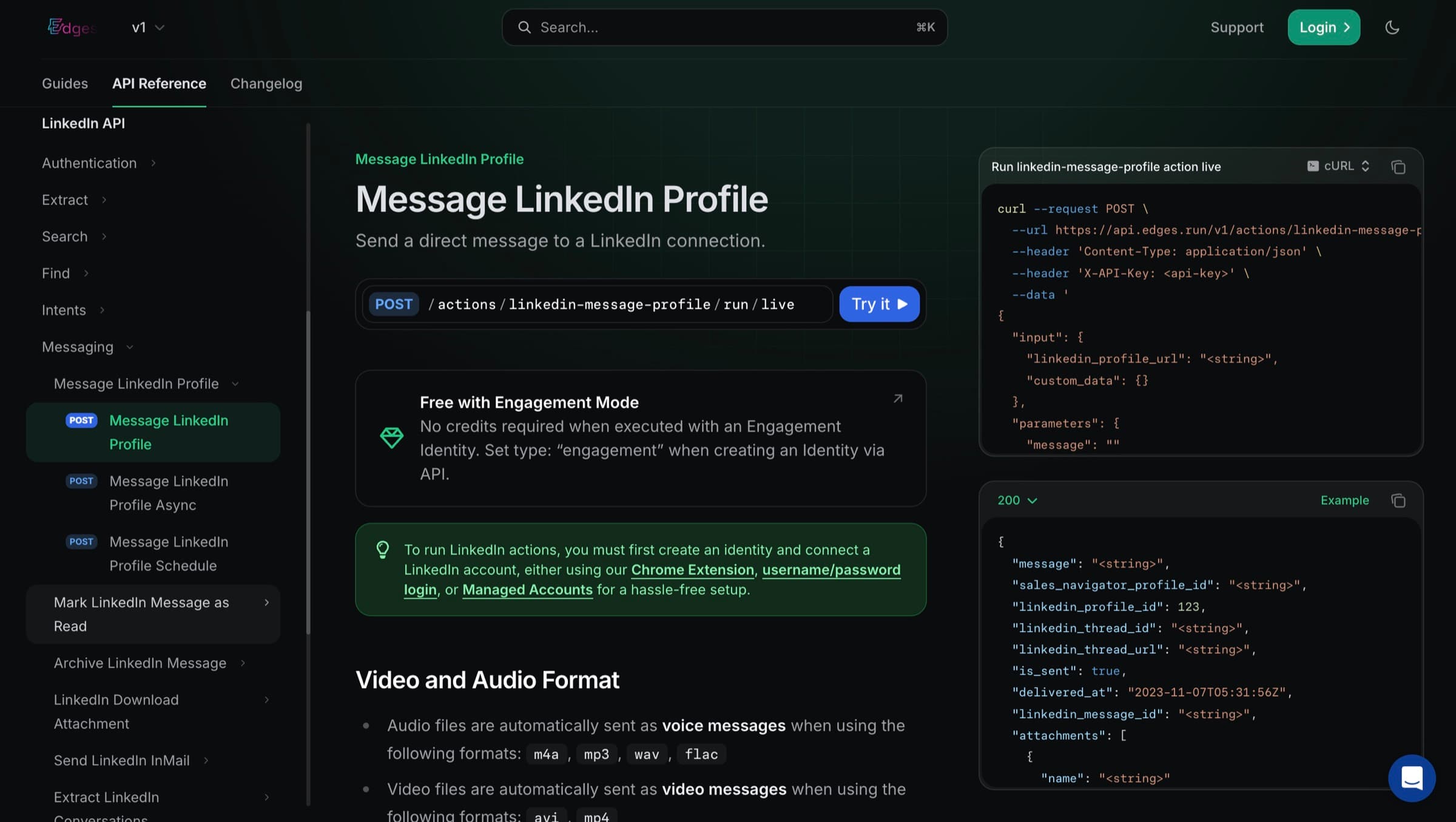
Edges is refreshingly direct about this: unlike async or scheduled runs, live mode gets no built-in pacing, and the docs describe rate-limiting and sequencing as your responsibility, warning that unsafe usage makes a blocked account a matter of time. The guidance that follows, minimum delays, jitter, a manual ramp plan for cold accounts, is exactly the judgment layer you would be signing up to implement and maintain. Swarmhit does not have an unpaced mode: per-sender limits and human-like scheduling are enforced by the infrastructure on every send, because on embedded features the accounts at stake belong to your customers.
What does the price actually buy?
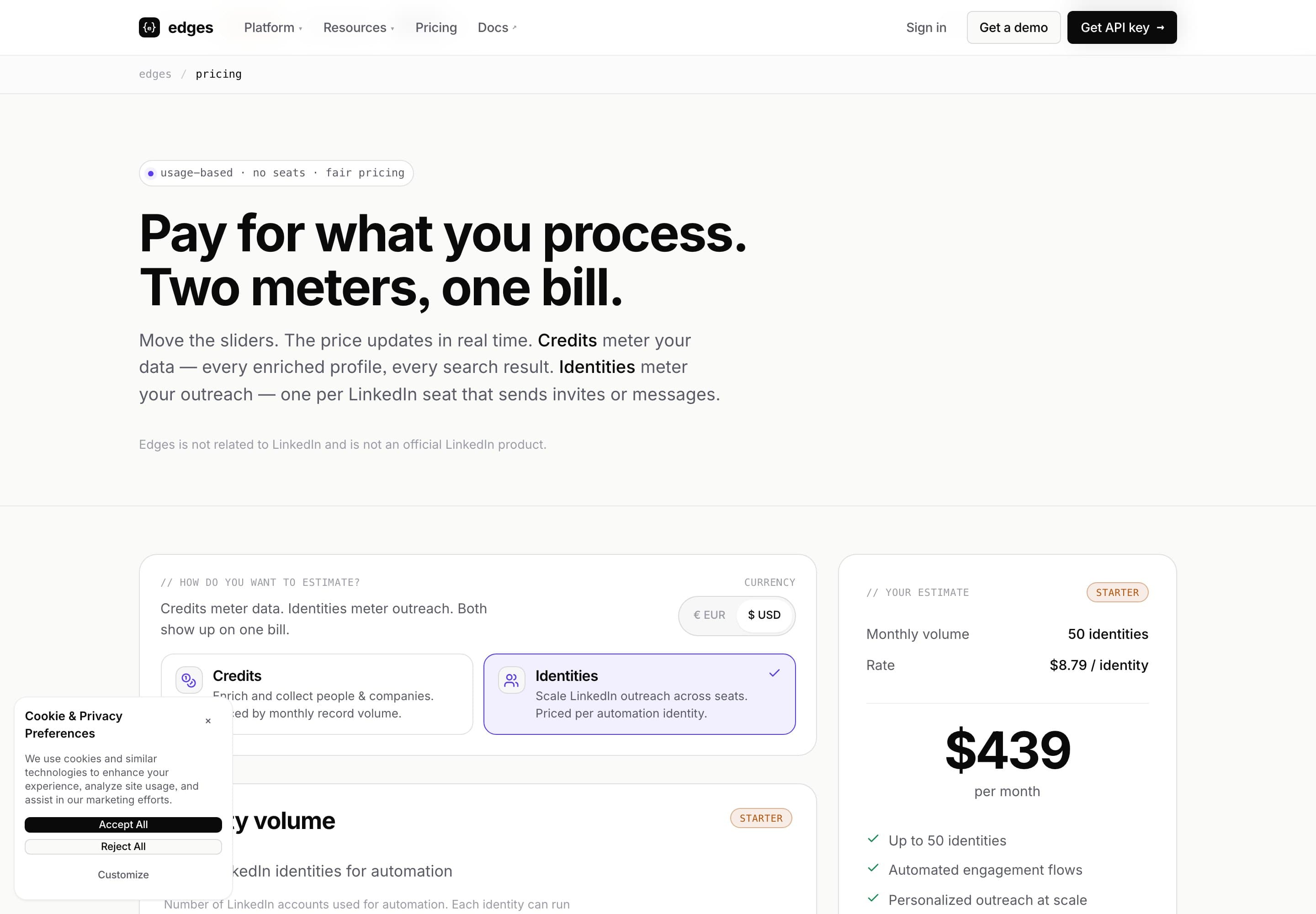
Edges runs two meters, and the credit meter is the wrong one to judge an outreach build by. Data actions bill as credits, from $27.49 per 1,000 at the 10,000 tier, about $275 a month. Outreach bills separately per identity at $8.79 per LinkedIn account per month at pilot volume, with graduated discounts as the fleet grows: its estimator quotes about $7.12 average at 200 identities and $5.76 at 1,000, read in September 2026. 50 senders is $439 a month on that meter before a single profile is enriched. Its docs have listed rented accounts at $70 to $125 a month each; we could not verify current rates in September 2026, and managed identity mode now bills at 1.5x standard credits. None of it buys the sequencer, the lead store, the inbox, or the safety judgment in live mode. Swarmhit's per-sender price includes all of those. Developer pricing is custom, based on the number of senders and scoped on the integration call, and graduated by band rather than flat, with a minimum sender count agreed on that call, so the rate improves as the fleet grows rather than staying flat.
Competitor pricing and product facts on this page were checked against the vendor’s own pricing page and documentation, and against the public corporate and court records, on 21 August 2026. Vendors change prices without notice, so treat anything older than a month as indicative.
What does each option cost?
Edges bills usage: data credits from $43.99 per 1,000 at the 2,500-credit minimum, dropping to $27.49 at the 10,000 tier (about $275 a month) and further at scale, plus per-identity pricing for engagement actions, around $8.79 per identity at 50 identities and higher on small fleets. Rented accounts run $70 to $125 a month per its docs. Those prices buy the actions; the sequencer, the storage, the inbox, and live-mode safety judgment still have to be built and run by your team.
Swarmhit’s developer and white-label pricing is discussed on a short call, because it depends on your integration model (white-label, API, or hybrid) and above all on volume: the price per sender starts higher on small fleets and decreases as you add accounts. Developer pricing carries a minimum sender count, agreed on the integration call, and is graduated rather than flat: each band of senders is priced at its own rate, so adding senders lowers what the next ones cost rather than repricing the fleet you already have.
Why pay for a platform instead of metered actions? Because the price buys the work itself. Swarmhit absorbs LinkedIn’s weekly algorithm changes behind 250+ monitored safeguards and ships the campaign logic, so you build on a working foundation instead of spending months rediscovering it with your clients’ accounts at risk. We do the sequencing work; you build the rest. See the integration models or book the call.
FAQ
Swarmhit vs Edges, answered.
Buy the outreach layer,
not another build.
Ship a LinkedIn outreach feature with the sequencer, safeguards, inbox, and data already running, driven through an API, webhooks, and MCP.