

- Edges (edges.run) is a LinkedIn actions API: 77 operations with transparent quotas, but no campaign engine, no lead storage past 90 days, and live-mode pacing left to your code.
- Edges returns LinkedIn data without you connecting an account, reading on a managed session pool it operates. Its terms make you indemnify Edges Labs and cap its liability at twelve months of fees.
- The right alternative depends on what you are replacing: the actions (Unipile), the automation glue (PhantomBuster), the data export (Evaboot), or the whole outreach layer (Swarmhit).
- Every price in this guide was read on the vendor's own pricing page on 21 August 2026, and the entity and court records cited below were checked the same day.
Teams searching for Edges alternatives usually are not unhappy with the API. Edges executes LinkedIn actions well and documents its limits more transparently than most of the category. The search starts when you price what the actions do not include: a sequencer its own docs teach you to build, lead storage that expires after 90 days, an inbox to assemble from extract calls, and pacing judgment that in live mode is contractually yours.
This guide compares the five serious routes, with the trade-offs stated plainly and pricing checked this week. If you want the direct head-to-head instead, our Swarmhit vs Edges comparison goes feature by feature.
How we compared
This is not a scraped listicle. We read the vendors' own documentation end to end, including all 286 pages of the Edges docs, checked every price on the vendor's own pricing page during the week of publication, and dated those checks on this page. Where a vendor's docs assign work to the customer, we quote the assignment rather than paraphrase it kindly. And we put ourselves in the list, first, with the same standard applied: you will find an honest limitation in our own entry and a section on when a rival is the better pick.
One scoping note: this list compares outreach and actions infrastructure. If what you actually need is an end-user prospecting tool a rep drives by hand, that is a different shopping trip, and the platform entries below will still serve you better than the APIs. Prices are quoted at each vendor's smallest realistic tier, monthly billing, because entry pricing is what you will actually pay during the evaluation; every vendor discounts annual commitments once you know the tool fits.
What is Edges, and what does it leave you to build?
Edges is a developer API that runs LinkedIn, Sales Navigator, and Recruiter Lite actions on connected accounts: search, enrichment, invites, messages, InMails, engagement. Each of its 70+ actions runs live, async, or on a schedule, and async runs get its Smart Limits system with published per-action quotas and a five-day ramp on new accounts. Pricing runs on two meters. Data credits start at $43.99 per 1,000 at the 2,500-credit minimum and drop to $27.49 per 1,000 at the 10,000 tier, about $275 per month. Outreach is metered separately per identity at $8.79 per LinkedIn account per month at pilot volume, with graduated discounts as the fleet grows: its calculator quotes about $7.12 average per identity at 200 and $5.76 at 1,000, read in September 2026. A 50-sender fleet is still $439 a month on that meter alone. Its docs have listed rented accounts at $70 to $125 per month; we could not verify current rates in September 2026, and managed identity mode now bills at 1.5x standard credits. Our Edges review covers the product, pricing meters, and terms end to end.
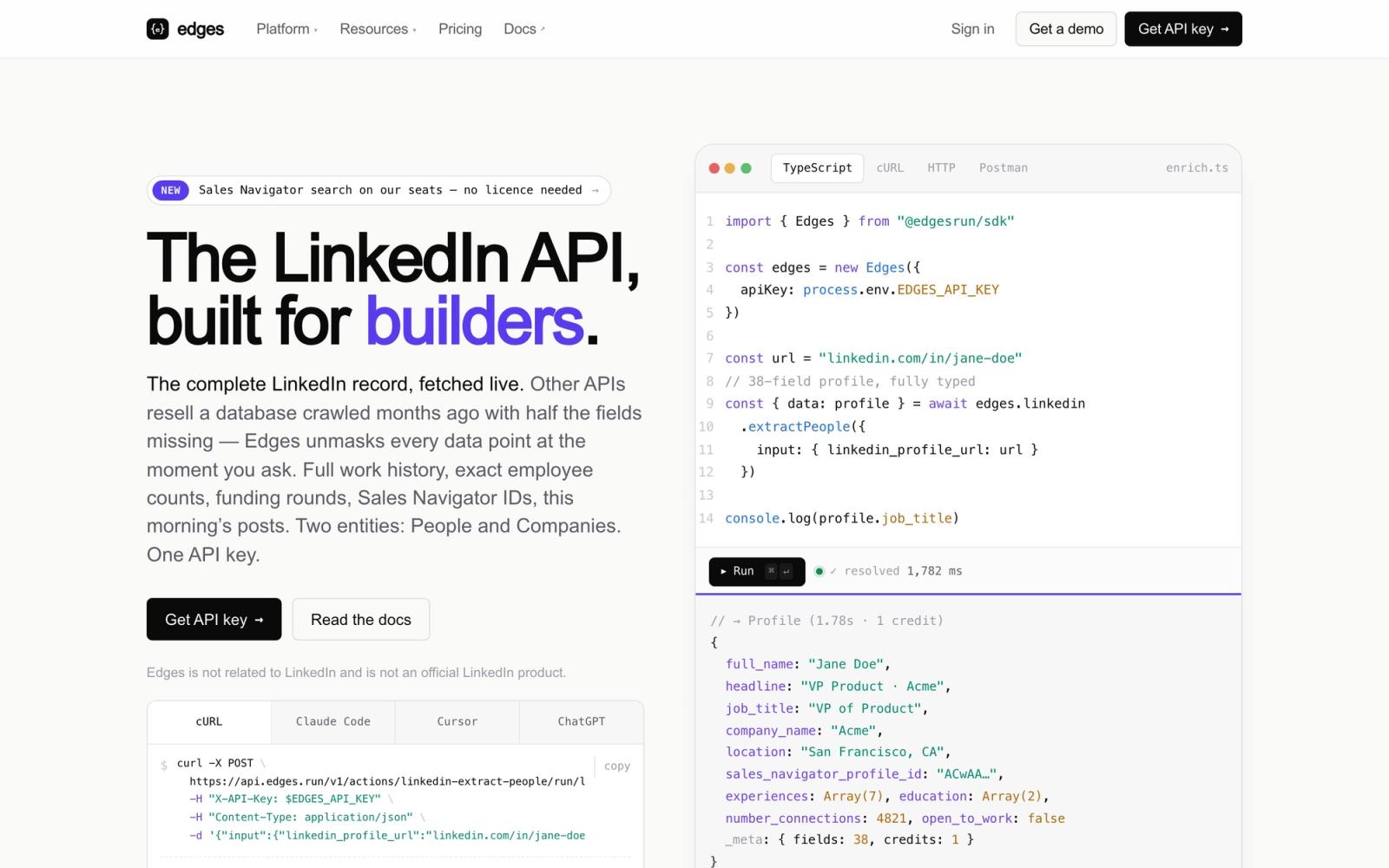
What the credits do not buy is the outreach layer. There is no campaign object anywhere in the documentation; instead there is a guide walking customers through building their own sequencer, from the leads table and dedup logic to a lead-lifecycle state machine and an orchestrator. Run data archives after 90 days, so storage is your system. The inbox is a pair of extract actions, not a product. And in live mode, the docs are explicit that rate-limiting and sequencing are your responsibility. If those gaps are the reason you are here, this list is ordered for you.
Where does Edges get its data, and who carries the risk?
One structural question outranks every feature gap on this page, and it is not about the sequencer. It is where the profile data comes from, and whose name is on the contract when someone objects.
Edges is built by the team behind Captain Data, the French B2B intent data company, under a new brand and a new US entity. The artifact is public: the Edges GitHub organisation, linked from Edges' own homepage, published its first repository on 17 September 2025 with a README that read, in full, "Skeleton code to build Chrome Extensions with Captain Data." Twelve minutes later the same repository was rewritten to name Edges instead, in a commit sent from a captaindata.co address belonging to a Directeur Général of Captain Data SAS. Captain Data continues to trade separately in France. What is new is the entity carrying the risk: Edges Labs LLC, a Delaware company at a registered-agent forwarding address in Dover, whose public footprint begins in August 2025.

Edges does not need you to connect a LinkedIn account to return LinkedIn data. Its homepage sells that as the headline benefit: "No cookies, no LinkedIn account, no warmup, no seats to babysit." The mechanics are described the same way: "Access health, rotation and pacing are handled on our side. You never touch a cookie or a credential." On its own Proxycurl comparison page it names the model directly, "Reads on a managed session pool," reserving connected seats for outreach rather than for reads.
That is cookie-less collection at scale, and it is the architecture that ended the last company to sell it. In January 2025 LinkedIn and Microsoft sued Proxycurl, its Singapore parent Nubela Pte Ltd, and both founders personally in the Northern District of California, in LinkedIn Corp. v. Nubela Pte. Ltd., with claims including breach of contract and the Computer Fraud and Abuse Act. The defendants settled, Proxycurl shut down on 4 July 2025, and the court entered a permanent injunction requiring deletion of the LinkedIn data. Edges describes that case accurately on its own site: "The lawsuit alleged scraping behind fake LinkedIn accounts. That architecture is what enforcement targeted." It also states that nobody who touches LinkedIn data can promise immunity from LinkedIn's terms, and puts itself inside that sentence.
Then read the contract. Edges Labs LLC is a Delaware limited liability company registered at 3500 South DuPont Highway, Dover, DE 19901, the same jurisdiction that heard the Proxycurl case. Its terms state that Edges Labs "DOES NOT CARRY OUT ANY VERIFICATION" and that the client is "RESPONSIBLE FOR VERIFYING THAT IT HAS THE RIGHTS AND/OR AUTHORIZATIONS REQUIRED." The client agrees to "indemnify and hold Edges Labs harmless" from third-party claims. Edges "will not be liable if the Client is banned or sanctioned by Third-Party Services." And total liability "WILL IN NO EVENT EXCEED THE AMOUNT PAID BY THE CLIENT DURING THE TWELVE (12) LAST MONTHS."
Put those together and the deal is legible: the supplier operates the collection, the customer signs for the consequences, and the ceiling on compensation is one year of invoices. For a team shipping a feature on top, that is a concentrated dependency. Proxycurl's customers got an announcement on 4 July 2025 and no service after it. The risk is not that the API degrades, it is that it stops, with your customers inside it.
This is also why the Swarmhit entry below draws its line where it does. Swarmhit does not operate a read pool and does not sell cookie-less scraping, which we consider illegal. Every action, data collection included, runs on a LinkedIn account the customer owns and has connected, on a dedicated proxy, under caps we enforce: 2,500 Sales Navigator profiles a day and 1,000 from standard search. We do not resell data, and access is vetted before onboarding rather than sold to anyone with a card. That is a lower ceiling than a managed pool can quote you, and it is deliberate: the volume you cannot get is the volume that ends companies.
1. Swarmhit: the outreach layer Edges leaves to you
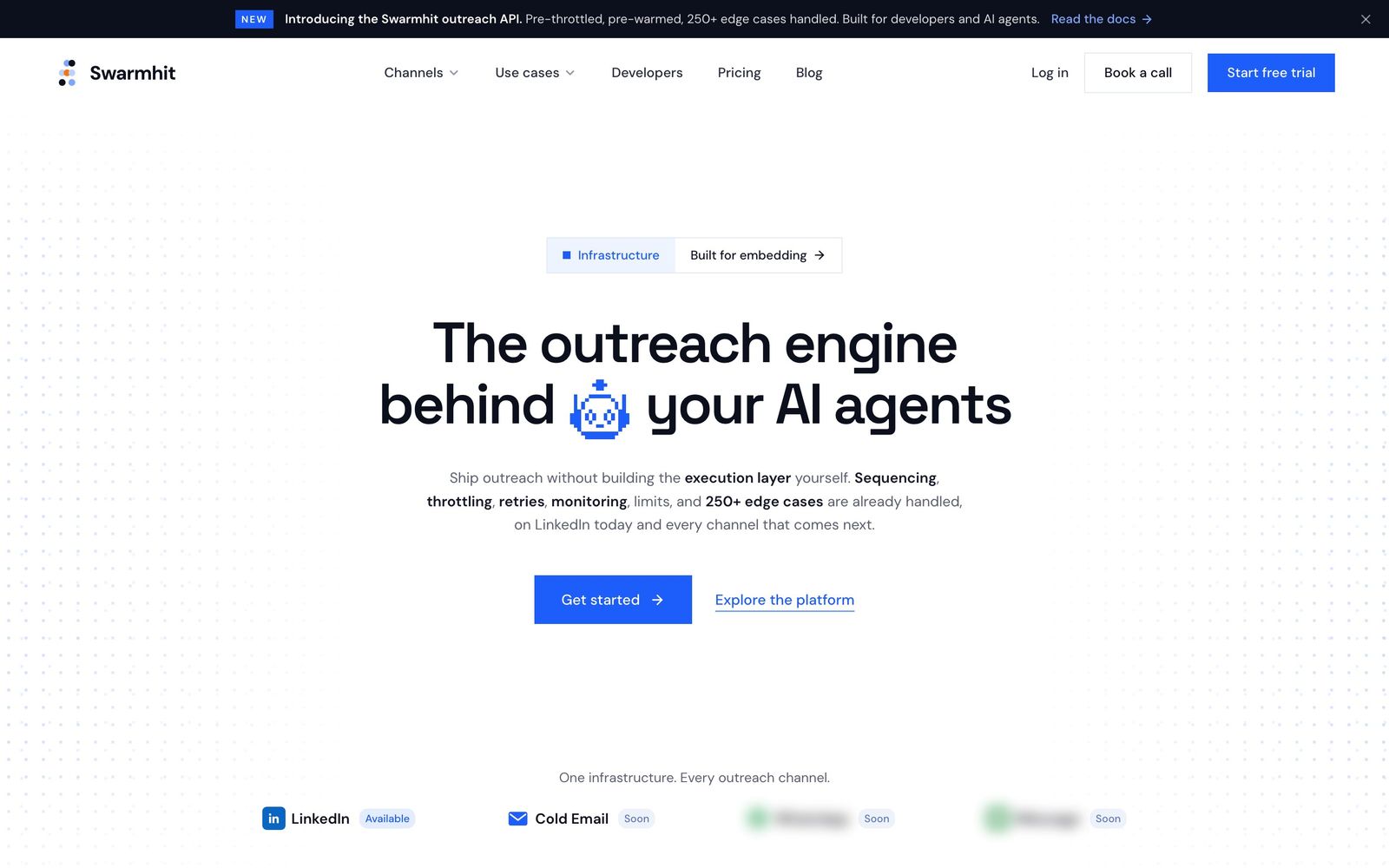
Swarmhit is the option for teams whose goal is a working LinkedIn outreach feature rather than a box of actions. The developer surface exposes campaigns, sequences, senders, leads, and the inbox as durable API resources: one POST creates a branched campaign with schedules and sender rotation, replies stream back as signed webhooks, and an MCP server lets Claude, ChatGPT, Clay, n8n, or Make drive the same handlers. The safety layer is the point: per-sender limits enforced server-side on every send, managed warmup, dedicated proxies, and 250+ safeguards monitored 24/7. There is no uncapped mode.
Pricing: the API, webhooks and MCP are included on every plan. Swarmhit's developer pricing is custom, based on the number of senders and scoped on the integration call. It is graduated by band rather than flat: each band of senders is priced at its own rate and the bill is the sum of the bands, with a minimum sender count agreed on the call, so adding senders lowers what the next ones cost rather than repricing the fleet you already have.
Best for: SaaS products, agencies, and AI-agent builders whose deliverable is working outreach. The migration path from an actions API is short because the account layer is the same shape: connect the seats, import or rebuild the audiences, and swap your orchestration code for campaign calls. The honest limitation: Swarmhit is LinkedIn-focused outreach infrastructure. If your primary need is metered data collection at massive scale rather than outreach, the credit-based tools below fit that job better.
2. Unipile: the multichannel actions API
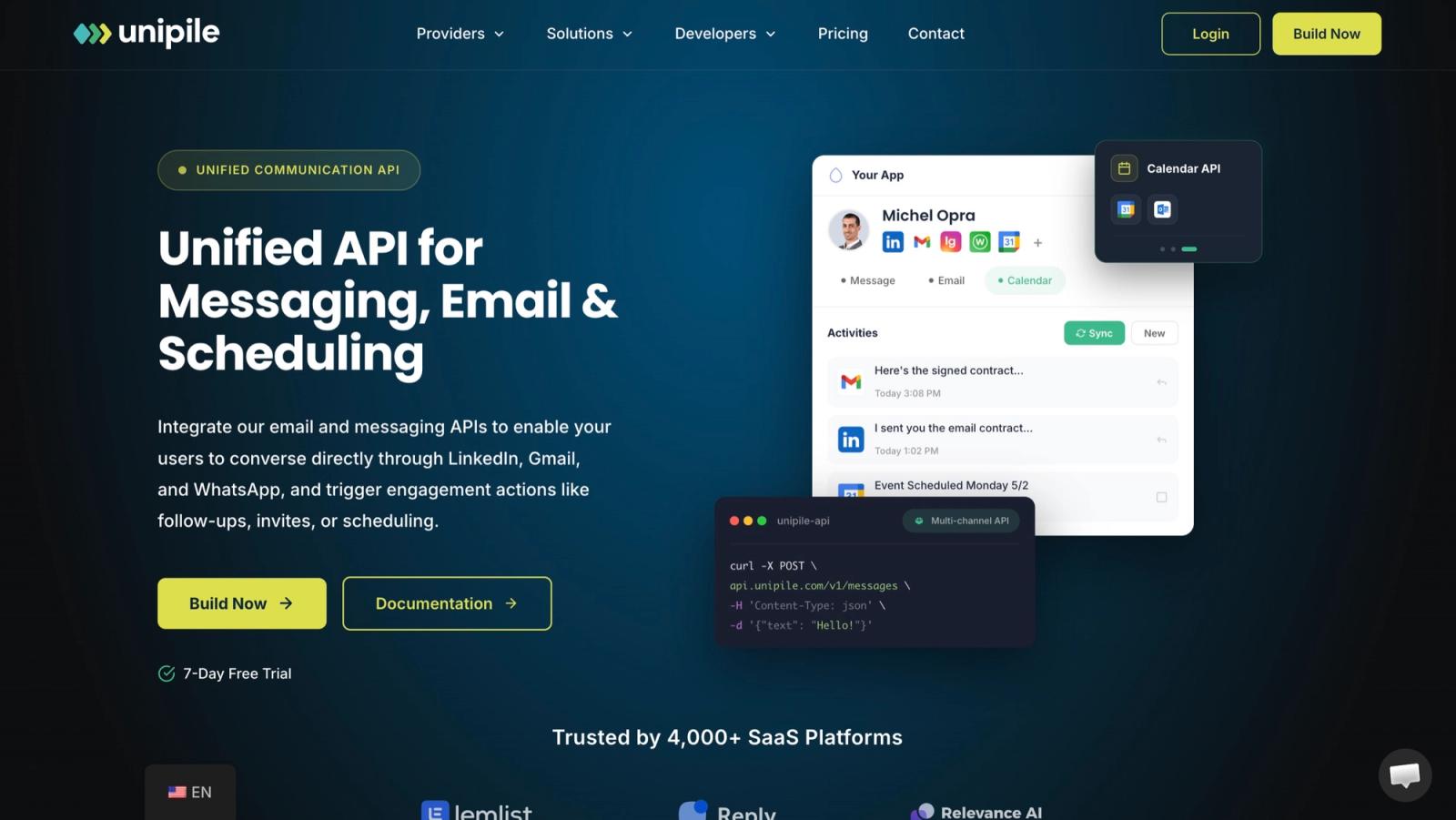
Unipile is the closest like-for-like swap: a raw account API in the same family as Edges, trading its LinkedIn-only depth for channel breadth across LinkedIn, WhatsApp, Instagram, Telegram, email, and calendars. Pricing is per connected account: from 49 EUR per month covering up to 10 accounts, then 5 EUR per account, with a 7-day trial. Like Edges, there is no campaign object; Unipile publishes its own guide to building a sequence, so the outreach layer remains your build either way. Our Unipile review covers that trade-off in depth, including what the 49 EUR actually buys and what stays on your roadmap. Choose it when multichannel matters more than LinkedIn-specific quota transparency.
Best for: engineering teams building a messaging product where LinkedIn is one channel among several, with the appetite to own sequencing and safety judgment in-house. The honest caveat cuts both ways: neither Unipile nor Edges will stop your live traffic from behaving badly, so whichever actions API you pick, budget for the pacing layer as a real workstream, not a TODO.
3. PhantomBuster: automation slots instead of an API
PhantomBuster swaps the developer API model for prebuilt cloud automations that run against your session: LinkedIn and Sales Navigator exports, auto-connects, message sequences chained from templates. Pricing is subscription plus execution time: $69 per month on Start (5 automation slots, 20 hours of execution, 500 email credits), $159 on Grow (15 slots, 80 hours), $439 on Scale (50 slots, 300 hours), with about 20 percent off annually and unlimited users on every plan.
Best for: a growth operator who wants recipes rather than endpoints and enjoys assembling the pipeline. The wrong shape for a product team: you chain automations in their UI rather than calling an API from your backend, execution hours meter heavy use faster than you expect on big exports, and pacing discipline is still largely yours to configure. It is a power tool with a workshop attached, not infrastructure your product can ship on.
4. Evaboot: when the job is really data export
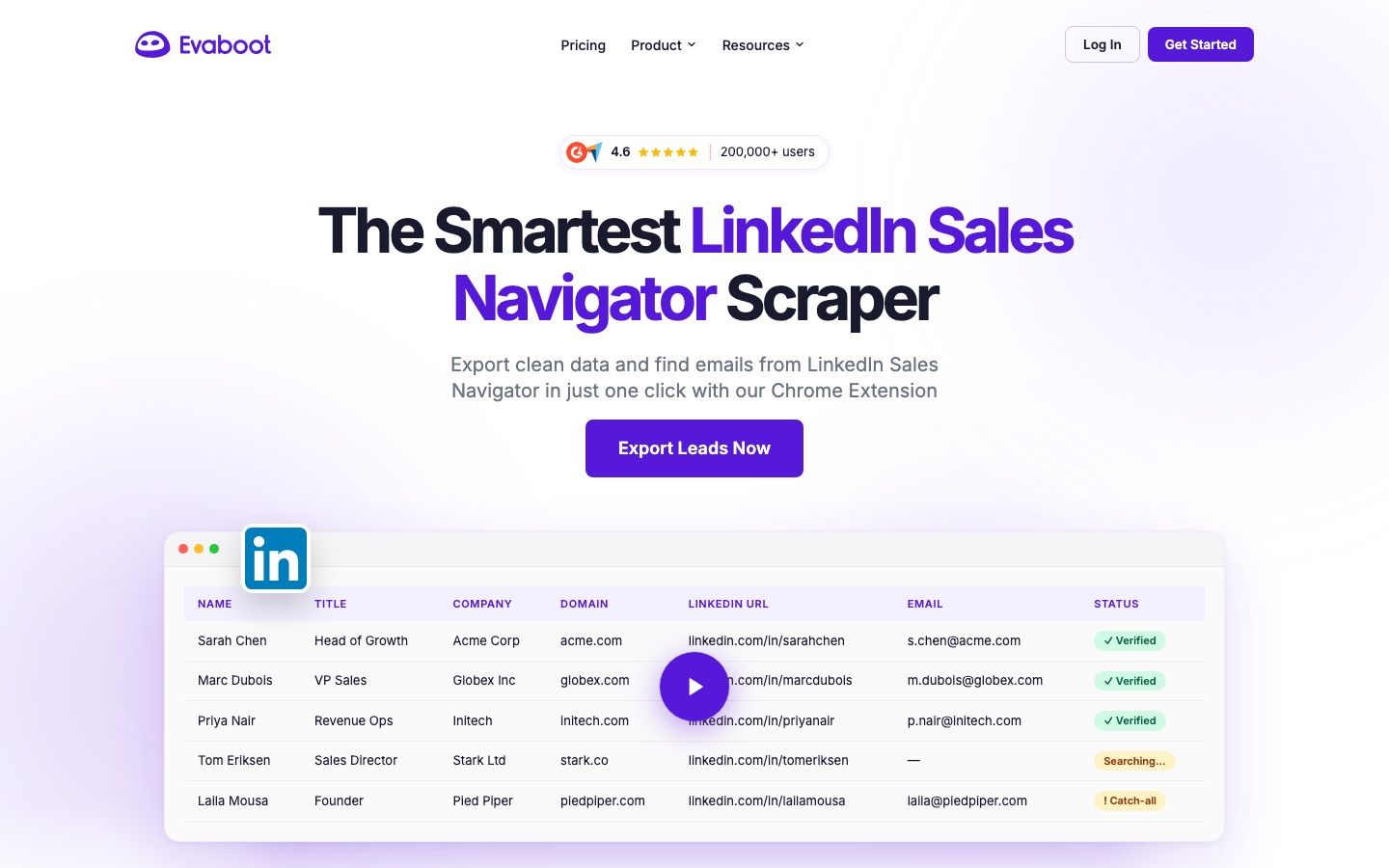
A meaningful share of Edges usage is Sales Navigator collection, and if that is your whole need, a dedicated exporter is simpler than an actions API. Evaboot attaches to your Sales Navigator seat and exports cleaned search results per credit: one exported lead is one credit, from $9 per month for 100 credits up to $1,699 for 200,000, credits rolling over while subscribed. It requires a real Sales Navigator subscription and does nothing beyond the spreadsheet: no sending, no inbox, no enrichment waterfall. We cover that whole category in our guide to the Sales Navigator API landscape.
The credit mechanics reward reading the fine print: an email found and verified costs one more credit, a lead with a verified email costs two, verification alone half a credit, and unused credits roll over while the subscription stays active. Best for: a data-literate team that treats prospecting as list production and already owns the downstream stack. If nobody on the team lives in spreadsheets, the export will sit unworked, and the cheapest plan is the one you did not need.
5. Self-hosted open source: the education option
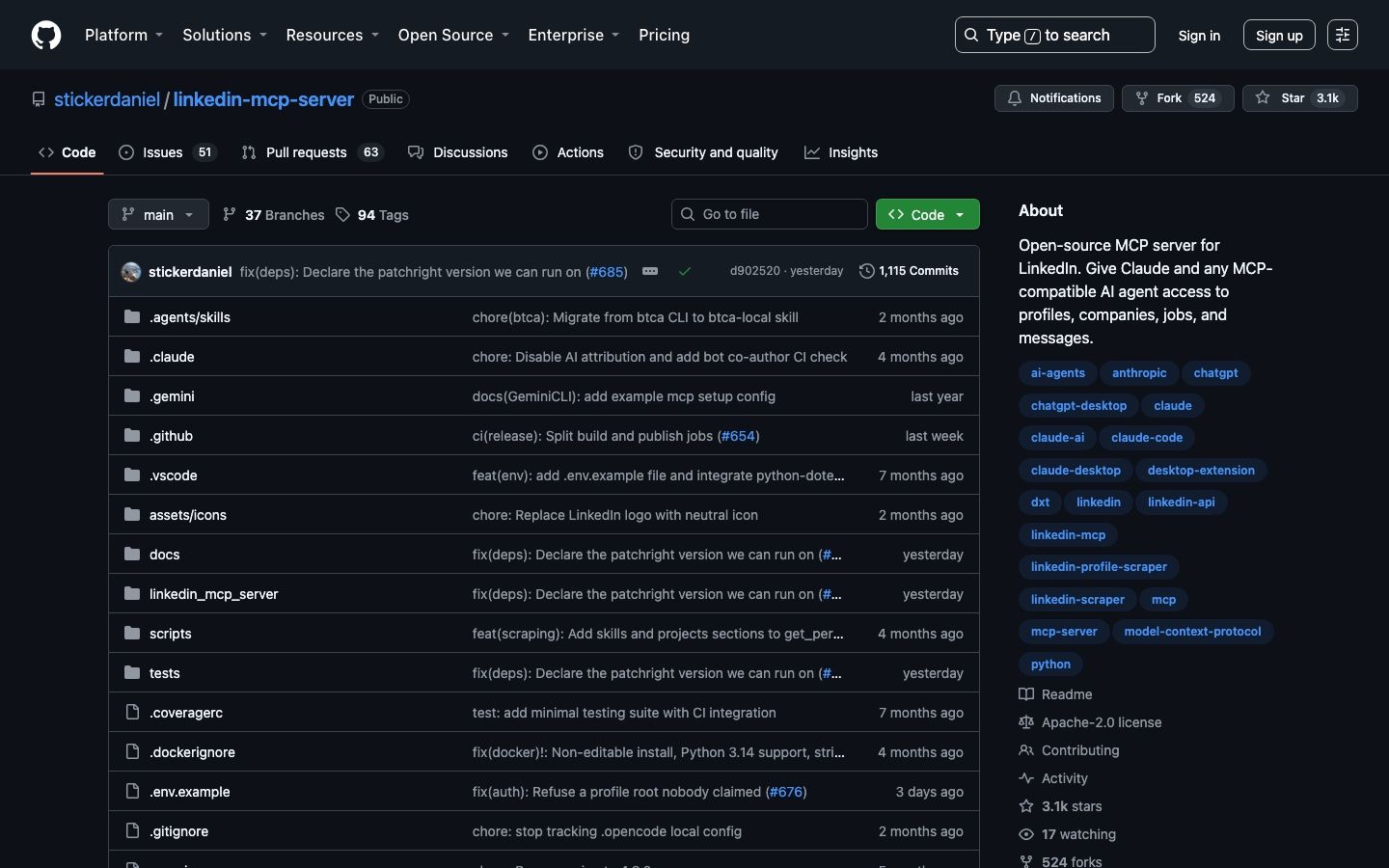
The free alternative is running your own server against your own LinkedIn session, and the honest framing is that it is a great education and a risky production system. Community projects, including the LinkedIn MCP servers we covered in our LinkedIn MCP server guide, get you to a first successful call in an evening. Then the real product begins: session upkeep, pacing decisions, silent breakage when LinkedIn changes, and a seat at risk that is yours. Choose it for tinkering on a personal account; do not choose it for outreach that pays invoices.
There is one legitimate production use: learning what you actually need before you buy. A week of driving your own session teaches you more about pacing, session fragility, and detection risk than any vendor page, and it will sharpen every question you ask on a sales call. Treat it as due diligence with a keyboard, then move the real workload somewhere with an operations team behind it.
What about the other names you will see?
Two more families show up in this search, and they answer a different question. Outreach platforms with APIs, HeyReach for agencies and lemlist for multichannel sequences, are end-user products first: strong if a human team drives the tool, thinner if your product needs to embed the capability. We compare both head-to-head in our HeyReach comparison and lemlist comparison. And scraping-first APIs (the Proxycurl-replacement crowd) solve data acquisition, not outreach; if a vendor's homepage leads with profile enrichment per credit, it belongs in a data shortlist, not this one.
The pattern worth noticing: Edges itself publishes comparison pages against Proxycurl, Bright Data, Apify, and PhantomBuster, among others, nearly all data and automation vendors. That is the company telling you which market it competes in. If you shopped for it as an outreach solution, you were always going to need one of the entries above on top.
How do the five compare?
Side by side, with pricing read from each vendor's own page this week:
| Option | Shape | Entry pricing (checked 21 Aug 2026) | You still build |
|---|---|---|---|
| Swarmhit | Outreach platform + API, webhooks, MCP | Custom pricing based on the number of senders, scoped on a call | Nothing; sequencer, storage, inbox included |
| Edges | LinkedIn actions API, credits + identities | Credits from $27.49/1k at the 10k tier (~$275/mo), plus outreach identities at $8.79 each per month | Sequencer, lead storage, inbox, live pacing |
| Unipile | Multichannel account API | 49 EUR/mo incl. 10 accounts, then 5 EUR/account | Sequencer, safety judgment, inbox |
| PhantomBuster | Prebuilt cloud automations | $69/mo (20h execution) to $439/mo | Pipeline assembly, pacing discipline |
| Self-hosted OSS | Your server, your session | Free | Everything, including the risk |
Read the last column twice: it is where the real budget lives. A credits bill you can forecast; three months of sequencer engineering plus permanent on-call for someone else's platform changes, less so.
And because five shapes are easier to choose between when the question is stated from your side of the table:
| You are | Your deliverable | Pick |
|---|---|---|
| A SaaS or AI-agent team | An outreach feature that ships this quarter | Swarmhit |
| A messaging-product team | Multichannel transport you build on | Unipile |
| A data or RevOps team | Enrichment and collection at metered scale | Edges |
| A growth operator | Recipes and exports without code | PhantomBuster |
| A data team with a SalesNav seat | Clean CSVs from saved searches | Evaboot |
| A tinkerer | Learning on your own account | Self-hosted OSS |
Notice Edges keeps a row: for pure metered collection it remains a rational pick, which is exactly why the alternatives question matters. You are not looking for a better Edges; you are looking for the product category it was never trying to be.
Which Edges alternative should you pick?
Start from the deliverable. If your product must ship a LinkedIn outreach feature, campaigns, replies, account safety included, Swarmhit is the only option on this list where that feature already exists; our LinkedIn messaging API guide shows the send-and-reply loop in real requests. If you genuinely want raw actions and accept owning the layer above, Unipile trades quota transparency for channels and Edges trades channels for LinkedIn depth. If the job is recipes, PhantomBuster; if the job is spreadsheets, Evaboot. Whatever you pick, read our breakdown of LinkedIn automation safety first, because on every option except a managed platform, the accounts at risk are yours or your customers'.
If you do decide to move, the migration itself is smaller than it looks, because the scarce asset is not the code, it is the connected seats and the conversation history. A workable sequence: keep the current stack sending while you connect the same accounts to the new platform, let warmup ramp them, rebuild your top two audiences from a fresh search rather than a stale export, and move one live campaign at a time so reply handling never drops a thread. Budget two weeks of overlap, not a quarter, and resist the temptation to port your homegrown orchestrator's edge cases: most of them exist because the old stack made you write them.
A final budgeting note from the buy side of many of these conversations: whatever route you choose, write down who owns three things before you sign anything: the sequencing logic, the stored pipeline data, and the pacing decisions at send time. On a platform, all three come with the invoice. On an actions API, all three are headcount. The vendors are not hiding this; their documentation says it plainly if you read past the pricing page. This guide exists so you read it before the quarter is committed, not after.
FAQ
What is the best Edges alternative for SaaS products?
Swarmhit, because it replaces the layer Edges leaves you to build: campaigns, lead storage, inbox, and server-enforced safety behind one API with webhooks and an MCP server that executes actions. Raw-API swaps like Unipile keep the sequencer on your roadmap.
Is Edges cheaper than a full outreach platform?
Not for outreach, and credits are the wrong meter to judge it by. Edges meters outreach per identity: $8.79 per LinkedIn account per month at pilot volume, graduated as the fleet grows (about $7.12 average per identity at 200 on its calculator, September 2026), so 50 senders is $439 a month before a single profile is enriched. Compare total cost rather than that line, because $439 excludes enrichment credits, the LinkedIn accounts themselves, and the sequencer, storage and inbox its docs assign to you. Swarmhit's per-sender price includes the campaign engine, unified inbox, dedicated proxy, managed warmup and 250+ monitored safeguards. Developer pricing is custom, based on the number of senders and scoped on the integration call, graduated by band with a minimum sender count agreed on that call, so the rate improves as the fleet grows rather than staying flat.
Does Edges run outreach campaigns?
No. It executes individual actions in live, async, or scheduled mode, and its documentation includes a guide for building your own sequencing on top. A campaign engine is exactly what its alternatives on the platform side ship.
Can I migrate from Edges to Swarmhit?
Yes. Connect the same LinkedIn accounts, import audiences by CSV or rebuild them from the 1B+ contact database or a Sales Navigator search, and replace your homegrown orchestration with campaign API calls. Senders go through managed warmup before ramping to full volume.
Is a raw LinkedIn actions API safe for customer accounts?
Only as safe as the pacing layer you build. Edges itself enforces quotas on async runs but states that live-mode pacing is your responsibility. On embedded features the connected accounts belong to your customers, which is why limits enforced by infrastructure, not by your prompt or your cron job, are the property to shop for.
Is cookie-less LinkedIn scraping safe to build on?
It is the model LinkedIn has actually litigated. Proxycurl was sued in January 2025 over data collected through provider-controlled accounts, settled, shut down on 4 July 2025, and was ordered to delete the data. Providers that read on their own session pool rather than on an account you connect concentrate that exposure in one vendor, and their terms typically push the verification duty and the indemnity back to you. Read the indemnity clause before you build a feature on it.


