

Unipile has become the default answer for developers who need one API across LinkedIn, email, and WhatsApp. But it is not the only option, and depending on what you are building (an outreach product, an AI agent, a recruiting tool, or an internal sales workflow), a different layer of the stack may serve you better.
This guide compares the 8 best Unipile alternatives in 2026, by the layer each one replaces. Every pricing figure below was re-read on the vendor's own pricing page on 1 and 5 October 2026, and every entry gets an honest verdict on what it does well and where it falls short.
Why look for a Unipile alternative in 2026?
Unipile is a unified messaging API: one REST interface over LinkedIn, WhatsApp, Instagram, Telegram, email (Gmail, Outlook, IMAP), and calendars. Pricing is per connected account, around €5 per account per month with a €49 monthly minimum, billed on your peak number of linked accounts in each 30-day period. Our Unipile pricing guide works out the bill at every band. We cover the product in depth in our Unipile review.
Teams typically shop for an alternative for one of three reasons. First, Unipile is deliberately just infrastructure: it gives you endpoints (including sequence endpoints) and account protection, but the finished product (the campaign experience, the inbox your team works from, the operating playbook) is still yours to build. Second, some buyers only need one slice (just LinkedIn actions, or just data enrichment) and do not want to pay a per-account minimum for a multi-channel platform. Third, per-account pricing compounds fast once you connect hundreds of accounts. The alternatives below each solve one of those problems.
1. Swarmhit: managed outreach infrastructure (our tool)
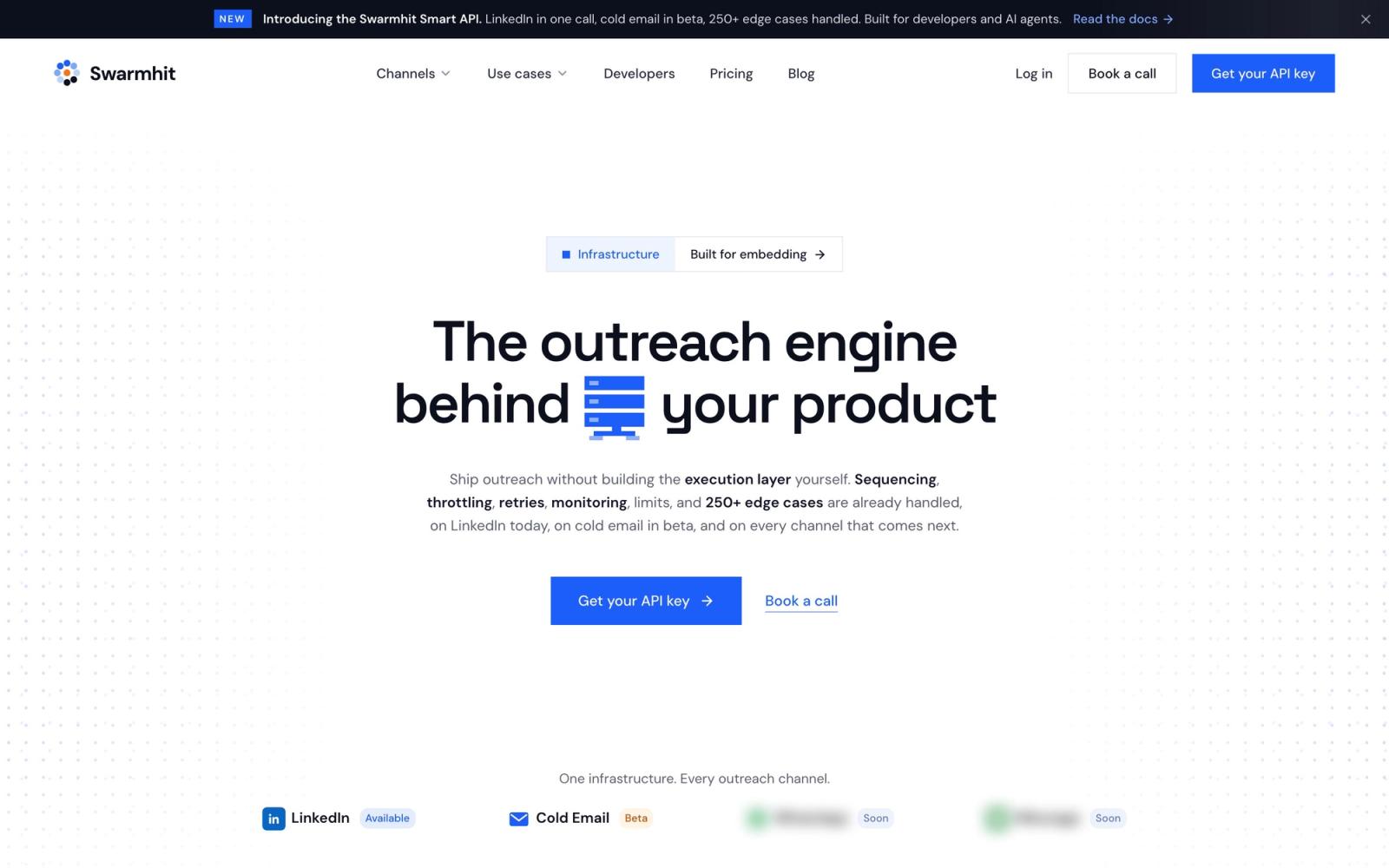
Swarmhit is the pick for teams whose end goal is running LinkedIn outreach rather than building messaging plumbing: a managed engine with native LinkedIn actions including voice notes and InMail, driven through API and webhooks, with public pricing from $16.90 per sender a month.
Disclosure: Swarmhit is our product, so read this entry knowing that. We built it for exactly the buyer who outgrows raw messaging APIs.
Where Unipile gives you API plumbing and leaves the outreach engine to you, Swarmhit gives you the finished engine plus programmatic access to it. You get multi-sender campaigns with rotation, a unified inbox with AI interest tags, AI personalization built from each prospect's profile, posts, and company news, and native LinkedIn actions including voice notes, post comments, and InMail. On the integration side, everything is reachable through the API and webhooks, so your product, your CRM workflows, or your AI agents can drive campaigns without you writing a sequencer from scratch.
Account safety is handled for you on every plan: a dedicated proxy per sender, managed auto-warmup, health checks, and smart sending caps. There is also a 1B+ contact database covering 60M companies, refreshed weekly, with free monthly credits and pay-as-you-go beyond them, plus Sales Navigator imports. Agencies that want a white-label inbox and reports can talk to the sales team at Cadency, the outreach app built on Swarmhit.
Pricing is public: LinkedIn is tiered per connected sender, from $16.90 a month for the first 50 down to $6.90 between 1,501 and 2,500 senders, and cold email starts at $59 a month for 50,000 sends. Each band is priced at its own rate, so adding senders lowers what the next ones cost rather than repricing the fleet you already have. Verdict: if you are evaluating Unipile because you want to run or embed LinkedIn outreach, Swarmhit removes the build phase entirely. If you specifically need raw WhatsApp or Telegram endpoints, it is not that; the tools below are.
Outreach infrastructure without the build phase
Multi-sender campaigns, unified inbox, and API and webhook access, with public pricing from $16.90 per sender a month.
Pricing: public, from $16.90 per LinkedIn sender a month, tiered down to $6.90; cold email from $59 a month.
2. Linked API: LinkedIn account control for developers
Linked API is the closest like-for-like Unipile replacement for LinkedIn-only builds: 50+ chainable account actions at $49 to $74 per seat per month on annual billing ($69 to $99 monthly), one seat per LinkedIn account.
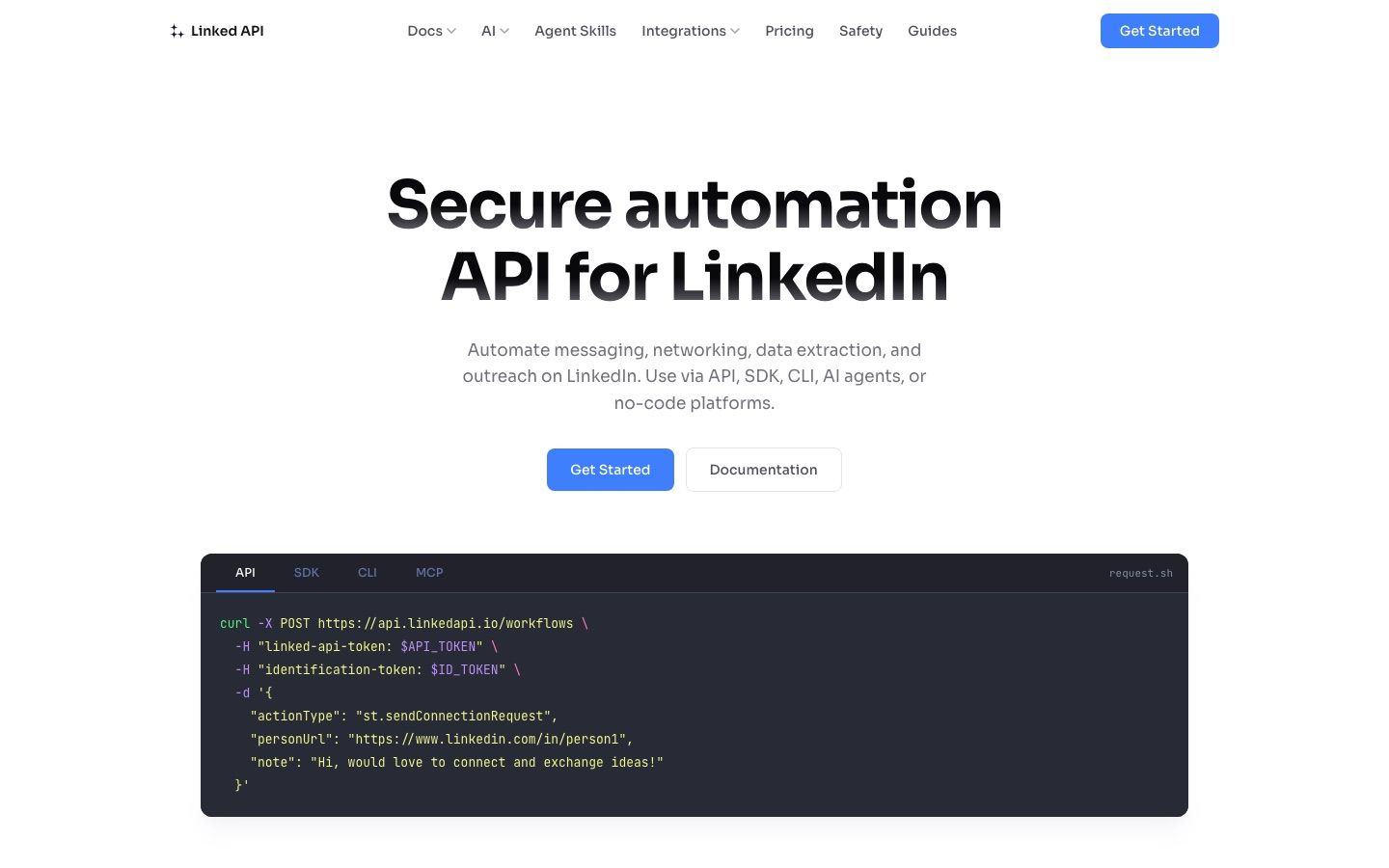
Linked API (linkedapi.io) does one thing: programmatic control of LinkedIn accounts. It offers 50+ chainable actions covering messaging, connection requests, people and company search (including Sales Navigator on the higher tier), profile extraction, and post reactions and comments. You can drive it through a REST API, a Node.js SDK, a CLI, an MCP server, or no-code tools like n8n and Make. It is explicitly independent and not affiliated with LinkedIn. We test it end to end in our Linked API review and run it head to head with Unipile in our Unipile vs Linked API comparison.
Verified pricing (1 October 2026): Core is $49 per seat per month and Plus $74 on annual billing, or $69 and $99 on monthly billing, with one seat per LinkedIn account, no usage caps on workflow execution and a 7-day free trial. Plus adds Sales Navigator capabilities. Verdict: a strong pick if LinkedIn is your only channel and you want fine-grained action control, but you give up Unipile's email, WhatsApp, and calendar coverage, and you still build the outreach logic yourself.
3. LinkupAPI: per-account LinkedIn, email and WhatsApp API
LinkupAPI is the closest per-account substitute for Unipile: $55 a month flat for up to 10 connected accounts (LinkedIn profiles, Gmail or Outlook mailboxes, WhatsApp numbers), then $5.50 down to $4.50 per account, capped at $3,000 a month for unlimited accounts. We tested it in our LinkupAPI review.
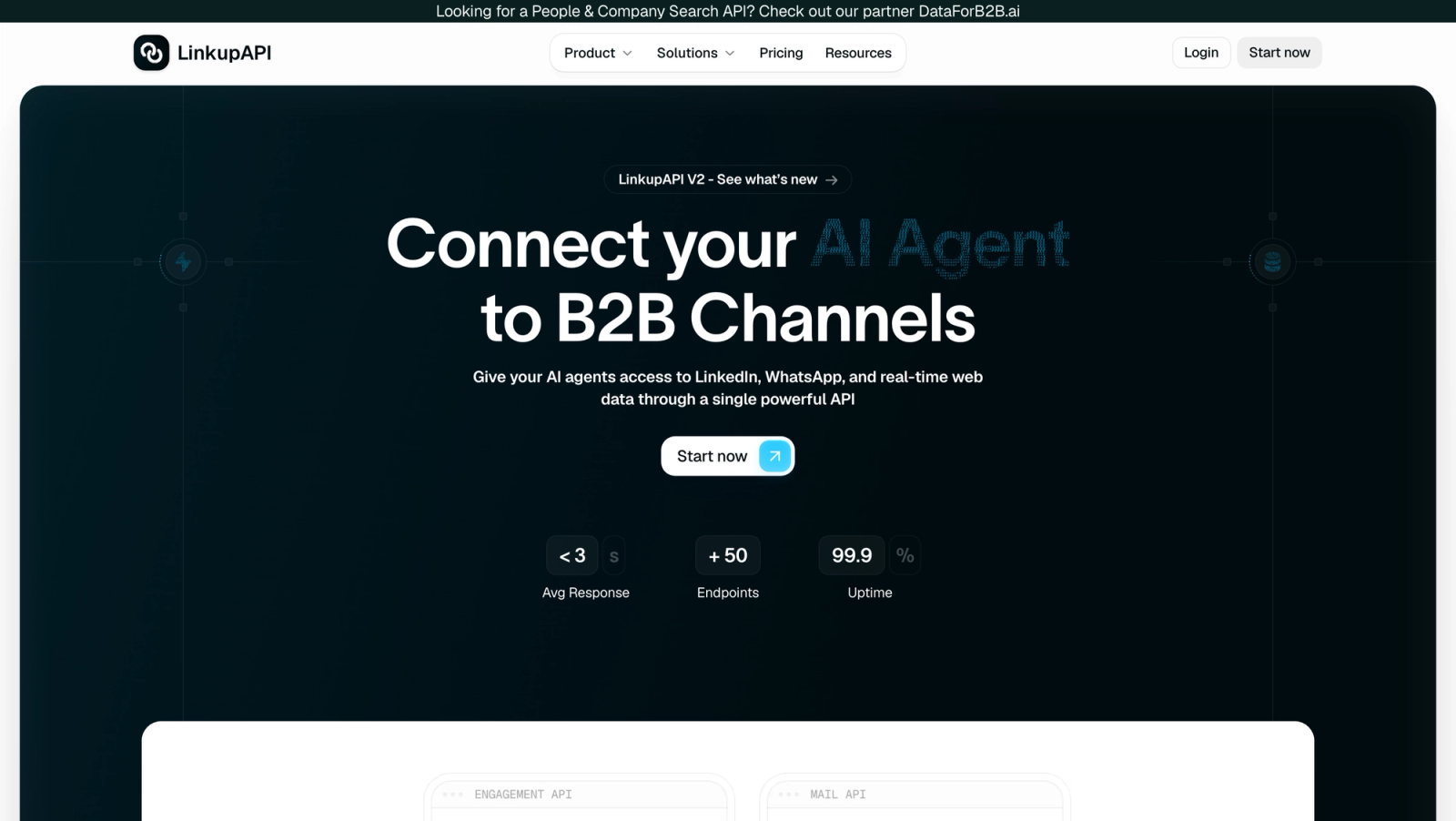
LinkupAPI bundles three APIs behind 50+ endpoints: an engagement API for LinkedIn messages, invitations, comments and likes, plus WhatsApp and Gmail and Outlook mailboxes on the same per-account price; a prospect data API for people search, full profiles, company data, job postings and funding rounds; and a mail API for finding and verifying professional emails. Every endpoint, Sales Navigator and Recruiter actions and an MCP server are included. It targets sales teams, recruiting platforms, AI agent builders and no-code users through n8n, Make and Zapier.
Verified pricing (1 October 2026) is per connected account, in USD, and no longer credit-based: $55 a month flat for up to 10 accounts, then $5.50 per account from 11 to 50, $5.00 from 51 to 200 and $4.50 from 201 to 640, with the band rate applied to every connected account (the page bills 50 accounts at $275 and 200 at $1,000), and an Unlimited plan at $3,000 a month flat from about 640 accounts. Usage is unlimited with no per-call fees, extra accounts are billed at the end of the cycle on the peak number connected at the same time, and no free trial is listed. Verdict: LinkupAPI now mirrors Unipile's dollar grid band for band up to 640 accounts ($55 for 10, $5.50, $5.00, $4.50), so the real difference is the cap: Unipile keeps metering at $4.50 up to 1,000 accounts and $4.00 then $3.50 beyond, while LinkupAPI stops at $3,000, which is cheaper from 667 accounts. Below that, choose on channels and tooling, not price.
If account safety is a deciding factor for you, our guide on whether LinkedIn automation is safe breaks down what actually gets accounts restricted and how infrastructure choices change the risk.
4. Captain Data: people and company data for AI agents
Captain Data fits when you need Unipile's data layer rather than its sending layer: people and company enrichment over 750M+ profiles, priced per 1,000 credits from a €59.99 base rate, about €29.99 at 20,000 credits a month, with a 2,500-credit minimum.

Captain Data is a data platform rather than a messaging API: people and company search, enrichment, and discovery over a base of 750M+ profiles, exposed through a production-ready API and an MCP integration for AI agents. It is SOC 2 certified and GDPR compliant, and lists customers like lemlist and Rippling.
Verified pricing (5 October 2026) is usage-based with a 2,500-credit minimum: €59.99 per 1,000 credits at the base rate, falling to about €29.99 per 1,000 on a 20,000-credit monthly volume (about €600 a month) and further on annual commitments, with most operations costing 1 credit per record (Find People and Find Company cost 2), unused credits that do not roll over, and 100 free credits to start without a card. Verdict: pick it when your problem is data freshness at scale rather than sending messages. It replaces the enrichment slice of Unipile, not the outreach slice. Teams migrating off retired data APIs should also see our roundup of Proxycurl alternatives.
5. Scrapin: real-time LinkedIn data API
Scrapin is the pick for real-time LinkedIn data with no outreach actions attached: a $30 trial, then credit packs from $500.

Scrapin (now part of Reverse Contact) retrieves public LinkedIn profile and company data in real time rather than from a stored database: job titles, experience, education, skills, headcount, and more, with responses under 2 seconds and bulk delivery to S3, GCP, or Snowflake. It is built for AI products and B2B teams that need fresh data without running scraping infrastructure.
Verified pricing: a $30 paid 7-day trial with full access, then pay-as-you-go credit packs starting at $500 (credits valid 12 months), with custom annual contracts for enterprise rate limits. Verdict: a clean choice for real-time lookups, but it is data only. There are no messaging or outreach actions, so it complements rather than replaces Unipile. For the wider category, see our guide to the best LinkedIn scraper APIs.
6. Nylas: the email and calendar API
Nylas replaces Unipile's email and calendar half, not its LinkedIn half: a Free plan, then $15/month with 10 connected accounts included and $2.25 per additional account.
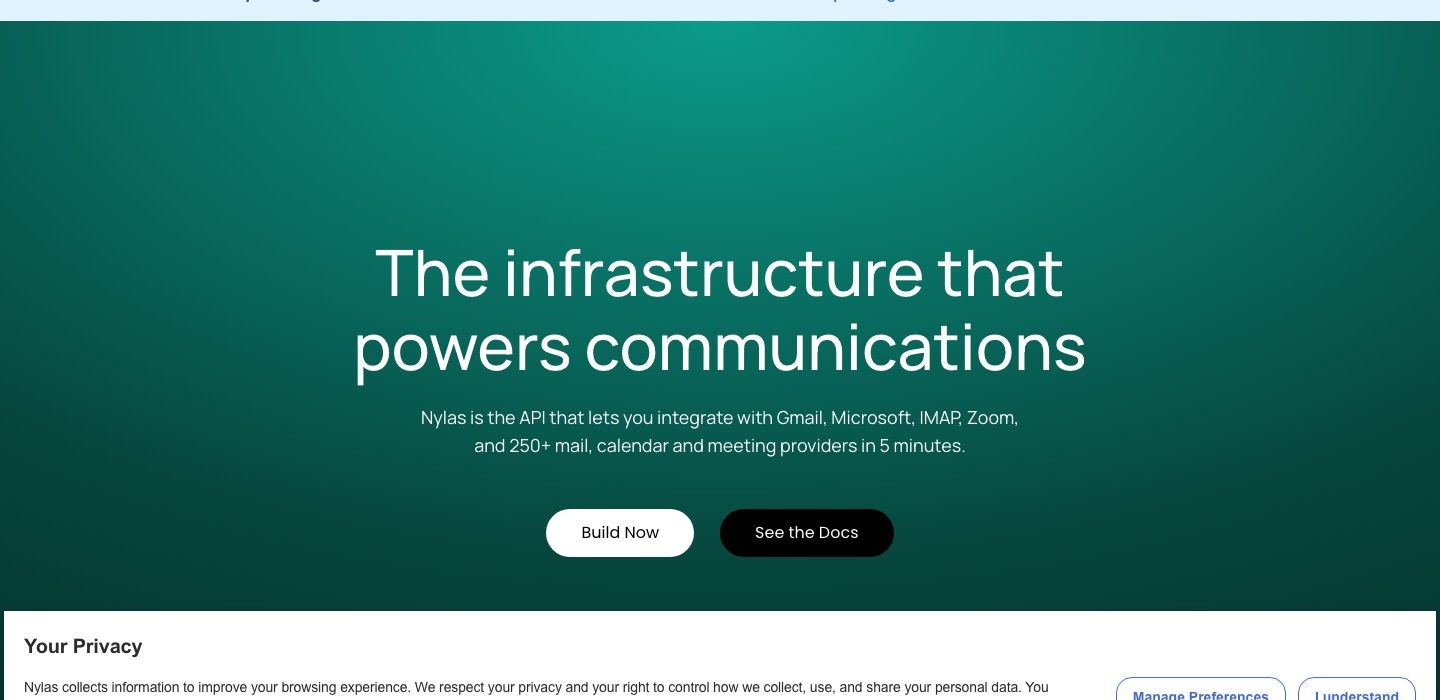
Nylas is communications infrastructure for email, calendar, and meetings: one API over 250+ providers (Gmail, Microsoft, IMAP, Zoom, Teams, and more), with OAuth handling, scheduling, and meeting transcription. It reports 99.99% historical uptime and SOC 2, HIPAA, ISO, and GDPR compliance. One thing it does not do: LinkedIn. There is no LinkedIn channel at all.
Verified pricing (1 October 2026): a Free plan with 5 connected accounts, then Essentials at $15/month including 10 accounts and $2.25 per additional account per month, Pro at $49/month (or $43 on annual billing) including 25 accounts and $2.00 per additional account ($1.75 annual), and enterprise custom pricing; our Nylas pricing guide works the overage math at 25, 50 and 100 accounts. Verdict: if email and calendar are the whole job, Nylas is more mature than Unipile on that slice. If LinkedIn matters, it cannot help. We compare its direct competitors in our Nylas alternatives guide.
7. Edges: LinkedIn actions API on credits and identities
Edges is the pick when you want to buy raw LinkedIn reads and sends by the unit: 70+ documented actions, data credits from $43.99 per 1,000 with a 2,500-credit minimum (about $110 a month) and outreach identities from $8.79 each per month, verified October 2026.
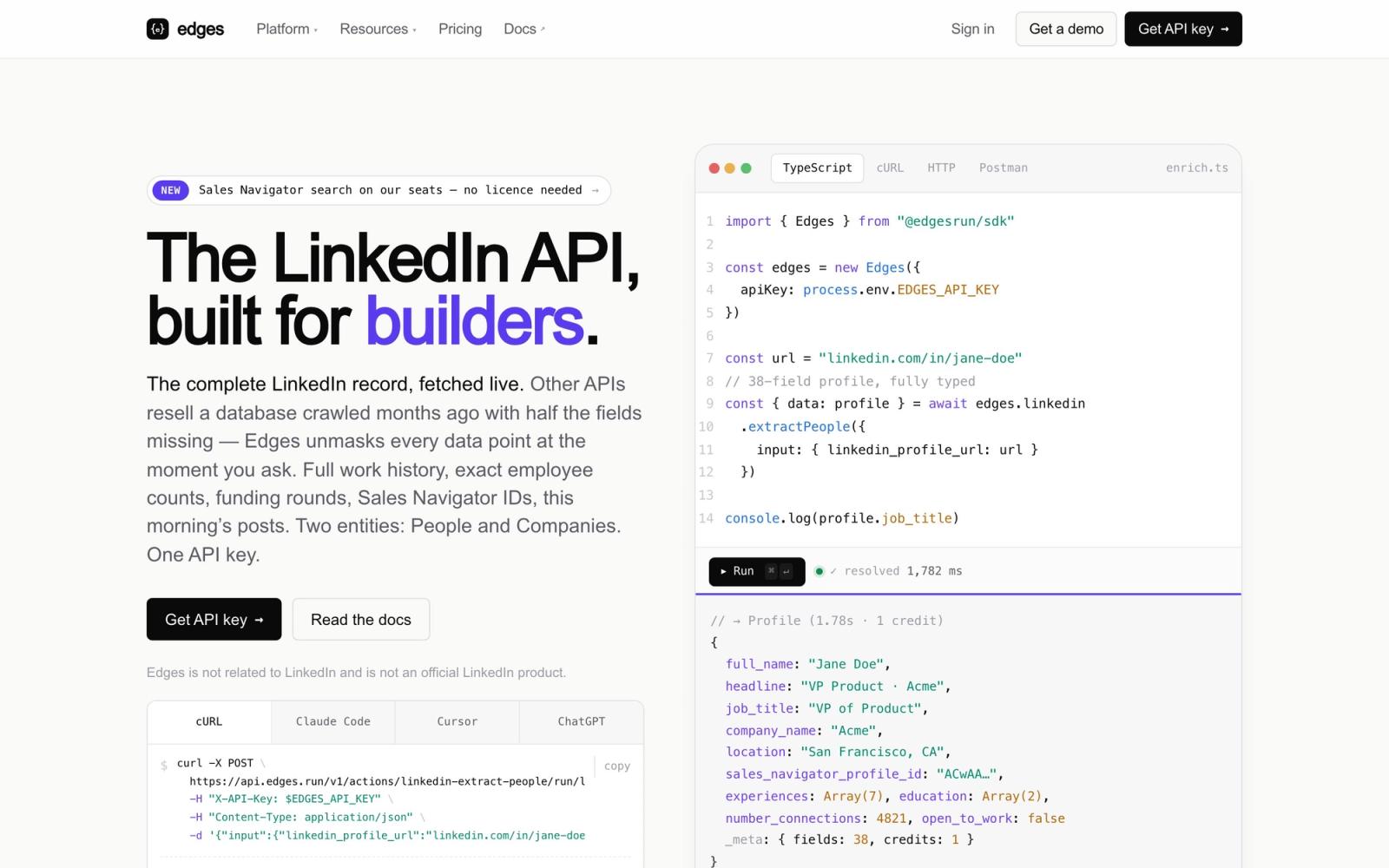
Edges (edges.run) sells raw LinkedIn actions to developers: 70+ actions across profile and company extraction, people and Sales Navigator search, messaging, InMails, connection requests and post engagement, and every action can run live, as an async job with callbacks, or on a cron schedule. The developer surface is strong for 2026: an official TypeScript SDK, open-source Agent Skills that teach coding agents to call the API, and an n8n guide; its MCP server only serves the documentation and does not run actions. The product has two halves. Data reads can run on accounts Edges provisions and operates (managed mode, at 1.5 times the standard credit rate), so you do not have to connect an account for them; outreach runs on identities, meaning LinkedIn accounts you connect yourself. Like Unipile, it ships no sequencer and no campaign object: Edges publishes a build guide for the state machine, lead storage and reply detection you write yourself, and run data is archived after 90 days, so your own database has to be the system of record. Our full Edges review walks through those trade-offs, and the Swarmhit vs Edges page covers the choice against a managed engine.
Verified pricing, read on the live calculator in USD on 5 October 2026: data credits at $43.99 per 1,000 with a 2,500-credit minimum, about $110 a month, dropping to $27.49 per 1,000 on the 10,000-credit Bronze tier ($275 a month) and to $1.64 per 1,000 at the top of the curve; outreach identities from $8.79 each per month, falling to $4.20 at volume, so 50 identities cost about $439 a month at the base rate, billed on the peak number active during the cycle; and a free tier of 100 credits and one identity. Connection requests, messages and likes sent from an engagement identity cost zero credits. Verdict: the most transparent metered pricing on this list and the closest match to Unipile's per-account model, but what you save on the API you spend again building the outreach layer that Unipile also leaves to you, and the read pool does not change what LinkedIn's User Agreement prohibits: scraping and automated access without permission, regardless of whose sessions do the reading.
8. EmailEngine: the self-hosted email leg
EmailEngine replaces the one thing it shares with Unipile, connecting your users' mailboxes to your product, with a flat self-hosted license: $1,450 or €1,200 a year for unlimited mailboxes, instances and API calls.
EmailEngine is a self-hosted email API for Gmail, Microsoft 365 and IMAP. You run it on your own server with Redis, and it exposes REST endpoints and webhooks for reading, sending and syncing mailboxes, with no LinkedIn, WhatsApp or calendar channel at all. The pitch is control and a flat bill: there is no per-mailbox or per-message metering, which is exactly where Unipile's per-account model and Nylas's overage rates compound at hundreds of mailboxes. Our Nylas pricing guide shows where that crossover sits.
Verified pricing (emailengine.app, 1 October 2026): $1,450 or €1,200 a year, renewing annually, covering unlimited connected mailboxes, unlimited production, staging and development instances and unlimited API calls, with a 14-day free trial activated on your own server and no card. Verdict: the right Unipile replacement only when email is the whole job and you accept running the server. The license works out to about $121 a month, which Unipile's per-account bill passes at around 22 connected accounts, and it stays flat at 5,000. For anything touching LinkedIn, it is not a candidate.
How do the best Unipile alternatives compare on pricing in 2026?
All prices below were re-verified on each vendor's own pricing page on 1 and 5 October 2026, with the billing basis stated; where a vendor only quotes on a call, the table says so instead of guessing.
| Tool | Layer | LinkedIn actions | Verified 2026 pricing |
|---|---|---|---|
| Swarmhit | Managed outreach engine + API and webhooks | Yes, native (incl. voice notes, InMail) | From $16.90 per sender a month, tiered down to $6.90 |
| Unipile | Unified messaging API | Yes, via API | About €5 per account/mo, €49 monthly minimum |
| Linked API | LinkedIn control API | Yes | $49 to $74 per seat/mo on annual billing ($69 to $99 monthly) |
| LinkupAPI | LinkedIn, email + WhatsApp account API | Yes | $55/mo for 10 accounts, then $5.50 to $4.50 per account; $3,000/mo cap for unlimited accounts |
| Edges | LinkedIn actions API | Yes, on connected identities | Data credits from $43.99 per 1,000 (2,500 minimum, about $110/mo); outreach identities from $8.79 each per month |
| Captain Data | Data platform | Data only | €59.99 per 1,000 credits base, about €29.99 at 20K credits/mo; 2,500-credit minimum |
| Scrapin | Real-time data API | Data only | $30 trial, then credit packs from $500 |
| Nylas | Email + calendar API | No | Free plan (5 accounts), then $15/mo with 10 accounts + $2.25 per extra account; Pro $49/mo |
| EmailEngine | Self-hosted email API | No | $1,450 or €1,200 a year flat, unlimited mailboxes |
Which Unipile alternative should you pick?
Pick by the layer you are missing, then by how much of the outreach engine you are willing to build. If you want a working outreach product with programmatic control, Swarmhit gets you there without building a sequencer (if you are curious what that build actually involves, we wrote up how to build a LinkedIn sequencer from scratch). If you are committed to building, Linked API, LinkupAPI and Edges are the closest LinkedIn-action substitutes, and our outreach API roundup compares that whole category.
| Your situation | Pick | Why, with the verified figure |
|---|---|---|
| You want to run outreach, not build outreach software | Swarmhit | Sequencer, unified inbox, 250+ monitored safeguards and prospect data already run; API and webhooks on top; public pricing from $16.90 per sender a month |
| LinkedIn only, you will build the sequencer, you prefer seat pricing | Linked API | 50+ chainable actions at $49 to $74 per seat per month on annual billing, $69 to $99 monthly |
| Large fleets that want a capped bill, LinkedIn plus email and WhatsApp | LinkupAPI | $55 for 10 accounts, then $5.50 to $4.50 per account, $3,000 a month cap for unlimited accounts |
| Metered reads plus per-identity sends, and you own the state machine and storage | Edges | Credits from $43.99 per 1,000, identities from $8.79 each per month, runs archived after 90 days |
| People and company data for agents, no sending | Captain Data | €59.99 per 1,000 credits base, about €29.99 at 20,000 credits a month, 2,500 minimum |
| Real-time profile and company data only | Scrapin | $30 seven-day trial, then credit packs |
| Email and calendar only, no LinkedIn at all | Nylas | Free five-account plan, then $15 a month for 10 accounts plus $2.25 per extra account |
| Email only, and you want to host it yourself for a flat bill | EmailEngine | $1,450 or €1,200 a year, unlimited mailboxes, 14-day trial |
Two rules of thumb sit under that table. First, count the sequencer: if the tool has no campaign object, budget weeks of build and permanent maintenance on top of the API bill, whichever vendor you pick. Second, count the accounts: per-seat and per-identity pricing look cheap at one account and scale linearly, so run the numbers at the sender count you expect in a year, not the one you start with. If you were hoping for an official route instead, our LinkedIn API pricing and access guide explains why the official LinkedIn API does not cover outreach at all.
How do you migrate off Unipile?
None of the eight tools above imports Unipile state, so a migration is a re-connection, not a transfer. Three steps keep it short. First, export what lives only in Unipile: the list of connected accounts per customer, the chat and message history you want to keep, and your webhook subscriptions, since the new provider will issue new account ids and new webhook endpoints. Second, map Unipile's objects to the replacement's: a connected account becomes a sender account on Swarmhit (connected through a hosted link your users open), a seat on Linked API, an identity on Edges or a connected account on LinkupAPI; Unipile chats become inbox chats or threads; and the events you consumed, new message, accepted invitation, account disconnected, exist under different names everywhere, so the webhook handler is rewritten rather than repointed. Third, reconnect accounts in waves and keep Unipile running for the channels the replacement does not cover, which for every LinkedIn-first option on this list means at least Instagram, Telegram and calendar sync, and for every one except LinkupAPI also WhatsApp.
The one thing that does not migrate is the outreach logic you built on top of Unipile. If you move to another raw API, that code moves with you almost unchanged. If you move to a managed engine, you delete it, because campaigns, pacing and reply detection become objects you configure instead of code you maintain; our guide on how to build a LinkedIn outreach tool lists exactly what that code was doing.
FAQ
What is Unipile?
Unipile is a unified messaging API that lets developers integrate LinkedIn, WhatsApp, Instagram, Telegram, email, and calendars into their product through one REST interface. It handles authentication, webhooks, and account protection, and is used by SaaS builders in outreach, recruiting, and CRM.
What is the best Unipile alternative?
For most teams, Swarmhit is the best Unipile alternative because it pairs a finished outreach engine (multi-sender campaigns, unified inbox, AI personalization, managed account safety) with API and webhook access, with public pricing from $16.90 per sender a month, tiered down to $6.90. If you strictly need a raw multi-channel API, Linked API and LinkupAPI are the closest substitutes for the LinkedIn side. See the full Swarmhit vs Unipile comparison.
Is there a free Unipile alternative?
Not for production LinkedIn automation. Nylas has a free 5-account sandbox tier for email and calendar, Captain Data offers 100 free pilot credits, and most tools on this list offer trials, but sustained LinkedIn sending through any API is a paid capability everywhere in 2026.
Which Unipile alternatives support LinkedIn outreach actions?
Swarmhit, Linked API, LinkupAPI and Edges all support LinkedIn outreach actions such as messages, connection requests and comments. Captain Data and Scrapin are data-only, and Nylas has no LinkedIn support at all.
Is Edges a good Unipile alternative?
Edges suits developers who want metered LinkedIn actions with transparent pricing: 70+ documented actions, data credits from $43.99 per 1,000 and outreach identities from $8.79 each per month, verified October 2026. Like Unipile it has no sequencer, so you still build the campaign logic, and its run data is archived after 90 days, so plan your own storage from day one.
Is it safe to automate LinkedIn through an API in 2026?
It can be, if sending behavior stays human-like and each account runs behind stable infrastructure: dedicated proxies, warm-up, and conservative caps. None of these providers is an official LinkedIn partner for automation, so the risk is managed rather than eliminated. Our guide on LinkedIn automation safety covers the details.
Does Swarmhit have an API like Unipile?
Yes. Swarmhit exposes its outreach engine through an API and webhooks, so you can create campaigns, sync replies, and connect your CRM or AI agents programmatically. The difference is that the sequencing, inbox, and account safety layers already exist, so you integrate an engine instead of building one.
What is the difference between Unipile and Nylas?
Unipile covers messaging channels including LinkedIn, WhatsApp, and Instagram alongside email and calendar, while Nylas focuses exclusively on email, calendar, and meetings across 250+ providers. If LinkedIn is in scope, Nylas is not an option; if it is not, Nylas is the more specialized platform.
Is there a self-hosted Unipile alternative?
EmailEngine is the self-hosted option, but only for the email leg: a $1,450 or €1,200 a year license you run on your own server covers unlimited Gmail, Microsoft 365 and IMAP mailboxes with no per-account metering. Nothing on this list lets you self-host LinkedIn automation, because every LinkedIn API here operates connected member accounts on the vendor's infrastructure.
Conclusion
Unipile earned its position, but it is one layer of the stack, not the whole stack. Builders who want raw APIs have credible substitutes in Linked API, LinkupAPI and Edges, data teams have Captain Data and Scrapin, and email-only products have Nylas or, self-hosted, EmailEngine. Teams whose real goal is running outreach, not building outreach software, get there fastest with Swarmhit. For the broader tool landscape beyond APIs, see our guide to the best LinkedIn automation tools.


