

lemlist is an email marketing platform with LinkedIn automation attached, not a LinkedIn-first tool built the other way around. This lemlist review checks what changed for September 2026: the Email plan runs $55 a user a month on annual billing ($69 monthly) and does not include LinkedIn at all, while LinkedIn only unlocks on the Multichannel plan, at $87 a user a month annual ($109 monthly). It suits a team whose pipeline runs on email and wants LinkedIn as a supporting touch, less so a team that wants LinkedIn to carry the outreach.
We read lemlist's pricing page, its plan feature lists and its credit system this month, then walked through the multichannel sequence builder before writing anything below. The rest of this review breaks down what lemlist actually does on each channel, what the Multichannel plan gates behind its price, and where a LinkedIn-first tool fits instead.
lemlist review: what is lemlist and who is it for?
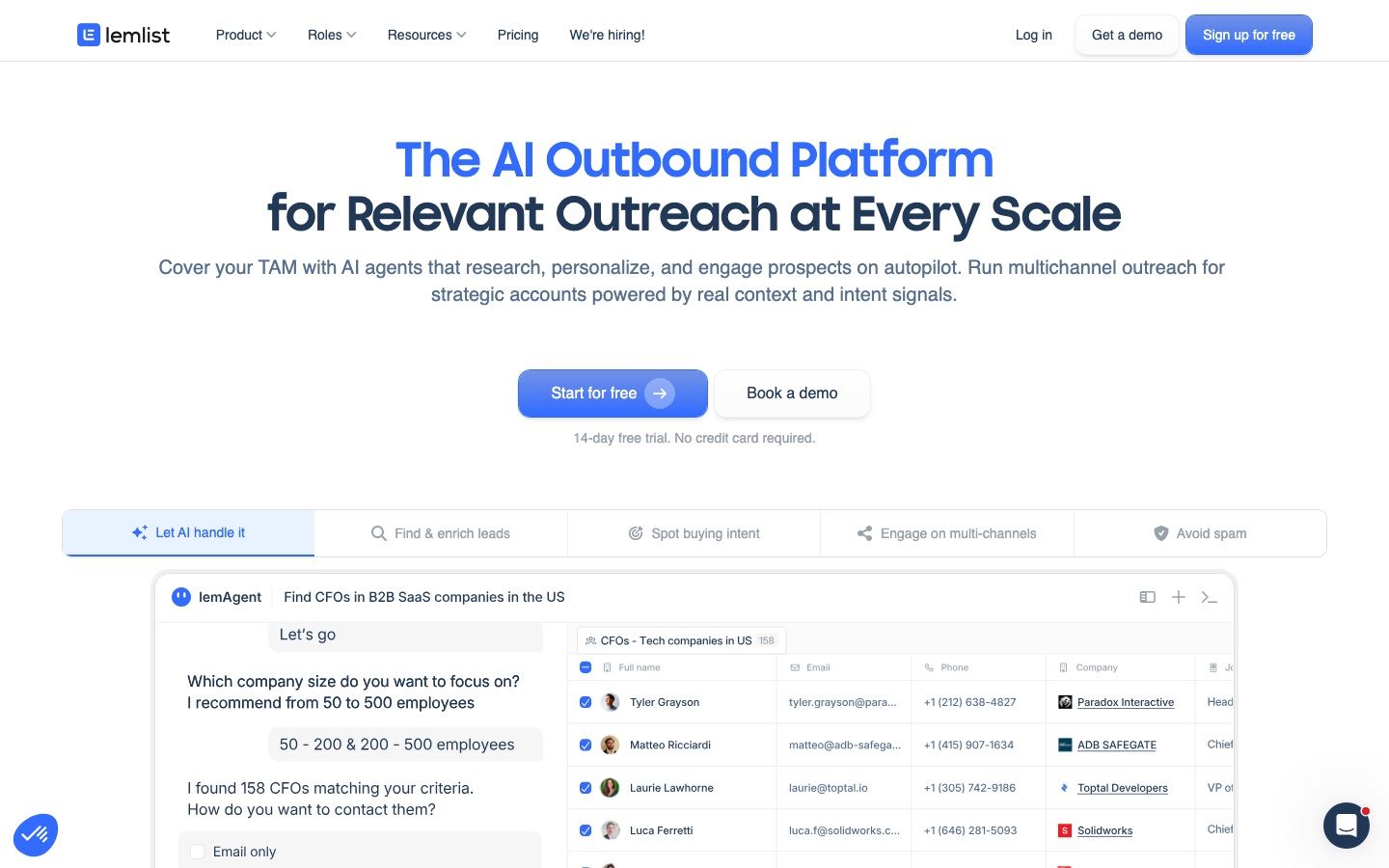
lemlist is an outbound sales platform sold in two tiers, and the split matters more than the marketing suggests. The Email plan is a genuinely capable cold email tool: unlimited users and email senders, 50,000 emails a month, an email and phone finder, a 650M+ lead database by lemlist's own count, unlimited contacts, lemAgent AI agents, a lemlist MCP server, a unified inbox, a deliverability hub with warm-up, and CRM integrations plus an API. For a team whose whole motion is email, that is a lot of platform for $55 to $69 a user a month.
LinkedIn does not exist on that plan. It lives one tier up, on Multichannel, alongside SMS automation, a WhatsApp add-on and a built-in call dialer. That structure tells you who lemlist is built for: a sales team that already runs on email and wants to layer other channels on top of it, not a team shopping specifically for a LinkedIn tool. If LinkedIn is your primary channel and you want several senders rotating under one campaign, read the pricing and feature sections below closely before you commit a full year of billing to it.
How does lemlist's sequence builder handle email and LinkedIn together?
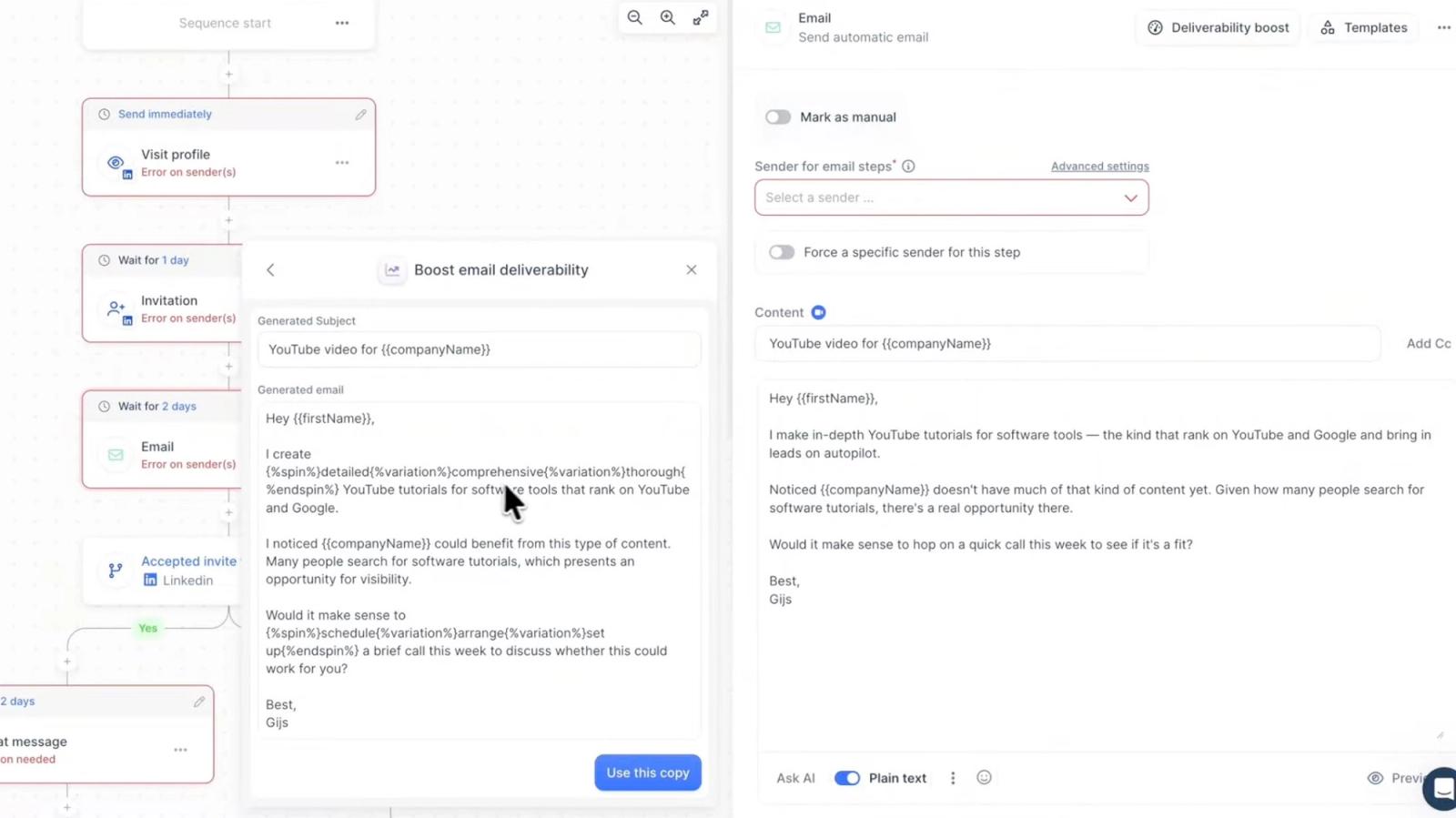
lemlist's sequence builder lets you chain email, LinkedIn and task steps into one campaign, and on Multichannel that chain can include profile visits, follows, connection invitations, LinkedIn text messages and LinkedIn voice messages alongside your email steps. Multichannel adds five senders per user, unlimited emails and messages once you are on that plan, SMS automation, a WhatsApp add-on, a built-in call dialer with VoIP integrations, task management, and the ability to work from Gmail or LinkedIn directly rather than only inside lemlist's own interface.
The builder itself is well designed for what it is: an email sequence tool that also understands LinkedIn steps, rather than a LinkedIn tool that happens to send email. Every step type carries its own sender configuration, which means a multichannel sequence is only as ready to launch as its least configured channel. That is not a flaw exactly, it is a consequence of building email-first and adding LinkedIn on top, and it shows up again in the feature list: the AI copywriting and deliverability tooling around email are more mature than anything on the LinkedIn side.
Run your LinkedIn outreach on Swarmhit
Multi-sender campaigns, safe sending limits and a unified inbox, from $29 per sender per month on annual billing.
7-day free trial. Cancel anytime.
Is lemlist Multichannel good for LinkedIn automation?
lemlist Multichannel covers real LinkedIn ground: profile visits, follows, connection invitations, text messages and voice messages, all inside the same sequence as your email steps. For a team that wants LinkedIn to warm up or follow through on an email-led sequence, that coverage is enough, and having it in the same builder as email means one campaign instead of two tools stitched together.
Where it shows its limits is scale and identity. Multichannel is priced and built per user, with five senders per user on the plan, which assumes each rep runs LinkedIn from roughly one identity rather than a team rotating outreach across a shared pool of accounts. There is no multi-account rotation model of the kind a LinkedIn-first platform builds around, and per-account health monitoring is not part of the plan's feature list. If your LinkedIn motion is one rep per account, that is a non-issue. If you are running an agency book or a team that wants several senders sharing load on one campaign, it is the first place the email-first design shows.
Can lemlist send InMails or comment on LinkedIn posts?
No. lemlist's own Multichannel feature list covers profile visits, follows, connection invitations, LinkedIn text messages and voice messages, and InMail and automated post comments are not on that list. That is a real gap if your outreach depends on reaching second and third degree prospects before a connection exists, since InMail is the tool built for exactly that, and it is worth reading our guide to LinkedIn InMail if that channel matters to your motion. InMail itself runs on a credit system LinkedIn controls, not lemlist, and LinkedIn's own help page on InMail credits is the source to check before assuming any tool can send them without limit.
Voice messages are the one place lemlist goes further than a lot of tools in this category: recording a personal-sounding voice note inside a LinkedIn sequence is a genuinely useful touch for warming up a connection before the ask. The gap is what surrounds it. No InMail means no way to message a prospect who has not accepted your connection request yet, and no post comment automation means one of the more effective warm-up moves, engaging with a prospect's own content before you invite them, is not something the platform does for you.
What does lemlist pricing look like in 2026?
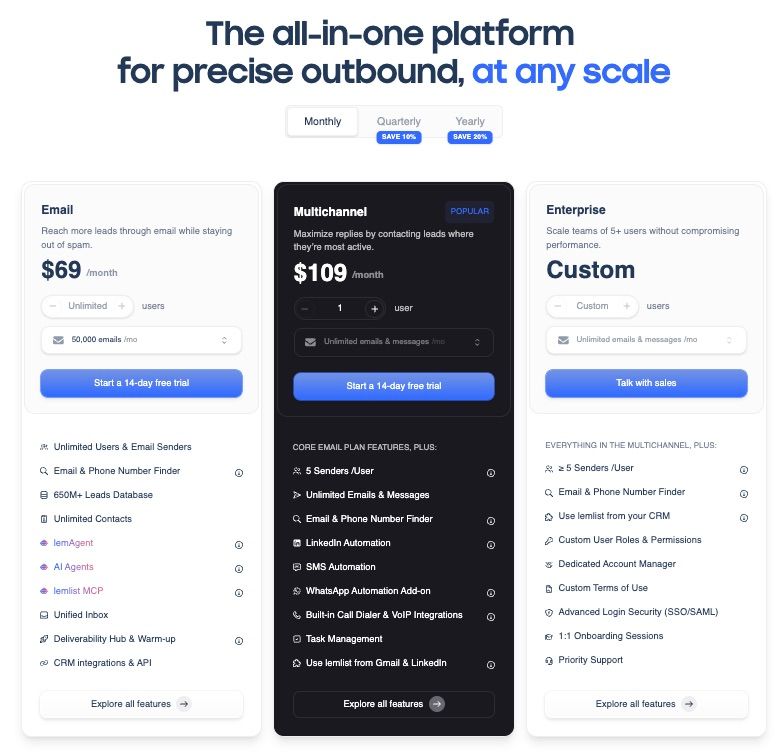
lemlist's pricing page defaults to yearly billing, so the number you see first is the discounted one; switch the toggle to check the monthly rate before you commit to anything. Verified on lemlist's own pricing page in September 2026, here is what each tier costs and includes:
| Plan | Monthly billing | Annual billing (per month) | What it includes |
|---|---|---|---|
| $69 per user | $55 per user | Unlimited users and email senders, 50,000 emails a month, email and phone finder, 650M+ lead database, lemAgent AI agents, lemlist MCP, unified inbox, deliverability hub with warm-up, CRM integrations and API | |
| Multichannel | $109 per user | $87 per user | Everything in Email, plus 5 senders per user, LinkedIn automation (visits, follows, invites, text and voice messages), SMS automation, WhatsApp add-on, call dialer with VoIP integrations, task management |
| Enterprise | Custom | Custom | For teams of 5+ users, 5 or more senders per user, CRM-embedded use, roles and permissions, dedicated account manager, SSO and SAML, 1:1 onboarding, priority support |
The tier gating is the single most important line in that table: LinkedIn automation is a Multichannel feature only. An Email plan user cannot send a single LinkedIn connection request from inside lemlist, no matter how many email sends their unlimited-sender plan allows. Annual billing saves 20 percent on both paid tiers, and there is a 14-day free trial on the paid plans.
Scaling the Multichannel plan by headcount makes the per-user pricing concrete. A three-person team pays $87 a user on annual billing, or $261 a month, which comes to $3,132 for the year; the same three seats on monthly billing run $109 a user, or $327 a month, $3,924 across twelve months of month-to-month billing. That gap, just over $790 a year, is what you give up for the flexibility of paying monthly rather than committing upfront. At ten people the math changes shape rather than just size: lemlist's own tier structure puts a team that large into Enterprise territory, since Enterprise is built for teams of 5 or more users, and Enterprise pricing is custom rather than published. Extrapolating the list rate anyway, ten seats at $87 a user annual would be $870 a month, or $10,440 a year, which is the number worth having in hand before a custom quote comes back, since it tells you what you are negotiating against.
Beyond the subscription, lemlist runs a separate credit system for lead-finding and verification. One credit costs $0.01: a verified email costs 5 credits ($0.05), and a phone number costs 20 credits ($0.20). At the bundle rate, 1,000 credits ($10) buys 200 verified emails or 50 phone numbers. Intent signals are priced per signal too: a company web visit costs 20 credits, hiring and job-change signals start at 100 credits, fundraising signals cost 100 credits, and LinkedIn engagement signals start at 400 credits.
Put a number on a real list and the credit system stops being abstract. A 500-lead list verified entirely by email costs 2,500 credits, or $25, at 5 credits a record. Verify the same 500 leads by phone instead and the cost jumps to 10,000 credits, or $100, since phone verification runs 20 credits a record, four times the email rate. Layer in intent signals on top of either list and the bill moves again: a company web-visit signal on all 500 leads adds another 10,000 credits, or $100, at the 20-credit rate, while running hiring and job-change signals across the same list adds at least 50,000 credits, or $500, at the 100-credit floor. None of that is a criticism of the pricing, it is simply the part of lemlist's bill that scales with enrichment depth rather than seats, and it is worth budgeting before you commit to a workflow that leans on signals for every lead.
Here is what actually changes between the two paid tiers, feature by feature:
| Feature | Email plan | Multichannel plan |
|---|---|---|
| Email sending | Unlimited users and senders, 50,000 emails a month | Same, plus unlimited multichannel messages once active |
| LinkedIn automation | Not included | Visits, follows, invites, text and voice messages |
| Senders per user | Unlimited email senders | 5 senders per user |
| SMS and WhatsApp | Not included | SMS automation, WhatsApp add-on |
| Call dialer and VoIP | Not included | Included |
| lemAgent AI agents and MCP server | Included | Included |
| Deliverability hub and warm-up | Included | Included |
The upgrade buys three new channels and five senders per user; it does not buy anything that widens what LinkedIn itself can do on the platform.
The decision rule is simpler than the feature lists make it look. Buy the Email plan if your outbound motion is entirely email-based and you need more than a couple of people sending: unlimited users and unlimited email senders at $55 to $69 a user means adding a fourth or fifth rep costs nothing extra in seats, and 50,000 emails a month covers a genuinely large send volume before you would need to talk to sales. Buy Multichannel the moment a LinkedIn step needs to exist anywhere in your sequence, even a single profile visit before the email lands, because there is no way to add LinkedIn actions to an Email-plan account. Multichannel also raises the sender ceiling, from unlimited email senders on Email to five LinkedIn senders per user, which matters if a rep runs more than one LinkedIn identity, though most reps will only ever connect one.
lemlist at a glance
Pros
- Unlimited users and senders on the Email plan for $55 to $69 a user
- Deliverability hub and warm-up genuinely help email land in the inbox
- LinkedIn, SMS, WhatsApp and calls in the same sequence builder as email
- lemAgent AI agents and an MCP server ship on every paid plan
- 14-day free trial on the paid plans
Cons
- LinkedIn automation does not exist on the cheaper Email plan
- No InMail or automated post comments on the Multichannel plan
- Priced per user with 5 senders per user, not built for multi-sender rotation
- Lead-finding and verification credits are a separate, stacking cost
Is lemlist safe for LinkedIn outreach?
lemlist does not publish a detailed breakdown of per-action LinkedIn safety limits on its pricing or feature pages, so we will not invent one. What we can say is general to any tool that automates LinkedIn actions: the account doing the sending is yours, LinkedIn enforces its own connection limits, and pushing volume past what a real person would send is the fastest way to see an account flagged or restricted. LinkedIn documents how invitation limits and account restrictions actually work on its own help page on invitations and restrictions, which is worth reading regardless of which tool you use. Our guide to whether LinkedIn automation is safe covers the mechanics in detail: what LinkedIn actually limits, how restrictions escalate, and what separates a tool that manages that risk from one that ignores it.
Because lemlist's LinkedIn steps assume one identity per user rather than a managed pool of senders, the safety burden sits mostly with whoever configures the sequence: how many invitations a day, how much delay between steps, how aggressively the campaign ramps. That is workable for a single rep running LinkedIn as a secondary channel. It is a heavier lift for a team that wants sender health monitored automatically across several accounts at once.
Is there an alternative to lemlist?
If email genuinely carries your pipeline and LinkedIn is a supporting touch, lemlist is a strong choice and its Email plan is hard to beat on price. If LinkedIn is the channel doing the outreach, Swarmhit is built the other way around: LinkedIn is the product, not an add-on tier.
Swarmhit prices per sender rather than per user, from $29 per sender per month on annual billing ($39 monthly), with the price per sender dropping sharply as you add more. One campaign rotates across a pool of senders, replies land in a shared inbox with assignment and interest tags, and the LinkedIn action set covers connection requests, messages, InMail, profile visits, follows, post comments and AI personalization pulled from each prospect's profile, posts and company news, including AI voice notes that speak your script in your own cloned voice. Every sender runs on a dedicated proxy with managed auto-warmup, health checks, smart caps and 250+ safeguards monitored around the clock. A built-in database of 1B+ contacts across 60M companies, refreshed weekly and sourced through third-party data providers, comes with free monthly credits and then pay as you go. Sales Navigator searches import directly, scraping runs only through accounts you connect yourself, capped at 2,500 profiles a day from Sales Navigator search and 1,000 a day from standard search, and CRM connectivity runs through API, webhooks and an MCP server. Larger fleets and agencies get custom pricing based on the number of senders, scoped on a call, with a white-label inbox and reports included at that level.
What Swarmhit does not do is native email in the same sequence, or the deliverability tooling lemlist has built around it. If email and LinkedIn genuinely need to live in one sequence with one sender identity per rep, lemlist's Multichannel plan does that job. If LinkedIn is the job and you want several senders, InMail, post comments and the safety architecture to run under it, that is what Swarmhit is built for. See the fuller Swarmhit versus lemlist comparison for the side-by-side, and our roundup of LinkedIn automation tools for the wider field, including where lemlist's other LinkedIn-first competitors land on price and coverage.
FAQ
Is lemlist worth it in 2026?
Yes, if email is your primary channel. The Email plan's unlimited users and senders, deliverability hub and 650M+ lead database are strong value at $55 to $69 a user monthly. It is a harder yes if you are buying it specifically for LinkedIn, since that requires the pricier Multichannel plan and still leaves out InMail and post comments.
Does lemlist include LinkedIn on the Email plan?
No. The Email plan, at $55 to $69 a user monthly, covers email sending, deliverability tooling and the lead database, but LinkedIn automation requires the Multichannel plan at $87 to $109 a user monthly. There is no way to add LinkedIn steps to an Email-plan account without upgrading.
How good is lemlist LinkedIn automation compared to LinkedIn-first tools?
lemlist LinkedIn automation covers profile visits, follows, invitations, text messages and voice messages, which is solid for a supporting channel. It does not cover InMail or automated post comments, and it is priced and built per user rather than around multiple senders rotating in one campaign, which is where LinkedIn-first platforms go further.
Is lemlist pricing per user or per sender?
Per user. Each user on the Multichannel plan gets five LinkedIn senders included, and the plan price scales with the number of users on your team, not the number of LinkedIn accounts you connect. A tool priced per sender charges only for the accounts actually sending, which changes the math once a team shares senders across reps.
How much does lemlist Multichannel cost for a three person team?
At the annual rate of $87 a user monthly, three users cost $261 a month. On monthly billing at $109 a user, the same team costs $327 a month. Lead-finding and verification credits are billed separately from either figure, so real monthly spend tends to land above the subscription price alone.
Does lemlist offer a free trial?
Yes. lemlist offers a 14-day free trial on its paid plans, which is enough time to build a real sequence and see how the email and LinkedIn steps behave together before committing to monthly or annual billing.
What is lemlist's G2 rating?
lemlist displays a 4.7 out of 5 rating based on 1,396 reviews as a G2 badge on its own pricing page, alongside a claim of 20,000-plus sales teams using the product. That is lemlist's own displayed figure, not an independent score we verified separately.
Is this lemlist review still accurate for 2026?
The pricing, feature lists and credit costs in this lemlist review were verified on lemlist's own pricing page in September 2026. Vendors change plans and pricing without notice, so treat any figure here older than a few months as worth rechecking against the live page before you buy.
Conclusion
lemlist is what it says it is: a strong email platform that added LinkedIn as a premium layer rather than building around it. The Email plan is genuinely good value for a team whose pipeline runs on email, and the Multichannel plan's LinkedIn coverage is enough for profile visits, invitations, messages and voice notes layered around that email sequence.
Where it falls short is any team that wants LinkedIn to be the main channel. No InMail, no post comments, per-user pricing built around one identity per rep, and a separate credit system stacking on top of the subscription all point the same direction: pick lemlist for email with LinkedIn support, and look at a LinkedIn-first platform like Swarmhit if LinkedIn is the job the outreach actually needs to do.


