

If you are searching for reply.io alternatives, you are probably staring at the $69 per account LinkedIn add-on and wondering why multichannel outreach costs so much on top of the base plan. This guide compares seven tools people actually switch to: Cadency, lemlist, Instantly, Smartlead, Apollo, Saleshandy, and Snov.io, using the pricing each vendor publishes on its own site as of September 2026.
The short version: if LinkedIn is your main channel, Cadency and lemlist build it in rather than bolting it on. If you only send cold email and want to cut cost per seat, Instantly and Smartlead compete on volume, Apollo and Saleshandy bundle a contact database, and Snov.io sells LinkedIn as its own paid slot. We break down what each one charges, what you get for it, and who should skip it.
Why look for a Reply.io alternative in 2026?
Reply.io's own pricing page, verified September 2026 with the annual toggle set as default, lists Email Volume from $49 per user per month annually ($59 monthly) for 1,000 active contacts a month, unlimited mailboxes under fair usage, email warmup, 50 live data credits, and up to 200 website visitor reveals a month. An active contact, in Reply.io's own terms, is a unique contact you can send a first-step email to in a given month, with unlimited follow-ups after that, which matters when you are sizing Email Volume against competitors that price by seat instead of by contact. LinkedIn is not included at that tier: it is a separate add-on at $69 per account per month, with calls and SMS a further add-on at $29.
Multichannel, which bundles email, LinkedIn, calls, SMS, and a WhatsApp semi-automation feature, starts from $89 per user per month annually or $99 monthly, with unlimited active contacts, five mailboxes per user (as read on 30 September 2026), CSM onboarding, and team reports. Here is the friction behind most reply.io alternatives searches: a five-person team on Email Volume plus the LinkedIn add-on pays 5 times ($49 plus $69), or $590 a month on annual billing, before even touching Multichannel. The same five seats on Multichannel cost 5 times $89, or $445 a month. Stacking the add-on onto the entry plan is usually a worse deal than buying Multichannel outright. Reply.io also sells Jason AI SDR from $500 a month. A separate custom tier for teams of 20+ adds enhanced API access and whitelabel options. Reply.io displays a 4.6 out of 5 rating from 1,448 reviews on G2 on its own pricing page, a vendor claim we are repeating, not verifying.
For the wider field of tools that automate LinkedIn actions beyond Reply.io's add-on, we cover it separately in our roundup of LinkedIn automation tools.
1. Cadency: the multi-sender LinkedIn and email alternative to Reply.io (our tool)
Cadency, built on Swarmhit, is outreach software for sales teams, recruiters and go-to-market agencies that send volume on LinkedIn and email: one campaign runs across every LinkedIn sender and every mailbox, each lead is worked by one sender, and every conversation lands in one unified inbox. If you are a single rep only replacing Reply.io's email side, skip ahead to the Instantly or Smartlead sections below; this entry is for teams that run several LinkedIn senders and want to drop the $69 add-on entirely.
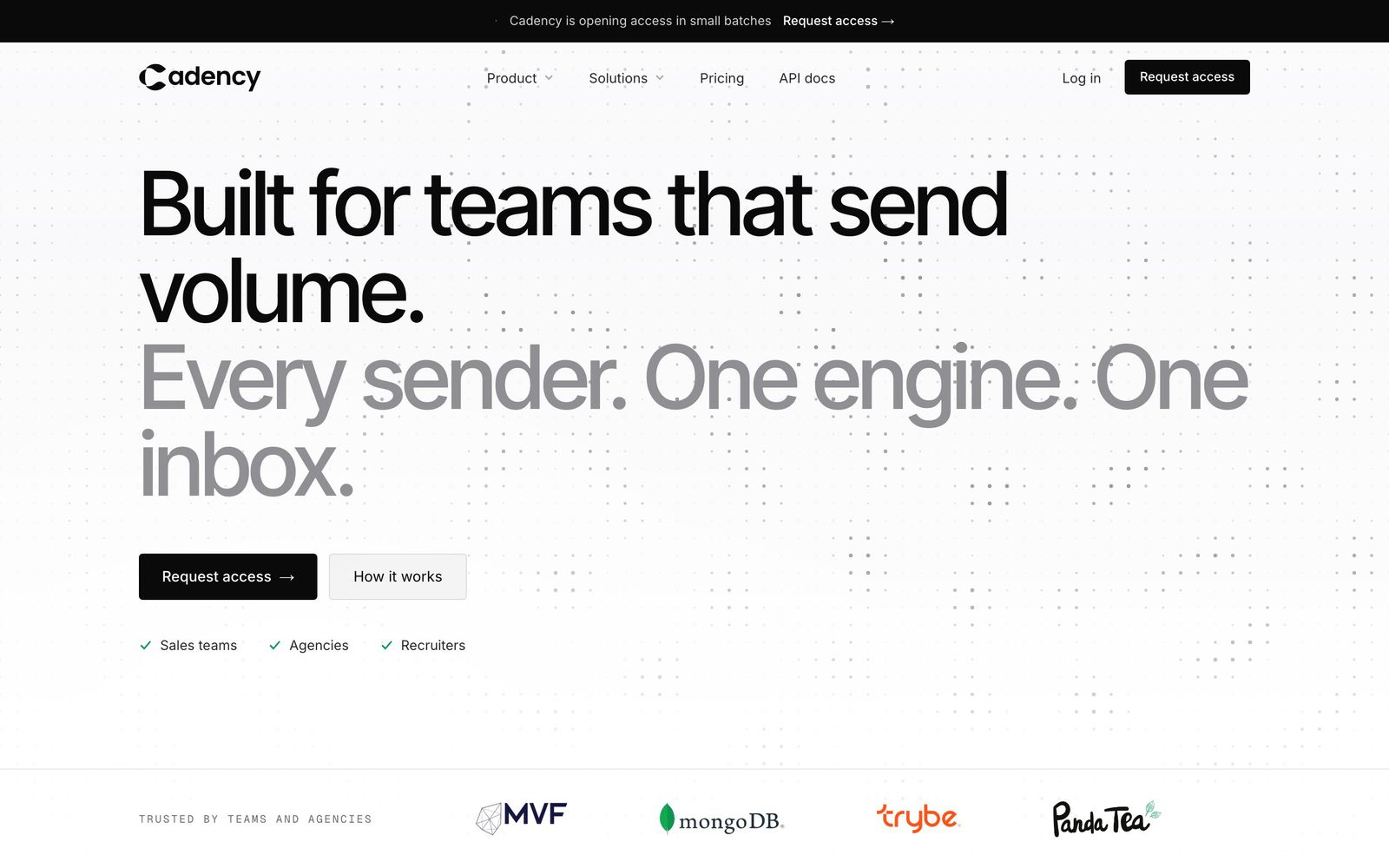
Cadency's Small Team plan costs $199 a month with 5 LinkedIn senders included and 100,000 emails a month, and Scale costs $699 a month with 20 senders included and 500,000 emails a month, with 1M emails for $200 more or 2M for $500 more. Those are monthly prices; annual billing takes 30 percent off, which brings the plans to $139 and $489 a month, and extra senders beyond the included ones are billed per sender. Mailboxes, teammates and workspaces are unlimited on both plans, so there is no per-user charge and no LinkedIn add-on; a LinkedIn sender is one LinkedIn account connected and sending.
What you get for that price: eight LinkedIn steps (profile visit, connection request, message, InMail, a comment on the lead's last post that is AI drafted and approved by you, voice note, like, and follow), conditions that branch on connected, replied, and email found, plus waits and A/B tests. Email runs from Google and Microsoft mailboxes with warm-up, rotated in the same campaign as the LinkedIn senders. Sender rotation spreads leads across the pool with per-sender ceilings and pacing, each sender gets a dedicated proxy, checkpoints are handled, and everything runs in the cloud, while LinkedIn's own invitation and usage limits still apply to every account. Ambassador accounts, vetted LinkedIn accounts operated for you, are available on demand. The inbox keeps one thread per lead across LinkedIn and email, threads are assignable, and you can reply as any sender; only conversations started from Cadency are tracked. Data comes from a native people and company database with waterfall enrichment paid per verified hit, plus CSV and Sales Navigator imports. API and webhooks come on every plan, and any CRM or ATS connects through the API rather than a native CRM sync.
Cadency at a glance
Pros
- One campaign runs across every LinkedIn sender and every mailbox, one sender per lead, with one unified inbox where you can reply as any sender
- Eight native LinkedIn steps, including InMail, voice notes, and AI-drafted post comments you approve, with branching on connected, replied, and email found
- Priced by LinkedIn sender, not by user: 5 senders included from $199 a month, with unlimited mailboxes, teammates, and workspaces
- Per-sender ceilings and pacing, a dedicated proxy per sender, and checkpoint handling, all running in the cloud
Cons
- No calling, SMS, or WhatsApp steps, so it does not replace everything in Reply.io's Multichannel plan
- CRM and ATS connections run through the API and webhooks, with no native CRM sync
- Access is private and by request, with no trial period, and the $199 monthly floor suits a team more than a single rep
Verdict: Cadency is our top pick for teams that run several LinkedIn senders alongside email and resent paying $69 per account a month just to unlock LinkedIn inside Reply.io. Skip it if you are a single rep or only send cold email, where the email-only tools below cost less, or if you need calls, SMS, or WhatsApp in the same sequence. See our guide to whether LinkedIn automation is safe, and our breakdown of LinkedIn's connection limits for the caps underneath every tool's sending.
Run LinkedIn and email from one campaign with Cadency
Every LinkedIn sender and every mailbox in one campaign, one sender per lead, and one unified inbox, with no per-user charge and no LinkedIn add-on.
From $199 a month with 5 LinkedIn senders.
2. lemlist: the multichannel alternative with LinkedIn built in
lemlist's Email plan costs $69 a month per workspace for 50,000 emails on monthly billing, or $55 yearly, and Multichannel costs $109 per user monthly or $87 yearly, according to lemlist's own pricing page, verified 26 September 2026.
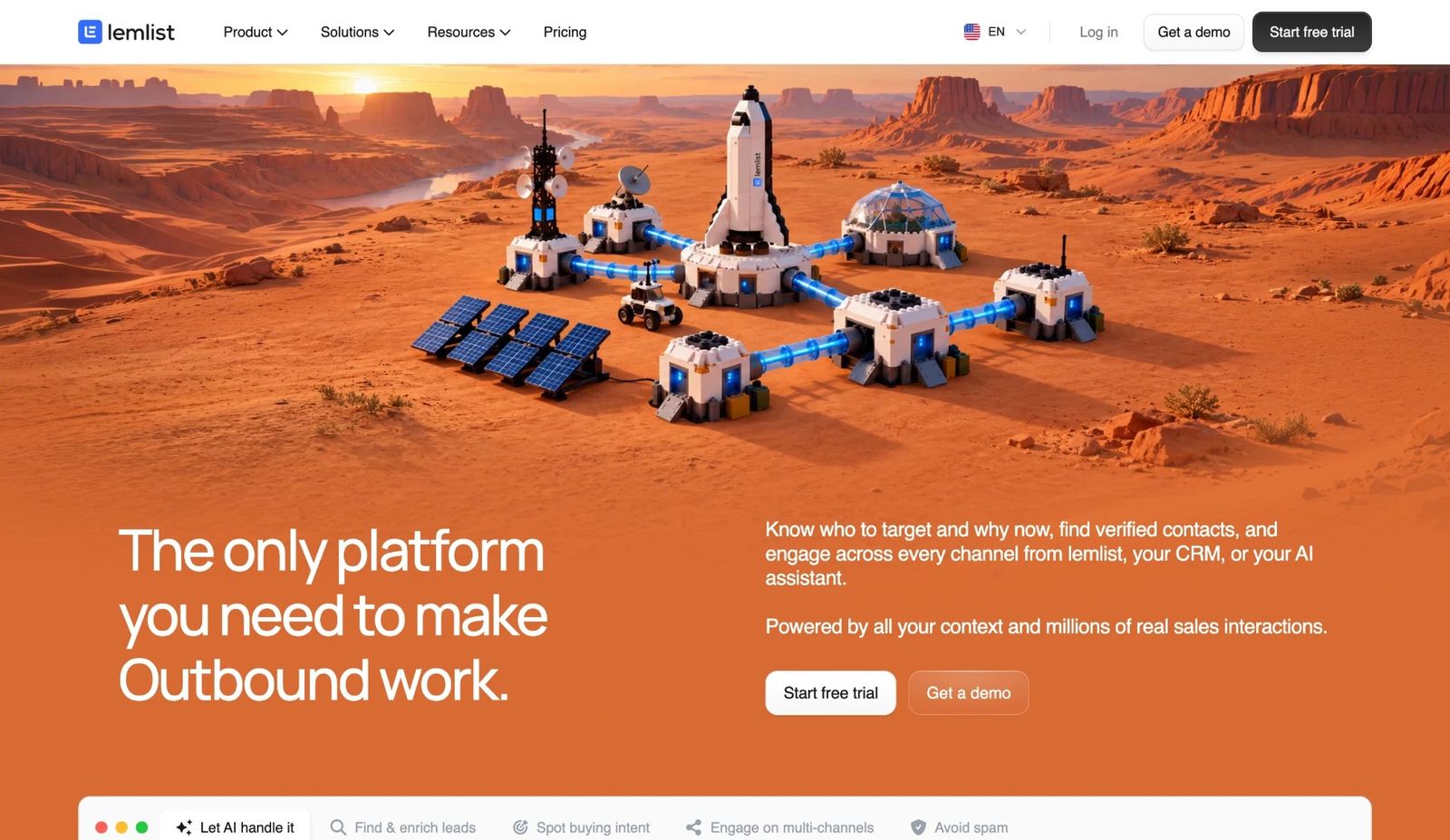
The Email plan includes unlimited users and senders, 50,000 emails a month, an email and phone finder backed by a 650 million-plus leads database, lemAgent AI agents, an MCP server, a unified inbox, a deliverability hub with warmup, and CRM integrations and API access. Multichannel is priced per seat, with one LinkedIn account and 5 sending mailboxes per seat ($9 per extra mailbox, as read on 26 September 2026), and adds unlimited emails and messages, LinkedIn automation covering profile visits, follows, invites, text messages, and voice messages, SMS automation, a WhatsApp add-on, a built-in call dialer with VoIP integrations, and task management. Credits work out to $0.01 each: a verified email costs 5 credits and a phone number costs 20, so 1,000 credits for $10 buys roughly 200 emails or 50 phone numbers. lemlist displays a 4.7 out of 5 rating from 1,396 reviews on G2, alongside a claim of 20,000-plus sales teams using it, both vendor claims. A 14-day free trial covers both plans.
lemlist at a glance
Pros
- One per-user price covers email and LinkedIn together on the Multichannel plan
- 5 sending mailboxes per seat on Multichannel, plus SMS automation and a built-in call dialer
- lemAgent AI agents and an MCP server for programmatic access
Cons
- Multichannel costs more per user than Reply.io's own Email Volume plan once you only need email
- WhatsApp is a separate add-on rather than included in the base Multichannel price
Verdict: lemlist is the closest like-for-like replacement for Reply.io's Multichannel plan, because it bundles LinkedIn into the same per-user price instead of pricing it as an add-on. Skip it if you only need email: its Email plan, which carries no LinkedIn, starts at $69 a month for 50,000 emails, above the entry price of most email-only tools on this list, though those entry tiers include far fewer sends. We cover the full feature set in our lemlist review, and if you want a direct head to head against Cadency, see our Cadency vs lemlist comparison.
3. Instantly: cold email at higher volume, no LinkedIn
Instantly's Growth plan costs $47 a month on monthly billing, according to Instantly's own pricing page, verified September 2026.
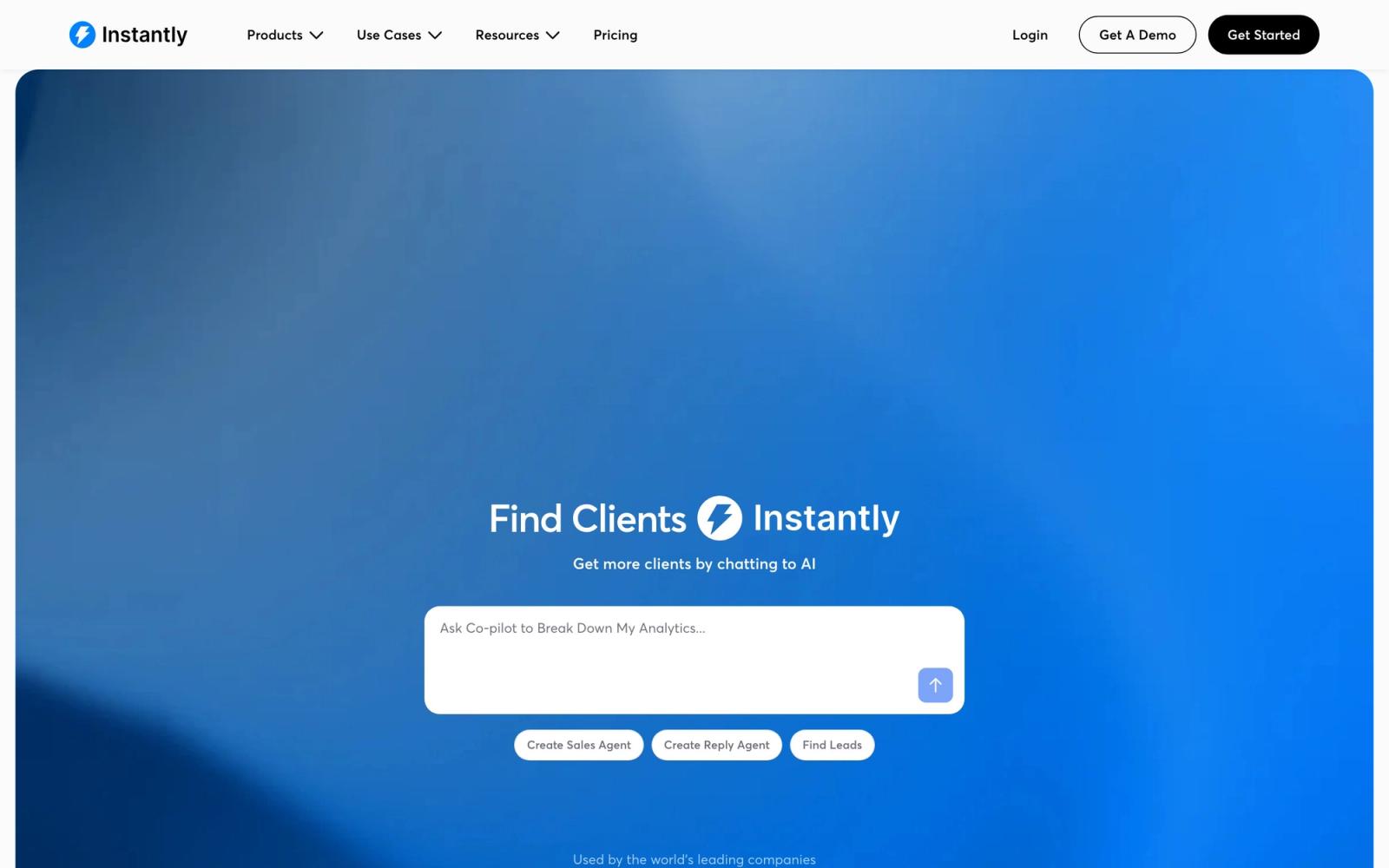
Growth includes unlimited email accounts, unlimited warmup, 1,000 uploaded contacts, 5,000 emails a month, and chat support. Hypergrowth costs $97 a month, raising the ceiling to 25,000 uploaded contacts and 125,000 emails a month, as read on 26 September 2026, with premium live support. Light Speed costs $358 a month and covers 500,000 emails and 100,000 uploaded contacts. It also adds what Instantly calls SISR, its private sending infrastructure for high-volume senders. Lead credits are a separate subscription: Growth Credits cost $47 a month for 1,500 credits against a 450 million-plus B2B leads database, and Hyper Credits cost $197 a month for 10,000 credits, with bundles at $94, $194, and $555 advertised as a 10 percent saving. Instantly's pricing page lists no LinkedIn automation; it is email only.
Instantly at a glance
Pros
- Unlimited email accounts and unlimited warmup on every outreach plan, including Growth at $47 a month
- Light Speed's SISR sending setup is built for teams sending 500,000 emails a month
- Lead credit bundles are sold separately, so light users are not forced to pay for data they do not need
Cons
- No LinkedIn automation listed on the pricing page, so LinkedIn stays a separate tool
- Lead credits are a second subscription on top of the outreach plan, not included in it
Verdict: Instantly is the pick if you have already given up on LinkedIn through Reply.io and just want cheaper, higher-volume cold email with generous mailbox limits. Skip it if you need any LinkedIn channel at all, since there is nothing to add on here the way Reply.io or Snov.io offer.
4. Smartlead: warmup and volume for high-sending email teams
Smartlead's own pricing page, verified September 2026, defaults to yearly billing with a 17 percent off badge. On monthly billing the four tiers are Base at $39, Pro at $94, Unlimited Smart at $174, and Unlimited Prime at $379 a month; the yearly-billed equivalents display as $32, $78, $144, and $315 a month.
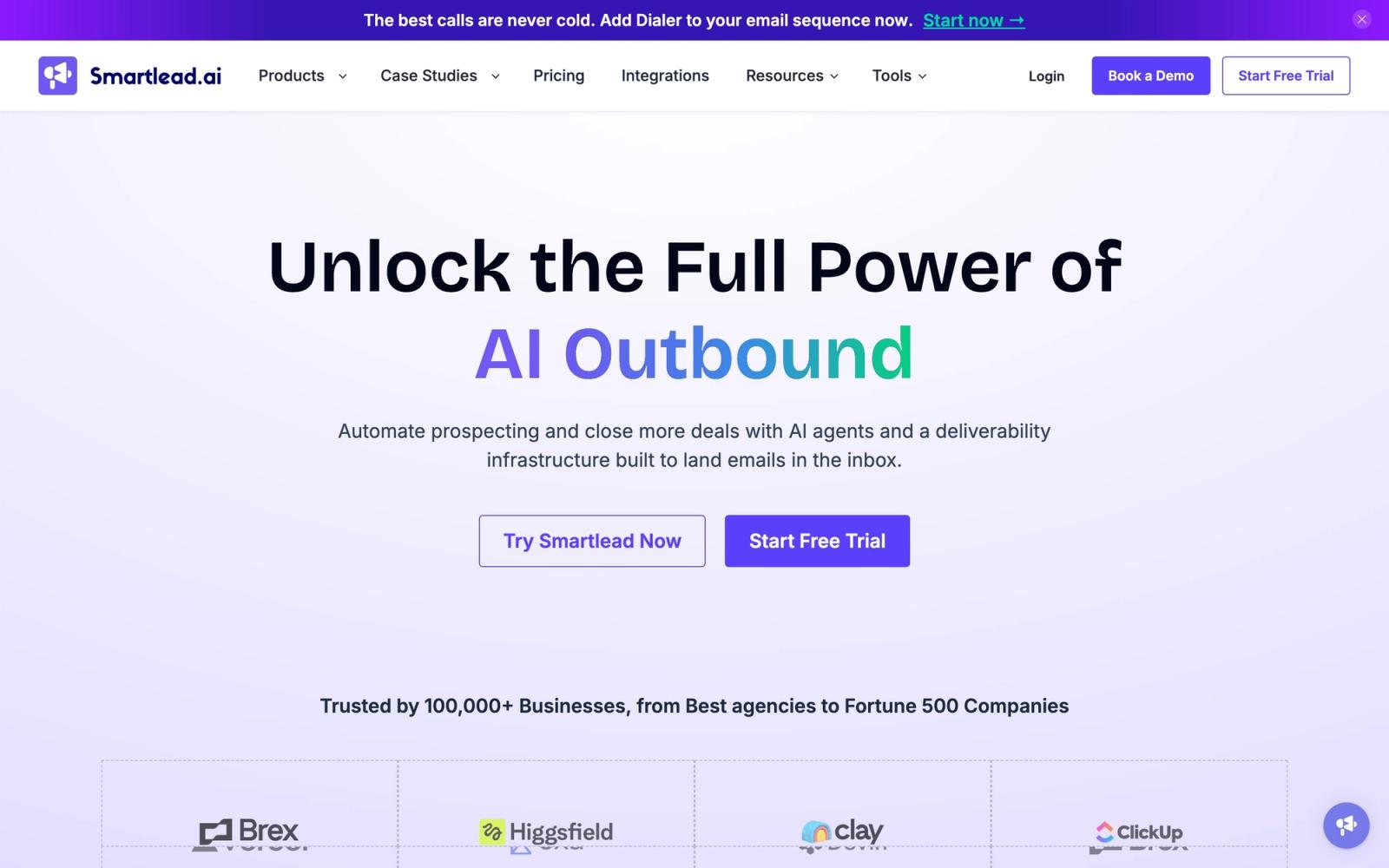
Base includes 2,000 contacts, 6,000 email sends, and 2,000 verified emails a month. Pro raises that to 30,000 contacts, 90,000 sends, and 30,000 verified emails. Unlimited Smart removes the contact cap and allows 150,000 sends with 50,000 verified emails, while Unlimited Prime allows 500,000 sends and 170,000 verified emails across three SmartServers. API and webhook access, CRM access, and client workspaces vary by plan; we are not stating which plan unlocks which without a captured row for each. Mailbox add-ons through SmartSenders run from $3.99 to $9 per mailbox a month. Like Instantly, Smartlead has no native LinkedIn automation; as read on 26 September 2026, LinkedIn reaches it only through HeyReach or Aimfox.
Smartlead at a glance
Pros
- Base plan at $39 a month covers 2,000 contacts and 6,000 sends, undercutting most other entry tiers
- Unlimited Smart and Unlimited Prime remove the contact cap for high-volume senders
- Annual billing drops every tier by roughly 17 percent against the monthly price
Cons
- No LinkedIn automation listed on the pricing page
- Mailbox add-ons through SmartSenders are billed separately from the plan price
Verdict: Smartlead is worth a look if your priority is the cheapest entry price for real sending volume, since Base at $39 a month undercuts most of the other email-only options here. Skip it if LinkedIn matters to your outreach at all, or if you need a bundled contact database, since Smartlead sells sending capacity, not leads.
5. Apollo: cold email, a dialer, and a contact database in one seat
Apollo's Basic plan costs $49 per seat per month billed annually, or $65 on monthly billing, according to Apollo's own pricing page, verified September 2026 with both toggles checked.
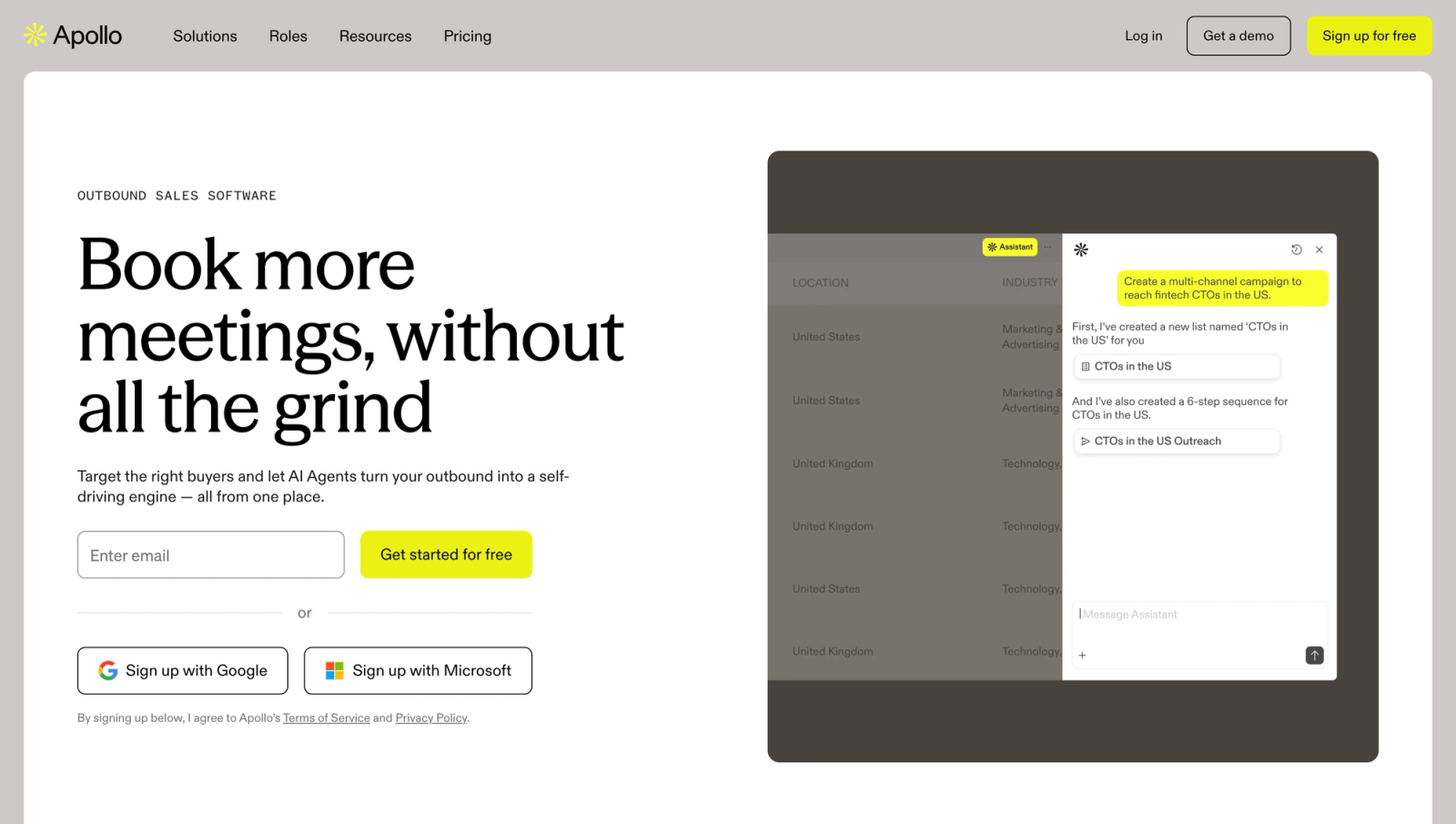
A free plan exists at $0, with 900 credits per seat per year granted monthly, 2 sequences, an AI assistant limited to 5 conversations, and API access. Basic adds 30,000 credits per seat per year, granted upfront on annual or 2,500 a month on monthly billing, unlimited sequences, a deliverability suite with warmup, CRM integrations, waterfall enrichment, 6 intent topics, and 100 website visitor identifications a month. Professional costs $79 annual or $99 monthly, with 48,000 credits per seat per year, agents, A/Z testing, unlimited Gmail and Microsoft mailboxes, automated workflows, and 4,000 minutes of call recordings with AI insights. Organization costs $119 per seat per month billed annually with a 3-seat minimum and 72,000 credits per seat per year; the monthly view shows $149 and only 6,000 credits labeled "annual only," so treat Organization as an annual contract. A phone number uses 8 credits and data enrichment uses up to 9 credits per record; Basic's 30,000 yearly credits work out to roughly 3,750 phone numbers a year. Worked over a year, Basic runs $588 per seat billed annually against $780 if billed monthly, Professional runs $948 versus $1,188, and Organization's 3-seat minimum puts the annual floor at $4,284 before adding a single extra seat. Apollo claims 240 million contacts and 30 million companies, plus an MCP server and a parallel dialer.
Apollo at a glance
Pros
- A free plan exists with 900 credits a year and two sequences, enough to trial the workflow
- Basic and Professional bundle a contact database, dialer credits, and email sequencing in one seat price
- Waterfall enrichment and intent topics are included from the Basic plan up
Cons
- Organization's $119 per seat annual price requires a 3-seat minimum and is annual-only pricing
- No LinkedIn automation listed on the pricing page
Verdict: Apollo suits teams that want a contact database, a dialer, and email sequencing under one seat price instead of stitching Reply.io's live data credits to a separate tool. Skip it if you need LinkedIn automation, since Apollo's pricing page does not list any, or if per-record credit consumption on enrichment and calls makes budgeting harder than a flat seat price. If Apollo's data-first approach is not quite the fit, we cover more options in our Apollo alternatives roundup.
6. Saleshandy: budget cold email with a lead finder built in
Saleshandy's Starter plan costs $34 a month billed annually, or $408 a year, and $41 a month billed monthly, according to Saleshandy's own pricing page, verified September 2026.
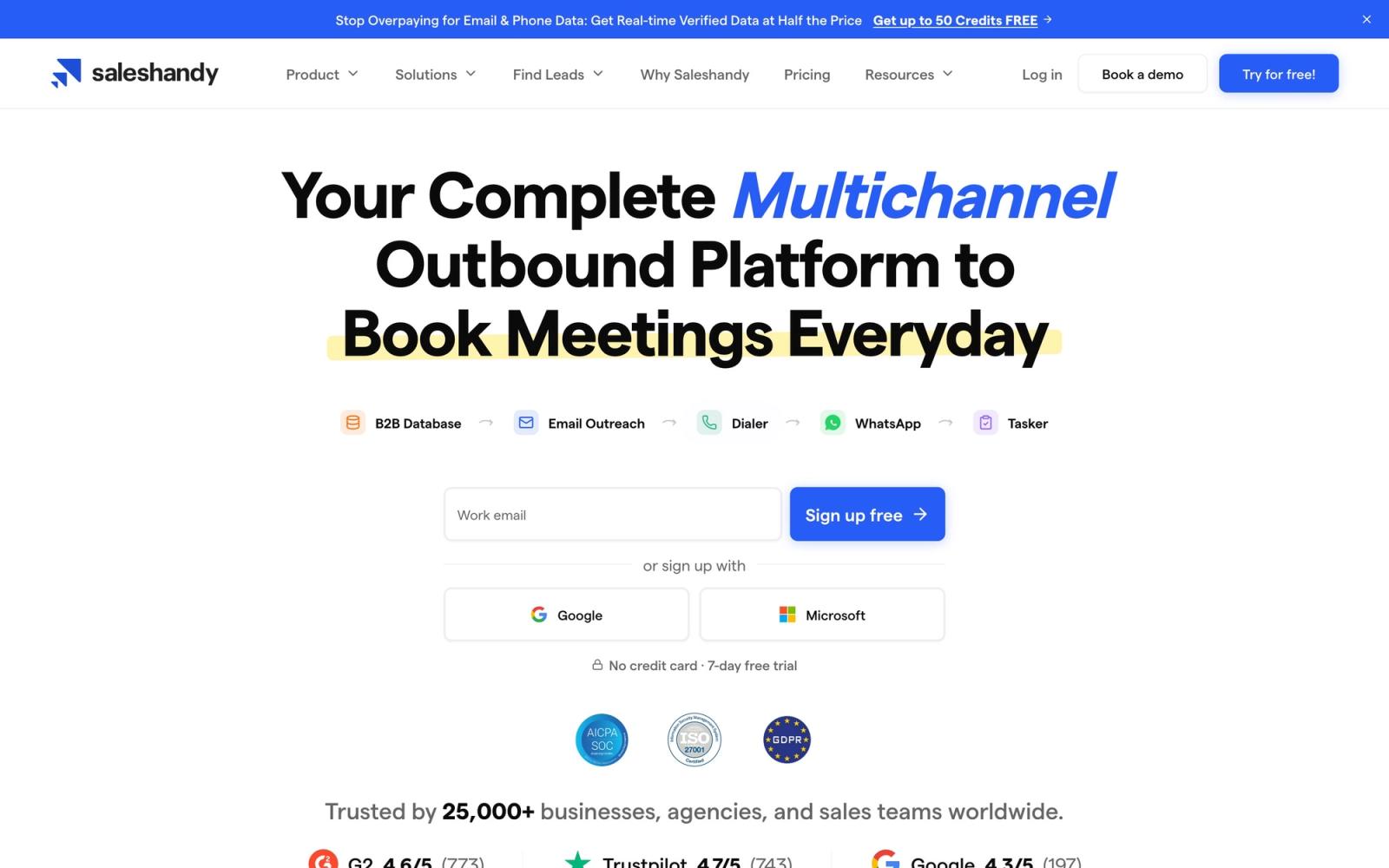
Pro costs $76 a month billed annually and includes 10 users, 30,000 active prospects, 100,000 emails a month, unlimited email accounts, 4,000 lead finder credits a month, and access to a B2B database of 852 million-plus contacts across 42 million-plus companies, alongside API access, an MCP server, and a CLI. Scale costs $149 a month billed annually. On monthly billing, as read on 26 September 2026, Pro costs $99 and Scale $189. Enterprise is custom, with SSO and whitelabel. Extra sending mailboxes start at $3.49 a month, with a 25 mailbox minimum. Multichannel sequences appear as a feature row, and as read on 26 September 2026, LinkedIn on Saleshandy means manual tasks or a relay into HeyReach or Aimfox, not native automation.
Saleshandy at a glance
Pros
- Starter at $34 a month billed annually is one of the cheapest entry tiers in this list
- Pro bundles 852 million-plus contacts, API access, MCP, and a CLI at one price
- Unlimited email accounts on Pro, so connecting your own mailboxes costs nothing extra
Cons
- Monthly billing costs more: Pro is $99 and Scale $189 a month, against $76 and $149 billed annually
- No native LinkedIn automation: LinkedIn runs as manual tasks or a relay into HeyReach or Aimfox
Verdict: Saleshandy is a reasonable pick if budget matters most and you also want lead finder credits bundled in rather than bought as a Reply.io-style add-on. Skip it if you need a confirmed LinkedIn channel, or if you send high enough volume that Pro's 100,000 emails a month becomes a ceiling rather than headroom.
7. Snov.io: the closest match to Reply.io's own add-on pricing
Snov.io's Starter plan costs $39 a month, with Pro S at $99, Pro M at $189, Pro L at $369, and Ultra at $738 a month, according to Snov.io's own pricing page, verified September 2026, with a 25 percent discount advertised on annual subscriptions.
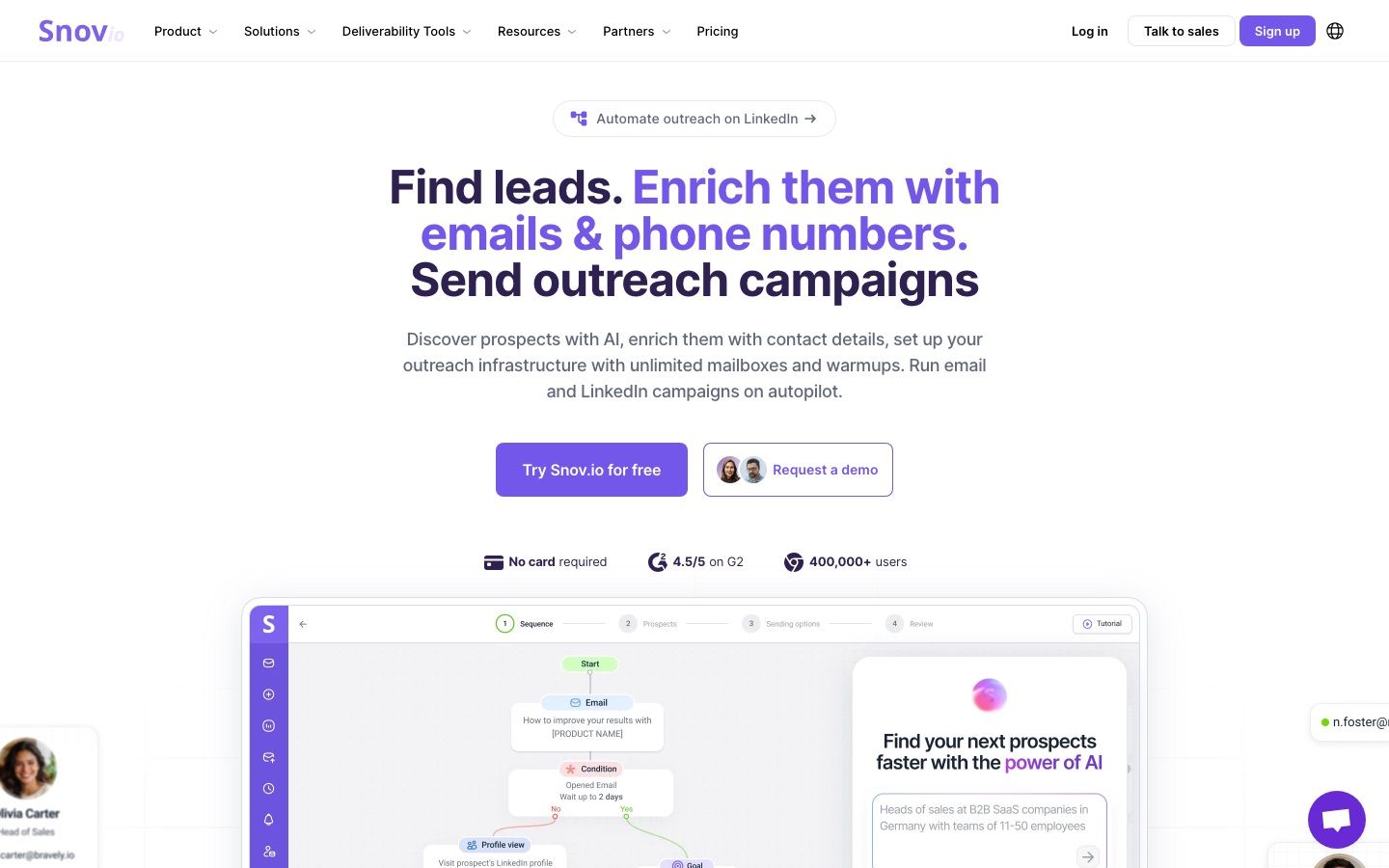
LinkedIn automation is sold separately from the email plans, at $69 per LinkedIn account slot per month on monthly billing, or $62 on a yearly plan, covering messages, InMail, connection requests, follows, and skill endorsements. An MCP server is listed alongside the outreach plans.
$69
Snov.io and Reply.io both list LinkedIn automation at $69 per account per month, verified September 2026
Snov.io at a glance
Pros
- LinkedIn automation actions include messages, InMail, connection requests, follows, and skill endorsements
- Starter plan at $39 a month is cheaper than Reply.io's entry email tier
- MCP server access is listed alongside the outreach plans
Cons
- LinkedIn automation is a separate per-account slot at $69 a month, the same list price Reply.io charges, or $59 with a paid plan as read on 30 September 2026
- The 25 percent discount is only on annual billing, so the monthly prices listed are the higher figures
Verdict: Snov.io mirrors Reply.io's own model most closely, email plans as the base product with LinkedIn sold as its own paid slot at the same $69 monthly list price as Reply.io's add-on, or $59 alongside a paid plan as read on 30 September 2026. The other difference is the base email tier: Snov.io's Starter at $39 a month undercuts Reply.io's Email Volume plan, so combined email plus LinkedIn ends up cheaper on Snov.io. Skip it if the point of switching is to stop paying a LinkedIn add-on at all; Cadency or lemlist, which both build LinkedIn into the price, fit better there.
Reply.io alternatives compared: pricing and channels in 2026
Verified pricing and channel coverage across all seven reply.io alternatives, plus Reply.io itself as the baseline, as published on each vendor's own pricing page in September 2026.
| Tool | Channels | LinkedIn automation | Entry pricing (verified September 2026) |
|---|---|---|---|
| Reply.io | Email, LinkedIn, calls, SMS, WhatsApp | Add-on, $69 per account/month | Email Volume from $49/user/mo annual ($59 monthly); Multichannel from $89/user/mo annual ($99 monthly) |
| Cadency | LinkedIn, email | Native, included | Small Team $199/mo with 5 LinkedIn senders ($139/mo annual) |
| lemlist | Email, LinkedIn, SMS, calls | Included on Multichannel | Email $69/mo ($55 yearly) per workspace for 50,000 emails; Multichannel $109/mo ($87 yearly) per user |
| Instantly | Email only | Not listed | Growth $47/mo, Hypergrowth $97/mo, Light Speed $358/mo |
| Smartlead | Email only | Not native, via HeyReach or Aimfox | Base $39/mo ($32 yearly) |
| Apollo | Email, calls, contact database | Not listed | Basic $49/seat/mo annual ($65 monthly) |
| Saleshandy | Email, lead finder | Manual tasks or a HeyReach or Aimfox relay | Starter $34/mo annual ($41 monthly) |
| Snov.io | Email, LinkedIn | Add-on, $69/slot/month ($62 yearly) | Starter $39/mo |
Two things stand out. Reply.io and Snov.io are the only two vendors here charging separately for LinkedIn, but Reply.io's base email price is high enough that its Multichannel bundle undercuts stacking the add-on. And none of the pure cold-email tools, Instantly, Smartlead, and Saleshandy, runs LinkedIn natively: as read on 26 September 2026, Smartlead reaches LinkedIn only through HeyReach or Aimfox and Saleshandy through manual tasks or the same relay, so switching to them only solves the email side of the bill. For the wider field of email-first tools, see our cold email software roundup.
Which Reply.io alternative should you pick?
The right pick depends on which channel is actually driving your pipeline, not on which tool has the longest feature list.
| If you... | Pick |
|---|---|
| Run several LinkedIn senders and mailboxes as a team, from one campaign and one inbox | Cadency |
| Want LinkedIn and email under one per-user price | lemlist Multichannel |
| Send high email volume and do not need LinkedIn | Instantly or Smartlead |
| Want a contact database and a dialer bundled with email | Apollo |
| Want the cheapest per-seat email with lead finder credits included | Saleshandy |
| Are comparing against Reply.io's own $69 LinkedIn add-on directly | Snov.io |
If your team splits across both channels, there are two ways to stop paying one bundled per-user price for a seat that only uses half of what it is billed for: run both channels from one Cadency campaign, priced by LinkedIn sender rather than by user, or pair a dedicated LinkedIn tool with Instantly or Smartlead for email, which means two inboxes and two bills.
FAQ
Is Reply.io worth it in 2026?
Reply.io is worth it in 2026 for teams that want one platform covering email, LinkedIn, calls, and SMS, and are willing to pay for the Multichannel plan to get all of it in one seat. It gets less worth it when only some seats need LinkedIn or one channel does most of the work: paying from $89 per user per month annually on every seat is a premium price for teams that would rather run LinkedIn and email on Cadency, priced by LinkedIn sender with unlimited teammates, or cold email alone on Instantly or Smartlead.
What is the best Reply.io alternative in 2026?
The best Reply.io alternative in 2026 depends on which channel you actually use. Cadency is the pick for teams running several LinkedIn senders alongside email, with one campaign across every sender and mailbox and no LinkedIn add-on fee. lemlist is the closest like-for-like replacement because its Multichannel plan bundles LinkedIn and email in one per-user price. Instantly and Smartlead are the picks if you have dropped LinkedIn entirely and just want cheaper high-volume cold email.
Who are Reply.io's competitors in 2026?
Reply.io competitors in 2026 span two categories. Cold email platforms like Instantly, Smartlead, Apollo, and Saleshandy compete on price per seat and sending volume. Platforms that build LinkedIn in, like Cadency and lemlist, compete on what Reply.io sells as an add-on: LinkedIn automation. Snov.io sits in between, selling email plans with LinkedIn priced as a separate paid slot much like Reply.io does.
How much does Reply.io pricing cost in 2026?
Reply.io pricing in 2026 starts at $49 per user per month on annual billing, or $59 monthly, for the Email Volume plan with 1,000 active contacts a month. Multichannel, which adds LinkedIn, calls, SMS, and WhatsApp, starts at $89 per user annually or $99 monthly. Adding the LinkedIn automation add-on to Email Volume instead costs $69 per account per month, on top of the base price.
Does Reply.io include LinkedIn automation?
Reply.io does not include LinkedIn automation on its entry Email Volume plan. LinkedIn automation is sold as a $69 per account per month add-on on Email Volume, or bundled into the Multichannel plan starting at $89 per user per month annually. Teams that only need LinkedIn often find it cheaper and simpler to run a dedicated LinkedIn tool instead of paying for email capacity they will not use.
What is the cheapest reply.io alternative for cold email only?
The cheapest Reply.io alternative for cold email only, based on entry-tier pricing verified in September 2026, is Smartlead's Base plan at $39 a month on monthly billing or $32 a month billed yearly. Instantly's Growth plan at $47 a month and Saleshandy's Starter plan at $34 a month billed annually are close behind. None of the three list LinkedIn automation on their pricing pages.
Which reply.io alternative includes a contact database?
Apollo and Saleshandy are the reply.io alternatives that bundle the largest contact databases into the outreach plan itself. Apollo claims 240 million contacts and 30 million companies, with credit-based access starting on its Basic plan. Saleshandy lists 852 million-plus contacts and 42 million-plus companies through its own B2B data, included from the Pro plan. Reply.io itself bundles only 50 live data credits a month into its Email Volume plan, a far smaller allotment than Apollo or Saleshandy provide.
Can I use Cadency and Reply.io together?
Cadency and Reply.io can run side by side, for example with Cadency running your LinkedIn senders while Reply.io keeps handling email once you drop its LinkedIn add-on. Teams do this to avoid paying $69 per account per month for LinkedIn automation while keeping Reply.io for email, although Cadency also sends from Google and Microsoft mailboxes in the same campaign, so both channels can move over together. Neither vendor lists a built-in integration between the two, so moving contacts between them relies on each tool's own API or a manual export.
Is Snov.io's LinkedIn add-on cheaper than Reply.io's?
Snov.io's LinkedIn add-on lists at the same $69 per account per month as Reply.io's, but it can come out cheaper: it drops to $62 on a yearly plan, and as read on snov.io on 30 September 2026, its pricing FAQ takes a further $10 a month off each slot when you also hold a paid plan, which brings it to $59. The other cost difference comes from the base email plan underneath, where Snov.io's Starter tier at $39 a month undercuts Reply.io's Email Volume plan.
Does any Reply.io alternative offer a free trial?
Several Reply.io alternatives here offer a trial, though lengths differ. Reply.io itself offers 14 days, matching lemlist and Apollo. Saleshandy offers 7 days with no credit card required. Instantly and Smartlead do not state a trial length on their pricing pages, so we are not inventing one. Cadency has no trial period: access is private, by request at trycadency.com.
Conclusion
There is no single best Reply.io alternative, because Reply.io itself is really two products stitched together: an email platform with LinkedIn priced as an afterthought. If LinkedIn is the channel that matters, Cadency and lemlist take it seriously instead of billing it as a $69 add-on, and Snov.io at least prices the add-on the same way Reply.io does. If email is the channel that matters, Instantly, Smartlead, and Saleshandy all undercut Reply.io's Email Volume plan, Apollo lands close to the same price, and Apollo and Saleshandy both bundle a far larger contact database than Reply.io's 50 monthly data credits.
Match the tool to the channel doing the actual work, not to the vendor with the longest feature list. A team running LinkedIn as a wedge into email, or vice versa, is usually better served by two focused tools than one bundle charging full price for a channel it barely uses.
If you want LinkedIn and email in one campaign without a per-user bundle or a LinkedIn add-on, Cadency is our pick for teams running several senders. It began as our internal test bed for the Swarmhit engine, the API for developers who build their own outreach product, and was never meant to be public, but we kept it running for the sales teams, recruiters and agencies who asked for it.


