

Picking between Apollo and ZoomInfo is really a question about how you sell, not a hunt for the single best database. Both hold hundreds of millions of B2B contacts, both bolt on AI, and both promise to fill your pipeline. The gaps show up in price, phone-number quality, and what happens after you export the list. This comparison covers published 2026 pricing and the real trade-offs, and it ends with a question most comparisons skip: if your outbound is LinkedIn-led, why are you buying a database and an outreach tool separately at all?
Apollo vs ZoomInfo at a glance
| Apollo | ZoomInfo | Cadency (outreach with data built in) | |
|---|---|---|---|
| Best for | Startups, SMBs, API builders | Enterprise, ABM, cold-calling teams | Sales teams, recruiters and agencies sending volume on LinkedIn and email |
| Entry price | Free; paid from $49/user/mo | No public price; annual contracts, typically five figures | $89 a month with 2 LinkedIn senders, $62 a month on annual billing |
| Database | 240M+ verified contacts | 500M+ profiles, 100M+ companies | Native people and company database, not a data API |
| Data strength | Global mid-market volume | US enterprise depth, direct dials, intent | Waterfall enrichment paid per verified hit, CSV and Sales Navigator imports |
| Execution | Email, call, LinkedIn-assist sequences | Engage module (extra cost) | One campaign across every LinkedIn sender and mailbox, one unified inbox |
| Billing | Self-serve, per seat | Annual contracts, sales-led, seat minimums | Monthly, or 30% off on annual billing; senders included in each plan |
What Is Apollo and Who Is It For?
Apollo is an all-in-one prospecting and engagement workspace: a B2B database it lists at 240M+ verified contacts, 65+ search filters, a Chrome extension that pulls contacts from LinkedIn, and built-in email, call, and LinkedIn-task sequences. Pricing is self-serve and transparent: a free-forever tier, then paid plans at $49, $79, and $119 per user per month billed annually (or $65 and $99 billed monthly on Basic and Professional, while Organization is annual only with a 3-seat minimum, as checked on 30 September 2026), all running on the unified credit system Apollo rolled out in 2026, with API access available on every plan including the free one. It fits startups, SMBs, and mid-market teams running email-led outbound who want one tool for finding and contacting prospects, and its open API makes it the default pick for teams building automations on top of their data.
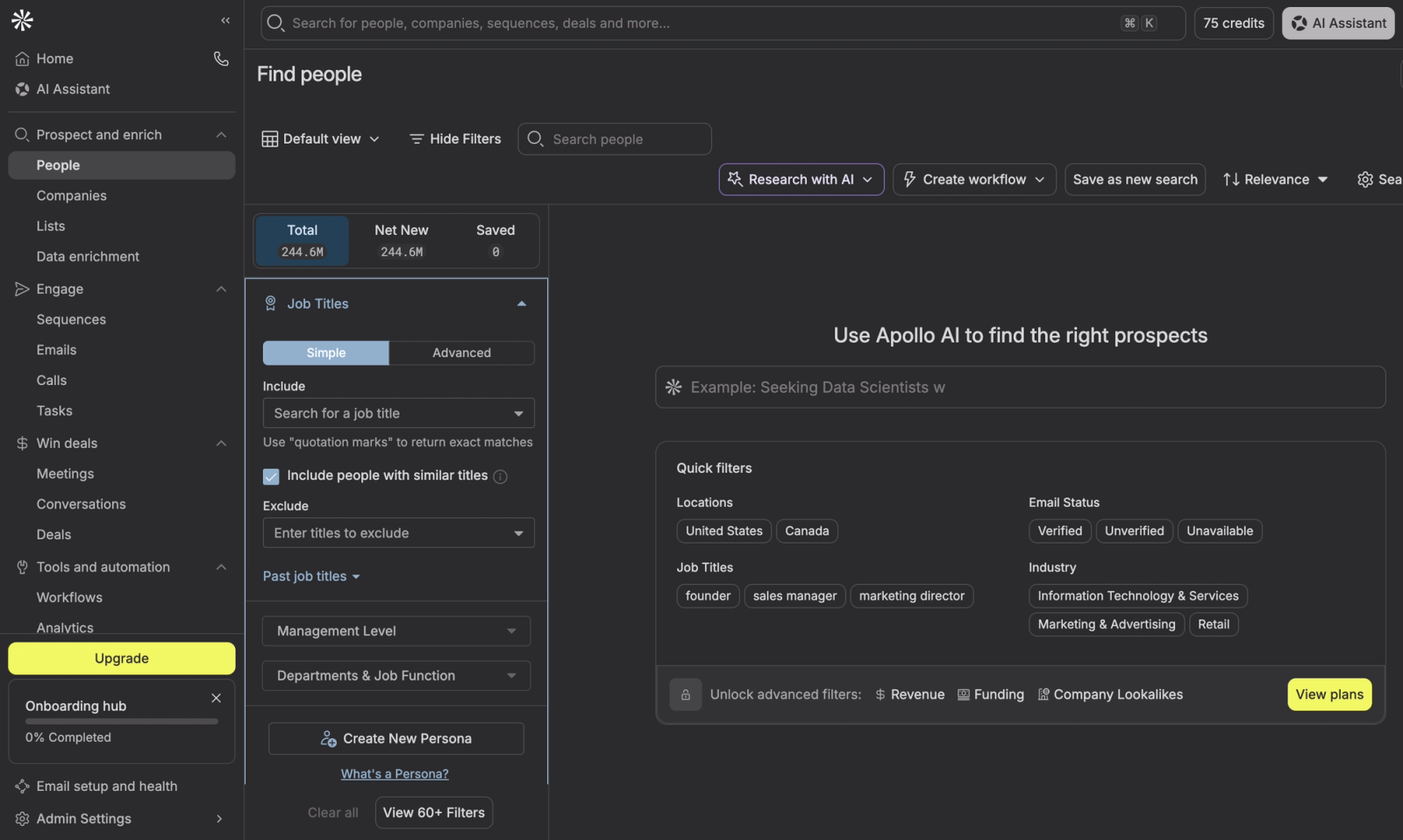
What we found inside Apollo: the Find People screen confirms the scale claim (244.6M total contacts at the time of our screenshot) and the filter builder really is quick to compose, with job title, management level, and department stacking in seconds. You also feel the monetization immediately: a credit counter sits in the header, and revenue, funding, and company-lookalike filters are locked behind a plan upgrade. The free tier is real, but the walls show up early.
What Is ZoomInfo and Who Is It For?
ZoomInfo is the enterprise sales-intelligence incumbent, and its data page now advertises 500M+ professional profiles, 100M+ company records, 135M+ direct dials, and intent signals across 4,500+ topics. There is no public pricing: the pricing page shows three Sales tiers (ZoomInfo Professional, Copilot Advanced, Copilot Enterprise) behind a Get Pricing form, packaging is based on features, licenses, and credit usage per its own FAQ, and its blog states that most paid plans are billed annually upfront. Vendr transaction data, drawn from 1,568 recorded purchases, puts the median contract at $33,500 per year, with deals ranging from about $7,200 to over $155,000, before add-ons like intent packages, extra seats, and API access. It earns that premium with the deepest direct-dial coverage in the market and intent timing, which is why phone-heavy enterprise and ABM teams keep paying.
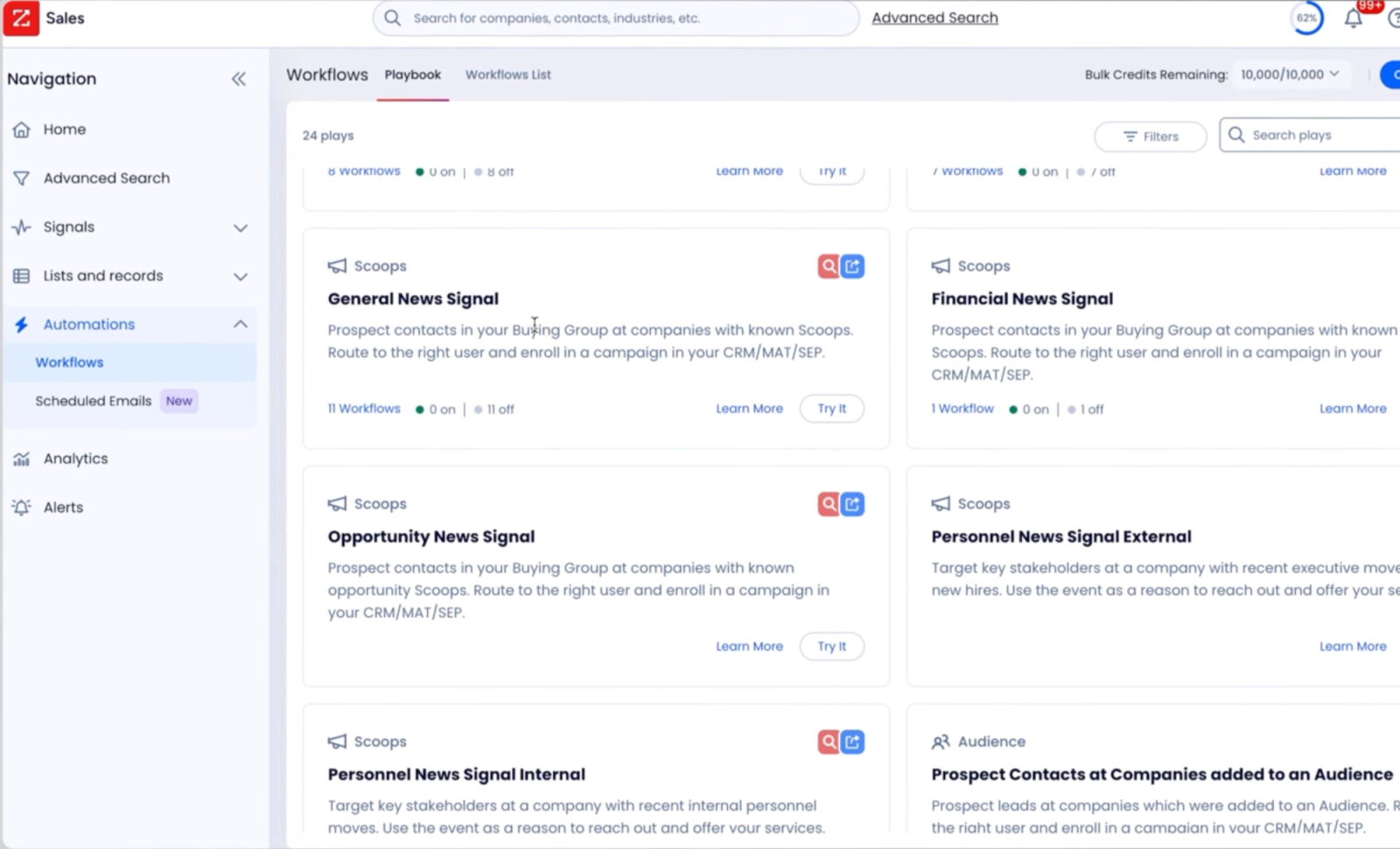
What we found inside ZoomInfo Sales: the Workflows playbook shows where the product's head is, with two dozen prebuilt automation plays triggered by signals (funding news, executive moves, opportunity Scoops) that route contacts into your CRM or sequencer automatically. It feels more operational than Apollo's search-first experience, built for teams that act on events rather than build lists. The bulk-credit meter pinned to the top of the screen is the quiet reminder that every play ultimately consumes the credits you negotiated in the contract.
Apollo vs ZoomInfo: Who Has Better Data Accuracy?
Raw database counts are marketing; tested accuracy is what fills a pipeline. The vendors' own pages make the case for skepticism better than any critic could: Apollo's site currently displays a 91% email accuracy rate on one page and 98% on another, and ZoomInfo's pages disagree with each other on verified emails, 300M+ on the data page against 200M+ on its own comparison blog. To ZoomInfo's credit, its data page also publishes hit rates most vendors hide: 96% for business email, 87% for mobile numbers, and 72% for direct dials. The consistent pattern across independent head-to-head tests and user reports: ZoomInfo leads clearly on phone data, with meaningfully higher direct-dial and mobile match rates, while email deliverability is close between the two, close enough that a standard verification pass before sending erases most of the difference. Job-title accuracy is similar, with a slight ZoomInfo edge. In practice that means one thing: if cold calling drives your revenue, ZoomInfo's phone coverage is the feature you're paying for. If email or LinkedIn drives it, the accuracy argument for the premium mostly disappears.
The part both vendors underplay: every static database decays. U.S. Bureau of Labor Statistics data puts median employee tenure under four years, and roughly a fifth of workers have been in their role a year or less. A "verified" contact exported today can be stale within months, which is the strongest argument for data sources that refresh continuously instead of snapshot exports.
Apollo vs ZoomInfo: What Will You Actually Pay?
Apollo publishes its prices; ZoomInfo doesn't, and that asymmetry tells you most of what you need to know. Apollo works out to roughly $590-$1,430 per seat per year on paid tiers (at the prices we checked on 30 September 2026) with credit allotments bundled in, putting the cost of a usable record somewhere between pennies and a dime. ZoomInfo's five-figure contracts, spread across the credits teams actually consume, put its effective cost per contact at a multiple of that, before extra seats, intent packages, and API access are added to the bill. G2 reviewers who switched report cutting data spend to a fraction of their previous ZoomInfo contract. What they give up is phone depth and intent signals, not list volume.
How does Apollo's new credit system work?
This is the part most comparisons have not caught up with: in 2026 Apollo replaced its old model of separate email, mobile, and export credit pools with one unified credit system, and all new customers land on it. Each seat gets an annual credit grant: 900 on Free, 30,000 on Basic, 48,000 on Professional, and 72,000 on Organization, with the paid grants deposited upfront on annual billing. Everything then draws from that single pool at published rates: revealing an email costs 1 credit, a phone number costs 8, data enrichment runs 1 to 9 credits per record (as read on 30 September 2026), an AI research run costs 1, and the US dialer meters 2 credits per minute.
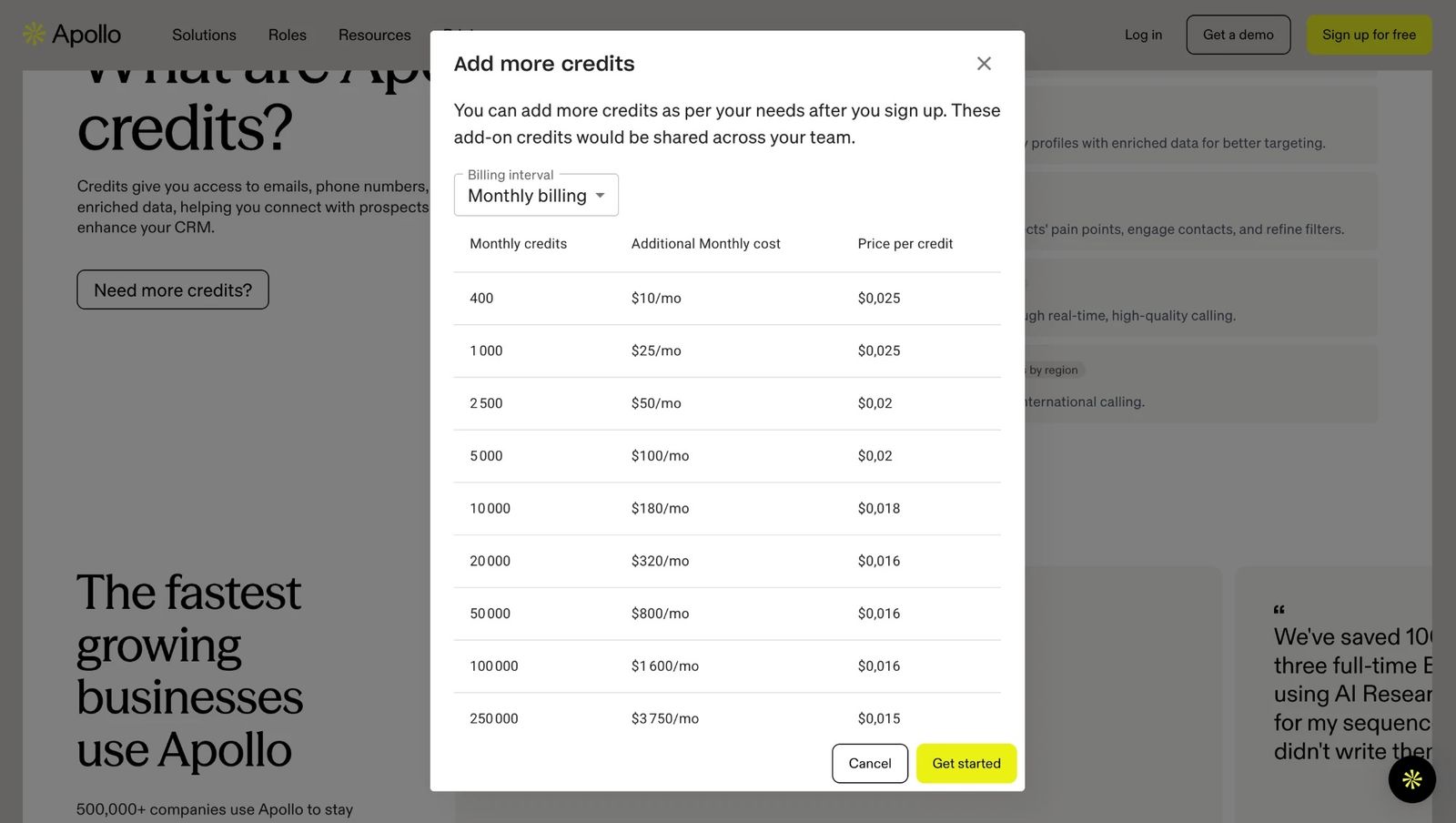
The 8x spread between an email and a phone number is the number to internalize. A Basic seat's 30,000 credits translate to 30,000 email reveals, or only 3,750 phone numbers if you spend the whole pool on dials. Phone-heavy teams burn Apollo credits far faster than the plan pages suggest, which is worth knowing before comparing it to ZoomInfo on price alone. When the grant runs out, extra credits are sold in-app in packs shared across the team, at identical per-credit rates on monthly and annual billing: $0.025 per credit on the smallest packs, stepping down to $0.018 at 10,000, $0.016 at 20,000 to 100,000, and $0.015 at 250,000. At those rates, one email reveal costs 1.5 to 2.5 cents in top-up credits and one phone number, at 8 credits, lands between 12 and 20 cents.
The other per-plan levers hide in the comparison table. Record selection, meaning how many new database records you can grab at a time, is capped at 25 on Free, 1,000 on Basic, 2,500 on Professional, and 10,000 on Organization. Daily email sending is limited to 250 on Free and Basic and unlimited on the two upper tiers. Intent data scales from 1 topic on Free to 6 on Basic and Professional and 12 on Organization. And two fine-print items matter for scaled teams: a fair-use policy caps even unlimited-style plans, and Apollo's standard terms prohibit using the data to power external products or reselling it.
What Do Real Users Say About Apollo and ZoomInfo?
Headline ratings are close: Apollo holds 4.7 on G2 across 9,000+ reviews, while ZoomInfo Sales sits at 4.5 on a similar volume. The interesting part is what repeats underneath the stars, on both sides.
Apollo on G2: recurring themes
Pros
- Ease of use is the #1 theme: reps report being productive within a day
- Targeted list building praised as fast and intuitive (65+ filters)
- Price-to-database ratio: nothing at this price gets close for SMBs
Cons
- Stale records and wrong emails flagged repeatedly, especially smaller companies and niche industries
- European, APAC, and LATAM data inconsistency: outdated titles, invalid phones
- Billing and customer-service friction is a steady complaint
ZoomInfo on G2: recurring themes
Pros
- Direct dials and mobile numbers rated the best in the category
- Intent signals and org charts credited with real meeting lift
- Deep Salesforce and Dynamics integrations praised by enterprise users
Cons
- Auto-renewal is the single loudest complaint: miss the ~60-day cancellation window and you're locked in for another year, often at a higher rate
- Cost and contract rigidity: reviewers describe renewal quotes rising 15-20% year over year
- Its Trustpilot score (1.8) diverges sharply from its G2 score, driven largely by billing and contract disputes
The synthesis: users like both products more than they like paying for them. Apollo's complaints are about data quality at the edges; ZoomInfo's are about the commercial experience wrapped around good data. Neither pattern is a dealbreaker, but both are worth knowing before you sign, and ZoomInfo buyers specifically should calendar the renewal window the day the contract starts.
What If Your Outbound Runs on LinkedIn? Outreach With Data Built In
Here's the structural problem with the whole Apollo vs ZoomInfo debate for a growing set of teams: both are databases first. You pay for records, export a list, and then need a second system to actually run outreach. And if that outreach happens on LinkedIn, a third problem appears, because neither tool executes LinkedIn sequences natively at scale; Apollo's LinkedIn actions are assistive tasks, and ZoomInfo's Engage add-on, sold at extra cost, is built around email and phone (checked 30 September 2026). You end up paying twice: once for the data subscription, once for the outreach platform, and your reps shuttle CSVs between the two while the exported data quietly goes stale.
That's the gap Cadency fills. Built on Swarmhit, it is outreach software with data built in rather than a data API: one campaign runs across every LinkedIn sender and every mailbox, one sender per lead, with every reply in one unified inbox. Around that sit a native people and company database, waterfall enrichment paid per verified hit, and CSV and Sales Navigator imports, so search, enrichment and sending happen in one place, and any CRM connects through the API and webhooks included on every plan. Plans bill monthly, with 30% off on annual billing: Essential is $89 a month with 2 LinkedIn senders included, Small Team is $199 with 5 and Scale is $699 with 20 senders. It is not the cheap route if records are all you need, and if your motion depends on ZoomInfo's direct dials and intent signals or on Apollo's open data API, keep those.
8 LinkedIn steps
profile visit, connection request, message, InMail, comment, voice note, like and follow, run in the same campaign as email
Outreach with the data built in
Search people and companies, enrich through a waterfall paid per verified hit, and run one campaign across every LinkedIn sender and mailbox, with every reply in one inbox.
From $89 a month with 2 LinkedIn senders included.
Apollo or ZoomInfo: Which Should You Pick?
Choose ZoomInfo if cold calling drives your revenue, intent timing is core to your motion, and you have enterprise budget: its direct-dial and mobile coverage is genuinely unmatched. Choose Apollo if you run email-led outbound and want transparent per-seat pricing, a solid API, and an all-in-one find-and-send workflow at a fraction of the cost. Choose Cadency if LinkedIn is your primary channel and you want outreach software rather than another database: the native database, enrichment paid per verified hit and the execution layer (sender rotation with per-sender ceilings, account safety through a dedicated proxy per sender, one unified inbox) live in one platform, from $89 a month with 2 LinkedIn senders included. And you can mix: ZoomInfo for phones or Apollo for email volume, with Cadency running the LinkedIn and email sending.
Apollo and ZoomInfo both stop at the list; Cadency is our answer for what comes after it. It began as our internal test bed for the Swarmhit engine and was never meant to be public, but sales teams, recruiters and agencies asked for it, so we kept it running. Swarmhit itself is the API for developers who build their own outreach product.
The honest trade-offs
Pros
- Apollo: cheapest usable records, open API, self-serve from day one
- ZoomInfo: best phone data and intent signals in the market
- Cadency: LinkedIn and email sending across every sender, with a native database and one inbox
Cons
- Apollo: weaker phone data, LinkedIn actions are assistive only
- ZoomInfo: five-figure entry, annual lock-in, API costs extra
- Cadency: outreach with data built in, not a data API or a cold-calling database; from $89 a month
FAQ
Is Apollo cheaper than ZoomInfo?
Yes, by a wide margin: self-serve from $49/user/month versus quote-only annual contracts that typically run well into five figures. Per usable contact, Apollo costs a fraction of ZoomInfo. ZoomInfo's premium buys phone accuracy and intent data, not cheaper records.
What is the best ZoomInfo alternative?
Depends on the job: Apollo for affordable volume and an API, Cognism for EU coverage, Lusha or RocketReach for basic contact finding. If the goal is LinkedIn outreach rather than a data contract, the last option is not a database at all: Cadency is outreach software with data built in, pairing a native people and company database and enrichment paid per verified hit with the sending engine.
Which B2B contact database is best for LinkedIn outreach?
One that connects directly to execution. Static exports from any provider decay as people change jobs, so the less time a list spends as a CSV, the better. Cadency works that way, as outreach software rather than a data API: its native people and company database, waterfall enrichment paid per verified hit and Sales Navigator imports feed campaigns across every LinkedIn sender and mailbox without CSV round-trips.
Can Cadency replace Apollo or ZoomInfo?
Not as a database: Cadency is outreach software with data built in, not a data API. For LinkedIn-led outbound, its native database, waterfall enrichment and multi-sender execution in one system can replace the export-then-send routine. For phone-heavy motions that live on direct dials, ZoomInfo still owns that niche, and teams that build on Apollo's open data API should keep it; Cadency can run the LinkedIn and email side next to either.
How much does ZoomInfo cost in 2026?
ZoomInfo doesn't publish pricing; its own FAQ says packaging depends on features, licenses, and credit usage, and its blog notes most paid plans are billed annually upfront. Vendr transaction data across 1,568 purchases puts the median at $33,500 per year, ranging from about $7,200 to over $155,000, before add-ons like intent packages, extra seats, and API access. Budget for the renewal too: G2 reviewers report 15-20% year-over-year increases.
Does ZoomInfo have a free trial?
Yes, in a limited form, though paid plans are still demo-and-quote only: ZoomInfo's site carries a free-trial sign-up page, and its blog describes a free ZoomInfo Lite tier with 10 monthly credits (checked 30 September 2026). Apollo has a free-forever tier you can start on today.
Can you use Apollo and ZoomInfo together?
Yes, and many teams do: ZoomInfo for direct dials and intent, Apollo for high-volume list building. The same logic extends to LinkedIn: add Cadency when you want LinkedIn and email run from one campaign across all your senders instead of exporting lists into a generic sequencer.
How does Cadency's data compare with Apollo and ZoomInfo?
Cadency is outreach software, not a data API, so it does not compete on record counts: Apollo lists 240M+ verified contacts and ZoomInfo now advertises 500M+ professional profiles. Cadency's native people and company database, waterfall enrichment paid per verified hit, and CSV and Sales Navigator imports exist to feed campaigns across every LinkedIn sender and mailbox. The commercial model differs too: plans start at $89 a month with 2 LinkedIn senders included, with 30% off on annual billing, instead of a negotiated annual data contract.
Does Apollo or ZoomInfo work for LinkedIn outreach?
Only partially. Apollo's LinkedIn actions are assistive tasks for reps rather than automated sequences, and ZoomInfo doesn't execute outreach at all without its paid Engage add-on, which is email-and-phone focused. Neither runs multi-sender LinkedIn campaigns natively; that's a different tool category.
