

Apollo pricing in 2026 runs across four tiers, and the number you land on depends entirely on which billing toggle you are looking at. Free costs $0 a month. Basic costs $49 per seat per month on annual billing or $65 per seat per month on monthly billing. Professional costs $79 annual or $99 monthly per seat. Organization lists at $119 per seat per month on an annual contract with a 3-seat minimum, and Apollo's own monthly toggle still shows $149 per seat and 6,000 credits marked "annual only," meaning that plan is never actually billed month to month.
Which plan is worth paying for depends on how many contacts, phone numbers and dialer minutes a seat actually burns through in a year, since every Apollo plan is really a credit allowance wrapped around a seat price. The rest of this guide works out exactly what a team of one, three, five or ten seats pays on each plan and each billing period, how Apollo's credits convert into phone numbers, enriched records and dialer minutes, what the Organization plan's "annual only" quirk means for a contract, and what teams reach for once the list Apollo built is ready to turn into outreach.
Apollo pricing in 2026: how much does each plan cost?
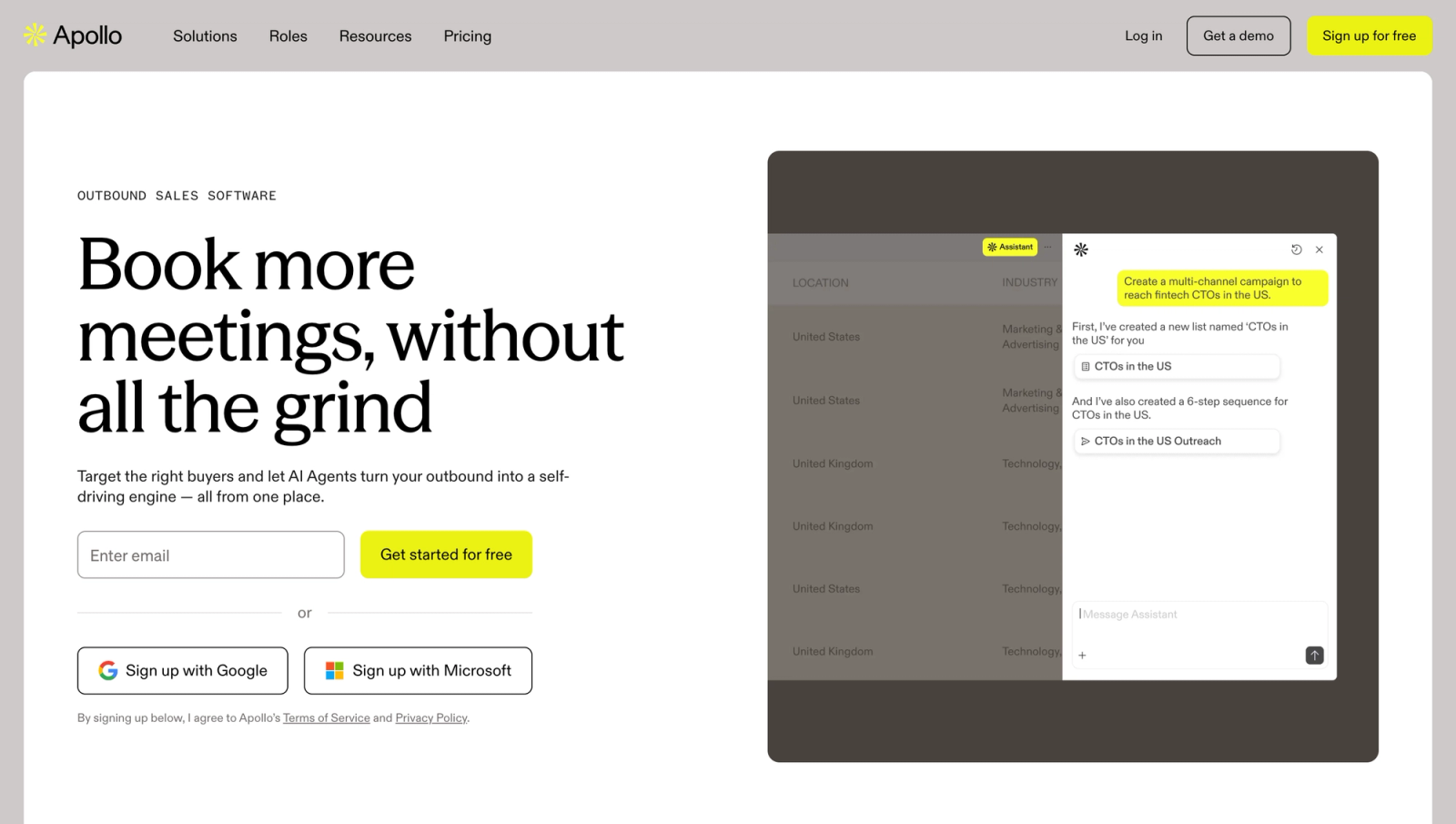
Apollo's pricing page, read with both billing toggles set in September 2026, shows an annual badge advertising "SAVE 24%," and the four tiers work out as follows. Free is $0 a seat, forever. Basic is $49 per seat per month on annual billing, $65 per seat per month on monthly billing. Professional is $79 annual, $99 monthly, per seat. Organization is $119 per seat per month, sold as an annual contract with a 3-seat minimum, and the same page's monthly toggle displays $149 per seat and 6,000 credits with an "annual only" label rather than a real monthly checkout option. It is easy to mix these up: the lower $49 and $79 figures apply only when you pay for the year up front, and paying monthly costs a flat $16 to $20 more per seat every month on both Basic and Professional.
| Plan | Annual billing (per seat/month) | Monthly billing (per seat/month) | Credits per seat/year | Minimum seats |
|---|---|---|---|---|
| Free | $0 | $0 | 900 (75/month) | 1 |
| Basic | $49 | $65 | 30,000 (2,500/month on monthly billing) | 1 |
| Professional | $79 | $99 | 48,000 (4,000/month on monthly billing) | 1 |
| Organization | $119 (annual contract) | $149 (display only, not sold monthly) | 72,000 (monthly display shows 6,000) | 3 |
$49
Apollo Basic, per seat per month on annual billing, as read on Apollo's pricing page in September 2026
Two details in that table are easy to miss on a quick read of the page. First, the credit totals over a year are identical whether you pick annual or monthly billing on Basic and Professional, 30,000 and 48,000 respectively; the difference is only how the credits are handed out, all at once on annual billing or in monthly installments on monthly billing. Second, Organization's $149 monthly figure, paired with 6,000 credits on that same monthly display, is not a real price you can buy: Apollo shows both numbers so you can compare the tiers side by side, but the plan itself only exists as an annual contract, a point we work through in full further down.
How do Apollo credits work?
Apollo credits work as a single pool that every paid action draws from, priced per action rather than per data type: a phone number costs 8 credits, data enrichment costs up to 9 credits per record, and using Apollo's US dialer costs 2 credits per minute, all figures as read on Apollo's pricing page in September 2026. Extra credits can be purchased directly if a seat runs out before the year or month resets.
| Action | Credits per unit |
|---|---|
| Phone number | 8 |
| Data enrichment (up to) | 9 per record |
| US dialer | 2 per minute |
Working the credit allowances against those rates shows how differently each plan behaves once you actually use it. On Basic, 30,000 credits a year divided by 8 credits per phone number gives 3,750 phone numbers a year, or divided by 9 credits per enriched record gives 3,333 records a year with 3 credits left unused, or divided by 2 credits per dialer minute gives 15,000 minutes, which is 250 hours of dialer time across the year. On Professional, the same math against 48,000 credits gives 6,000 phone numbers, 5,333 enriched records, or 400 hours of dialer time. On Organization, 72,000 credits a seat gives 9,000 phone numbers, exactly 8,000 enriched records with none left over, or 600 hours of dialer time. A 3-seat Organization contract, the minimum Apollo will sell, pools 216,000 credits a year across the team, which is 27,000 phone numbers if every credit went toward the phone-number action alone.
The Free plan's 900 credits a year, granted as 75 a month, work out to 112 phone number lookups across the year at 8 credits each, with 4 credits left unused, or 9 phone numbers in any single month if a seat spends the whole monthly grant on that one action.
Run your LinkedIn outreach on Swarmhit
Multi-sender campaigns, safe sending limits and a unified inbox, from $29 per sender per month on annual billing ($39 monthly).
7-day free trial. Cancel anytime.
What does each Apollo plan include?
Apollo's Free plan includes 2 sequences, an AI assistant limited to 5 conversations, API access and website-visitor identification for 20 companies a month, on top of the 900 yearly credits already covered above. Basic adds unlimited sequences, a deliverability suite with email warmup, CRM integrations, waterfall enrichment, 6 intent topics tracked, website-visitor identification for 100 companies a month, and a 14-day trial. Professional layers on top of Basic with AI agents, A/Z testing, unlimited Gmail and Microsoft mailboxes, automated workflows, and call recordings with AI insights covering 4,000 minutes, also on a 14-day trial. Organization adds website-visitor identification up to 50,000 companies a month on top of everything Professional includes.
A few limits sit underneath the feature list rather than inside it, and they matter as much as the headline features; this set of figures was verified against Apollo's pages in August 2026 and nothing on today's pricing page contradicts them. Apollo caps how many contacts a single search or list can select in one pass: 25 on Free, 1,000 on Basic, 2,500 on Professional and 10,000 on Organization. Daily sequence sends are capped at 250 a day on Free and Basic, then go unlimited on Professional and Organization. Intent-topic tracking scales the same way the credit pool does: 1 topic on Free, 6 on both Basic and Professional, and 12 on Organization. Apollo also publishes API access on every plan including Free, gated by its own fair-use rate limits and a no-resale clause in its terms rather than a separate paid API tier, so a developer testing Apollo's API does not need to buy a seat above Free to start.
Apollo's own site is not fully consistent about data quality once you read more than one page: one page states 91 percent email accuracy while another states 98 percent, and the site does not reconcile the two anywhere we could find. Treat "accuracy" as a figure Apollo has not settled on internally rather than a guarantee either number represents, and see our Apollo vs ZoomInfo comparison for how that stacks up against ZoomInfo's own published hit rates. Apollo's platform-wide numbers are more consistent: 240 million contacts across 30 million companies, the same figures on every plan tier since the database itself does not change, only how much of it a seat can pull in a given month.
What does an Apollo team actually pay?
Multiplying the per-seat monthly price by 12 gives the real annual cost of a seat, and multiplying that by the number of seats gives what a team pays, which is worth doing by hand rather than trusting the sticker price alone. On Basic, one seat at $49 a month on annual billing comes to $588 a year ($49 times 12); the same seat on monthly billing at $65 a month comes to $780 a year ($65 times 12), a $192 annual gap for choosing the monthly toggle. On Professional, one seat at $79 a month annual comes to $948 a year; at $99 a month monthly it comes to $1,188 a year, a $240 gap.
| Seats | Basic, annual billing (per year) | Basic, monthly billing (per year) | Professional, annual billing (per year) | Professional, monthly billing (per year) |
|---|---|---|---|---|
| 1 | $588 | $780 | $948 | $1,188 |
| 3 | $1,764 | $2,340 | $2,844 | $3,564 |
| 5 | $2,940 | $3,900 | $4,740 | $5,940 |
| 10 | $5,880 | $7,800 | $9,480 | $11,880 |
Each row in that table is the same multiplication repeated: 3 seats on Basic annual billing is $49 times 12 times 3, which is $1,764; 5 seats is $49 times 12 times 5, which is $2,940; 10 seats is $49 times 12 times 10, which is $5,880. Professional follows the identical pattern at $79 a seat: 3 seats is $2,844, 5 seats is $4,740, 10 seats is $9,480. The gap between annual and monthly billing widens in lockstep with headcount, since it is the same per-seat difference multiplied across every seat on the contract, not a separate team-level penalty.
Is the Apollo Organization plan annual only?
Yes, in the sense that Apollo's own pricing page states it directly: Organization is priced at $119 per seat per month with a 3-seat minimum, sold as an annual contract, and the page's monthly toggle displays $149 per seat and 6,000 credits marked "annual only" rather than offering either figure as a real monthly purchase option. Read literally, that label means Apollo built the monthly view so buyers can compare Organization against Basic and Professional on the same $-per-seat-per-month basis, without actually selling Organization month to month at any price.
The 3-seat minimum sets a real floor on what an Organization contract costs before you add a single extra seat: 3 seats times $119 a month times 12 months comes to $4,284 a year, the smallest amount Apollo will invoice for this tier. Adding seats scales from there in the same straight line as the tables above: 5 seats is $119 times 12 times 5, which is $7,140 a year; 10 seats is $119 times 12 times 10, which is $14,280 a year.
| Seats on Organization | Annual contract total |
|---|---|
| 3 (minimum) | $4,284 |
| 5 | $7,140 |
| 10 | $14,280 |
Is Apollo worth it in 2026?
Apollo is worth it once the credits a plan grants comfortably cover what a seat actually uses in a year, which turns the decision into a math question rather than a feature-list comparison. A Basic seat's 3,750 phone-number-equivalent credits a year works out to roughly 10 phone numbers a day across a 365-day year, plenty for an individual seller running targeted outbound but tight for anyone dialing at volume; a team that regularly burns through more than that before the year resets is already paying for credits it does not have, since extra credits are a separate purchase rather than something a lower tier absorbs quietly.
The billing-period decision is simpler once the annual gap is in front of you: choosing monthly billing over annual costs $192 a year per Basic seat and $240 a year per Professional seat, purely for the flexibility of not committing for twelve months. That is worth paying if a team expects to cancel or downsize inside the year; it is money left on the table if the team already knows it will renew.
Where Apollo is a weaker fit is anyone whose actual bottleneck is not seats or credits but the reliability of the data itself, given the 91-versus-98-percent accuracy split Apollo's own pages do not reconcile. A team that has already hit that wall is better served comparing options directly; our Apollo alternatives roundup and our Clay alternatives guide both cover vendors built around a different data model, multi-provider waterfalls on Clay's side rather than one owned database, which changes the accuracy conversation entirely.
Apollo free plan: what do you get?
Apollo's free plan gives a seat 900 credits a year, granted as 75 a month, alongside 2 sequences, an AI assistant capped at 5 conversations, API access and website-visitor identification for 20 companies a month, all at $0. Worked against the 8-credit phone-number rate, that is enough for 112 phone number lookups across the year, or roughly 9 in any single month if the whole monthly grant goes toward that one action, with the search-selection cap set at 25 contacts per list and daily sequence sends capped at 250, both figures verified in August 2026.
That is a real starting point for testing whether Apollo's data and workflow fit before paying for a seat, not a plan built to run outbound at any real volume. The 2-sequence and 25-contact-selection ceiling means Free suits evaluating the product or working a very small, hand-picked list, and a seat that needs more than a couple of hundred contacts a month, more than a handful of enrichment pulls, or more than 20 identified website visitors a month has already outgrown it and is comparing against Basic's $49 to $65 a seat instead.
Apollo at a glance
Pros
- Credits are granted upfront on annual billing rather than trickled out monthly
- API access ships on every plan including Free, gated by fair-use limits rather than a separate paid tier
- A single 240-million-contact, 30-million-company database sits behind every tier, so the underlying data does not change as you upgrade
Cons
- Organization only sells as an annual contract with a 3-seat minimum, so its $149 monthly figure is not a real price
- Paying monthly instead of annually costs $192 to $240 more a year per seat on Basic and Professional
- Apollo's own pages disagree on email accuracy, quoting both 91 percent and 98 percent without reconciling the two
After Apollo builds the list, who runs the outreach?
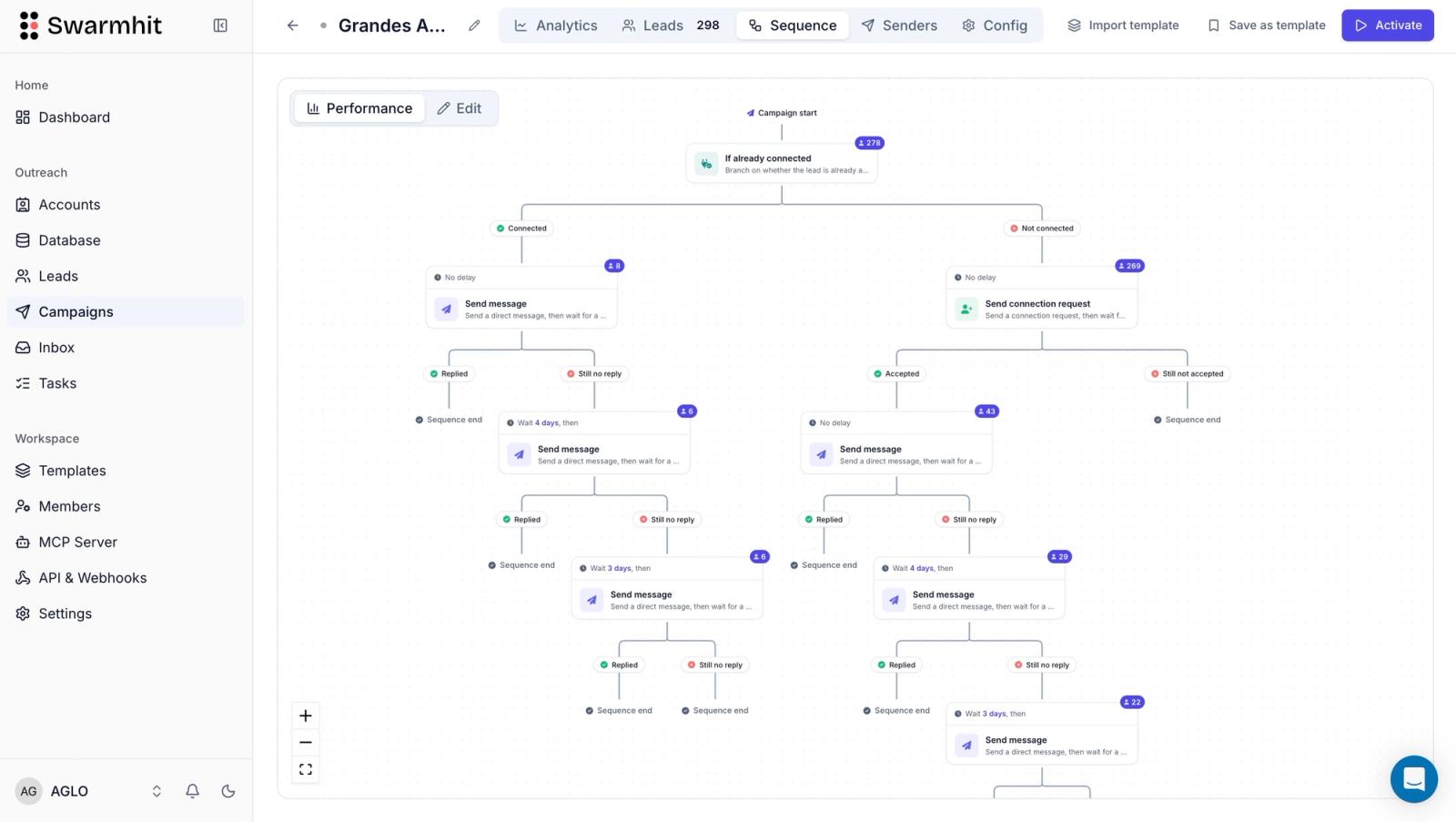
Apollo and Swarmhit solve different problems, and the difference is worth stating plainly rather than blurring: Apollo is a contact database and sequencing tool for building and enriching a list, while Swarmhit is the execution layer that runs LinkedIn outreach once that list exists. Swarmhit is not another data provider competing on credits or contact counts; it imports a list a seat already has, then runs connection requests, messages and InMails across multiple connected LinkedIn accounts inside one campaign, rotating sends across senders rather than working one identity at a time.
That execution layer runs on LinkedIn accounts the customer already owns and connects, capped at 2,500 profiles a day from Sales Navigator search and 1,000 a day from standard search per connected account, limits Swarmhit enforces on its own rather than numbers LinkedIn publishes; see LinkedIn's own help page on invitation limits and restrictions for the layer LinkedIn does state publicly. Every sender carries a dedicated proxy, managed auto-warmup, health checks and smart caps, with 250+ safeguards monitored around the clock, and replies land in one shared inbox with assignment and interest tags rather than scattered across however many LinkedIn accounts a team runs. CRM connectivity runs through API, webhooks and MCP rather than a built-in two-way sync, which keeps Swarmhit focused on the outreach layer instead of trying to be a CRM itself.
Pricing follows the same pay-as-you-go shape as the credit systems above, just measured in senders instead of contact credits: from $29 per sender per month on annual billing ($39 monthly). Larger fleets and agencies that need branded reporting are quoted on a call. For a fuller view of where this category sits next to other LinkedIn automation tools, see our LinkedIn automation tools roundup, our note on whether LinkedIn automation is safe, our guide to LinkedIn connection limits, our Sales Navigator alternatives comparison, and our broader list of LinkedIn prospecting tools.
FAQ
Is Apollo pricing based on seats or contacts?
Apollo pricing is charged per seat, not per contact. Each seat on Basic, Professional or Organization gets its own yearly credit allowance, from 30,000 to 72,000, that it draws down as it enriches records, pulls phone numbers or uses the dialer, but the seat price itself, $49 to $119 a month on annual billing, does not change based on how large the contact list is.
What happens to unused Apollo credits at the end of the year?
Apollo's pricing page does not state a rollover policy for unused annual credits, so we are not going to guess one here. What is documented is the allowance itself: 30,000 a year on Basic, 48,000 on Professional and 72,000 on Organization, granted upfront on annual billing or in monthly installments on monthly billing, with extra credits available as a separate purchase if a seat runs out early.
Is Apollo worth it for a small team?
Apollo is worth it for a small team once its members' combined phone number, enrichment and dialer usage fits comfortably inside the credits a plan grants, since a 3-seat Basic team pools 90,000 credits a year, enough for roughly 11,250 phone numbers if that were the only action used. It is a weaker fit if the team needs Organization's higher selection caps but cannot meet its 3-seat minimum.
Does Apollo charge extra for API access?
No, Apollo includes API access on every plan, including Free, rather than gating it behind a separate paid tier, a structure verified in August 2026. Access is governed by Apollo's own fair-use rate limits and a no-resale clause in its terms, so a developer evaluating the API can start on the $0 Free plan before deciding whether a paid seat's higher credit allowance is worth it for production use.
Can you buy extra Apollo credits without upgrading a plan?
Yes, Apollo's own pricing page states that extra credits can be purchased directly, separate from upgrading to a higher tier. That matters for a seat that occasionally spikes past its monthly or yearly allowance, since a one-time credit purchase avoids paying for a permanently larger seat price just to cover a single busy month.
Is the Apollo free plan enough to start prospecting?
Apollo's free plan is enough to evaluate the product on a small, hand-picked list, with 900 credits a year, 2 sequences and a 25-contact selection cap per list, but it is not built for real prospecting volume. A seat regularly working more than a couple of hundred contacts a month, or wanting more than 20 identified website visitors a month, has already outgrown Free and is comparing against Basic's $49 to $65 a seat instead.
How does the Apollo Organization plan pricing actually work?
Apollo's Organization plan is priced at $119 per seat per month, sold only as an annual contract with a 3-seat minimum, so the smallest possible commitment is $4,284 a year, three seats times $119 times 12 months. The plan's monthly toggle displays $149 per seat and 6,000 credits marked "annual only," both shown for comparison against the other tiers rather than offered as a real monthly purchase.
What is the difference between Apollo credits and Apollo's dialer minutes?
Apollo credits are the single pool every paid action draws from, while dialer minutes are just one of the actions priced against that pool, at 2 credits per minute on the US dialer. A seat's yearly credits, 30,000 on Basic for example, convert to 15,000 dialer minutes if spent entirely on calling, or to a mix of phone-number pulls at 8 credits each and enrichment at up to 9 credits per record if split across actions instead.
Is apollo.io pricing the same everywhere it gets quoted?
Apollo.io pricing is only ever correct straight from Apollo's own pricing page, and even reading it correctly takes care: the annual toggle shows $49 and $79 for Basic and Professional, while the monthly toggle shows the true monthly prices of $65 and $99, a gap of $16 to $20 a seat that is easy to miss on a quick skim. Any number that does not match one of those two toggles is out of date.
Do phone numbers and enriched records cost the same number of Apollo credits?
No, phone numbers and enriched records are priced differently on Apollo's credit system. A phone number costs a flat 8 credits, while data enrichment costs up to 9 credits per record, a difference that adds up: a Professional seat's 48,000 yearly credits convert to 6,000 phone numbers if spent one way or 5,333 enriched records if spent the other, not the same total either way.
Conclusion
Apollo's 2026 pricing is straightforward once the annual-versus-monthly gap is in front of you: Free at $0, Basic at $49 to $65 a seat, Professional at $79 to $99, and Organization at $119 a seat on a 3-seat-minimum annual contract that starts at $4,284 a year. The credit system underneath scales in the same clean multiples, 900 a year on Free up to 72,000 on Organization, and the same 8-credits-per-phone-number, up-to-9-per-record and 2-per-dialer-minute rates apply no matter which tier grants the credits.
Buy Basic if a seat's real usage sits comfortably under a few thousand phone numbers or enrichment pulls a year and the deliverability suite and CRM integrations matter. Buy Professional once automated workflows, unlimited mailboxes and call-recording insights earn their $30-a-seat premium over Basic. Buy Organization only once a team can commit three seats to an annual contract and needs the higher selection caps and 12 intent topics that come with it. And once the list Apollo built is ready to turn into LinkedIn outreach, that is a different job with a different tool built for it.

