

Waalaxy is a Chrome extension for LinkedIn prospecting, built around a library of prebuilt campaign templates instead of a sequence builder. This Waalaxy review is for the reader deciding whether the low entry price is worth the trade-offs: Pro starts at €19 a month for 300 invitations, and the ceiling shows up fast once you want logic the templates don't cover.
It's a solid on-ramp for a single rep sending a modest volume from one LinkedIn account, and a poor fit the moment a team needs more than one sender, a shared inbox, or campaign logic beyond invite-then-message. We looked at the tiers, the extension model and the paid inbox add-on to see exactly where that ceiling sits.
Waalaxy review 2026: what is it, and who is it for?

Waalaxy is a Chrome extension that automates LinkedIn prospecting from inside your browser: connection invitations, follow-up messages and, on the top tier, email. It positions itself as the easy entry point into LinkedIn automation, and on its own site it claims over 200,000 users, a claim we can only attribute to Waalaxy rather than verify independently.
The product is built for one kind of buyer: a solo founder, freelancer or independent rep who wants a first LinkedIn campaign live in an afternoon, without configuring daily caps, IP settings or a sequence builder from scratch. You install the extension, log into LinkedIn as normal, pick a template, add a list, and Waalaxy runs the sequence while your browser session stays active.
That simplicity is genuinely the product's strength. It also draws a hard line around who it's for. A team running outreach from three or five LinkedIn accounts, or an agency managing client profiles, will find Waalaxy's per-seat pricing and lack of sender rotation turn into an operational headache well before the invite quota does. For a single account sending a few hundred invitations a month, none of that friction shows up yet. Our wider LinkedIn automation tools roundup covers where Waalaxy sits against the rest of the category.
What can you actually build inside a Waalaxy campaign?
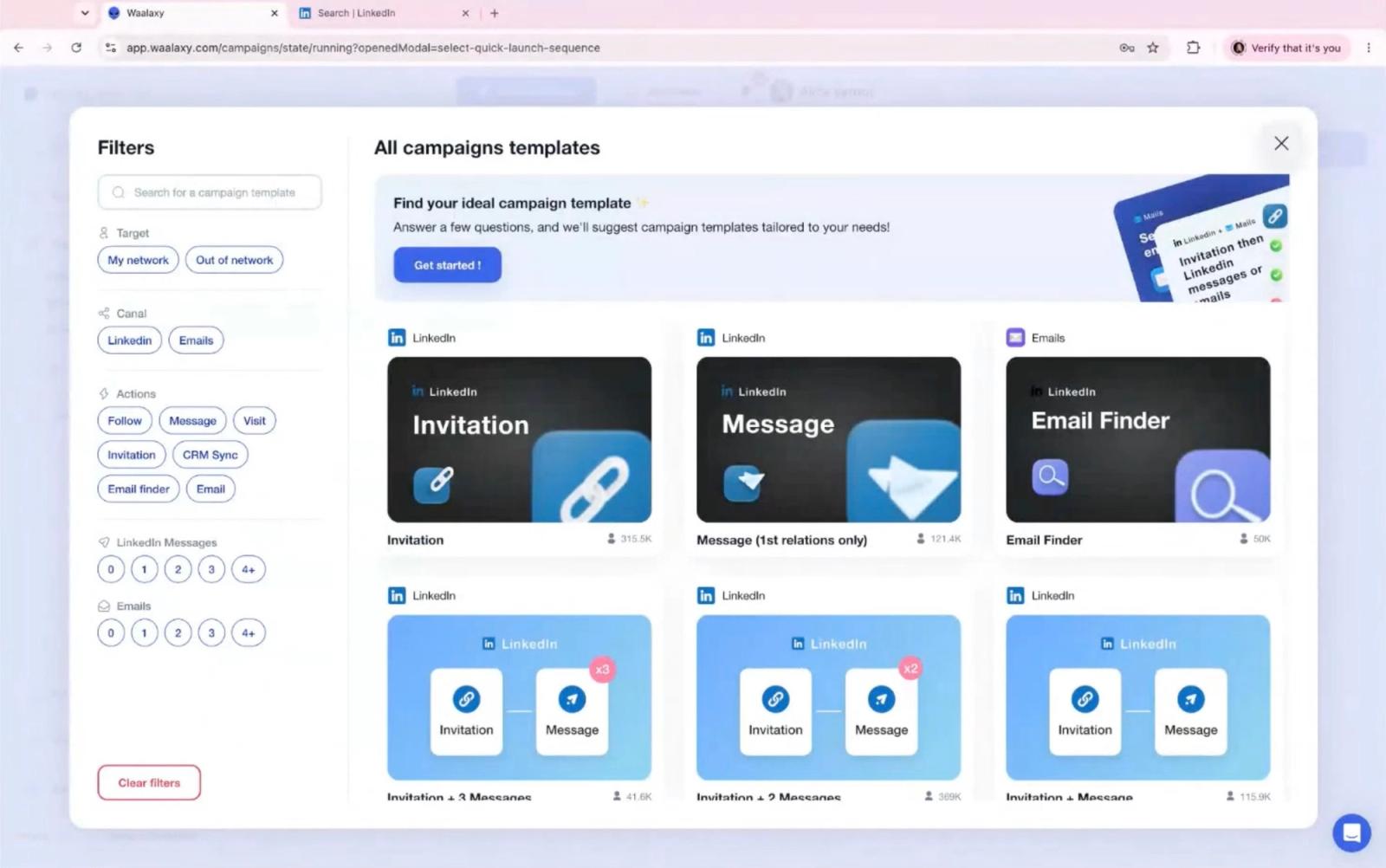
Campaign creation in Waalaxy means choosing from a list of prebuilt templates rather than drawing your own sequence. Ready-made options cover the classic flows: send an invitation, follow up with a message if it's accepted, find an email address, and so on. That library is the fastest route to a first live campaign in the category, and it is also the ceiling: if your outreach logic differs from the closest template, you're working around the tool rather than with it.
Invitation volume is metered by tier, not by account health. Pro allows 300 invitations a month, which works out to roughly 10 a day averaged across a month. Advanced and Business both raise that to 800 a month, closer to 26 a day. Pro also bundles unlimited campaigns, automatic follow-ups, CRM sync and a feature Waalaxy calls team prospecting. Advanced adds API access and modules for Make, Zapier and n8n, useful if you're already piping LinkedIn data into another workflow tool such as ours for n8n or Make. Business keeps the same 800-invitation cap as Advanced but adds cold email sequences and a larger monthly allotment of email finder credits.
Laid out side by side, the gap between what Advanced and Business actually unlock becomes clearer than the invitation count alone suggests.
| Feature | Pro | Advanced | Business |
|---|---|---|---|
| Invitations a month | 300 | 800 | 800 |
| API access | Not included | Included | Included |
| Make, Zapier, n8n modules | Not included | Included | Included |
| Cold email sequences | Not included | Not included | Included |
| Email finder credits a month | Not listed | 25 | 500 |
| Support response time | 48 hours | 4 hours | Priority |
That table is the clearest evidence that the jump from Advanced to Business isn't about sending more LinkedIn invitations at all; it's a bet on whether you also want cold email in the same tool.
Run your LinkedIn outreach on Swarmhit
Multi-sender campaigns, safe sending limits and a unified inbox, from $29 per sender per month on annual billing.
7-day free trial. Cancel anytime.
How does the extension, the inbox add-on and integrations work?
Waalaxy runs as a Chrome extension rather than a cloud service, which means campaigns execute from your own browser and IP while the extension is active. That architecture keeps setup simple, since there's no dedicated server or proxy to configure, but it also means the tool's activity pattern is tied to your machine and your normal LinkedIn session rather than to infrastructure built specifically to look consistent over time.
The unified inbox that most competitors bundle into a base plan is a separate paid add-on on Waalaxy, though the page doesn't display its price and offers 500 free conversations to try it. Once enabled, it covers reply templates, scheduled follow-ups, tags and CRM export. Support response times scale with the tier you're on: 48 hours on Pro, 4 hours on Advanced, and priority handling on Business. Practically, what that add-on changes is whether replies live inside Waalaxy at all: without it, a reply is just a LinkedIn notification like any other, and without it you're back to checking LinkedIn's own message list rather than a queue with tags and assignment. The 500 free conversations are enough to judge whether that workflow is worth paying for before you commit to it.
Email finder credits work the same way as a gate rather than a raw quota difference. Advanced includes 25 a month, which covers a handful of manual lookups on the leads that matter most; Business jumps to 500, which is closer to what you'd need to run email finding across an entire invitation list rather than a shortlist. If your outreach is LinkedIn-only and you don't plan to chase email addresses at volume, that 500-credit jump is not a reason to pay for Business on its own; the cold email sequences are the actual product you're buying at that tier.
Import options are one of the more useful parts of the setup: Waalaxy pulls lead lists from a standard LinkedIn search, from Sales Navigator, and from Recruiter Lite, so you're not limited to LinkedIn's free-tier search results if you already pay for Sales Navigator elsewhere. Integrations lean on the Make, Zapier and n8n modules available from Advanced up, plus the CRM sync that comes with the plan. Full plan details and the current toggle prices are on Waalaxy's own pricing page.
What does Waalaxy pricing look like in 2026?
For this Waalaxy review, the pricing detail that matters most is how the tiers gate volume, not just the sticker price. Waalaxy runs three paid tiers, billed per user, after a 14-day free trial. As of September 2026, Waalaxy's own pricing page shows figures in the visitor's local currency; ours displayed in euros, so that's what we quote below rather than converting ourselves.
| Tier | Monthly | Quarterly (minus 20 percent) | Yearly (minus 50 percent) | Invitations a month |
|---|---|---|---|---|
| Pro | €19 | €15.20 | €9.50 | 300 |
| Advanced | €49 | €39.20 | €24.50 | 800 |
| Business | €69 | €55.20 | €34.50 | 800, plus cold email |
What do the quarterly and yearly discounts actually cost per tier?
The yearly discount is steep, cutting the monthly-equivalent price in half compared with paying month to month. On Pro, quarterly billing brings the effective monthly rate from €19 down to €15.20, a 20 percent cut, and yearly billing takes it down to €9.50, a 50 percent cut against the monthly sticker price. Advanced follows the same arithmetic: €49 monthly becomes €39.20 on quarterly and €24.50 on yearly. Business runs €69 monthly, €55.20 on quarterly, and €34.50 on yearly. Because none of the three tiers change what they include based on billing cadence, the only real decision on the toggle is cash flow: pay quarterly or yearly if you're confident you'll stay on the tool, since the annual price effectively buys six months for the cost of twelve.
Run the invite quota against the sticker price and the unit economics get more interesting than the headline numbers suggest. On monthly billing, Pro's €19 for 300 invitations works out to about €0.06 per invitation sent. Advanced's €49 for 800 invitations lands at almost exactly the same €0.06, so the jump from Pro to Advanced barely changes the cost per invite; what you're actually paying for is API access and the automation modules. Business keeps the same 800-invitation cap as Advanced for €69, which pushes the cost per invitation up to roughly €0.09, since the extra €20 buys cold email and more email finder credits rather than more LinkedIn volume. Switch to annual billing and the same math roughly halves again: Pro's €9.50 a month for 300 invitations is about €0.032 per invite, Advanced's €24.50 for 800 is about €0.031, and Business's €34.50 for 800 is about €0.043. Annual billing is the single biggest lever on cost per invitation, well above whichever tier you pick.
Which Waalaxy tier fits which team size?
For exactly one LinkedIn account sending a modest, steady volume, Pro at €19 a month is enough: 300 invitations a month covers roughly 10 a day, and the CRM sync and ready-made sequences handle the basics without paying for API access you won't use. Once you want to pipe leads or replies into another tool through Make, Zapier or n8n, or you're bumping against the 300-invitation ceiling, Advanced is the natural step up, still on one account. Business only earns its price if cold email is genuinely part of your outreach mix; if you're LinkedIn-only, the extra €20 a month over Advanced buys email finder credits and a feature you won't touch.
Past one account, the tier ladder stops being the relevant question. On the Pro, Advanced and Business plans this review covers, Waalaxy is priced and built one LinkedIn account per seat with no rotation between them, so running outreach from three accounts means three separate seats, three separate quotas and three separate inboxes to check, rather than one workspace coordinating all of them. That's the point where the per-seat model, not the per-invitation price, becomes the real cost, and it's the threshold where a team typically starts pricing multi-sender platforms instead.
Waalaxy at a glance
Pros
- Lowest entry price among mainstream cloud-adjacent LinkedIn tools, at €19 a month
- Fastest route to a first live campaign, thanks to the prebuilt template library
- Steep quarterly and yearly discounts, annual billing halves the monthly rate
- Sales Navigator and Recruiter Lite list imports built in
Cons
- No custom sequence builder, only a choice of prebuilt templates
- Priced and built one LinkedIn account per seat, with no rotation across senders
- Unified inbox is a separate paid add-on, not included in the base price
- Runs through a Chrome extension rather than dedicated cloud infrastructure
Is Waalaxy safe?
Running as a browser extension changes what "safe" means for Waalaxy compared with a cloud-based tool. Because the extension executes from inside your own Chrome session, uptime depends on your machine staying on and the browser staying open with the extension active, unlike a cloud platform that keeps sending from a server regardless of whether your laptop is asleep. Waalaxy does enforce monthly invitation quotas by tier, which puts a ceiling on volume, but a monthly quota is a billing construct, not a per-day safety system: nothing in the pricing page describes per-account daily caps, dedicated IP infrastructure, or automated warm-up for new accounts, the kind of controls that manage detection risk on a day-to-day basis.
No LinkedIn automation tool, Waalaxy included, can make automation entirely risk-free, because the detection question ultimately depends on LinkedIn's own enforcement rather than any vendor's claims. LinkedIn's own help center confirms it enforces invitation limits and can restrict accounts that send at a pace or pattern it flags as automated, without publishing the exact threshold. What differs between third-party tools is the depth of the safety layer sitting under the sequence: extension-based tools generally offer less infrastructure control than cloud platforms with a dedicated IP and managed warm-up per account. Our guide to is LinkedIn automation safe breaks down what actually drives restrictions, and our rundown of LinkedIn Chrome extensions covers how the extension architecture compares with cloud-based alternatives across the category. If you want the weekly invitation math behind the quota numbers, our guide to LinkedIn connection limits lays it out, and our piece on what happens when a LinkedIn account gets restricted covers the recovery side.
Is there an alternative to Waalaxy?
Every honest Waalaxy review has to answer this question directly: Waalaxy and Swarmhit solve different problems. Waalaxy is priced and built for one person running one LinkedIn account through prebuilt templates; Swarmhit is built for teams and agencies that need to run outreach across multiple senders from one workspace. Where Waalaxy sequences are picked from a template list, Swarmhit gives you a visual sequence builder with branching on connection status and replies, plus native LinkedIn actions including voice notes, post comments and InMail. Where Waalaxy's unified inbox is a paid add-on tied to one account at a time, Swarmhit includes a unified inbox with assignment and interest tags across every connected sender as standard.
On infrastructure, Swarmhit runs a dedicated proxy per sender with managed auto-warmup, health checks and smart caps, backed by 250+ safeguards monitored around the clock, standard on every plan rather than something you configure yourself. AI personalization reads each prospect's profile, posts and company news, rather than filling in template variables. Swarmhit also ships a built-in database of 1B+ contacts across 60M companies, refreshed weekly and sourced through third-party data providers, with free monthly credits and pay-as-you-go beyond that, plus imports from Sales Navigator searches. Account-based scraping runs only through accounts the customer owns and connects, capped at 2,500 profiles a day from Sales Navigator search and 1,000 a day from standard search. CRM connectivity runs through API, webhooks and an MCP server rather than a native two-way sync.
Swarmhit is priced from $29 per sender per month on annual billing ($39 monthly), pay as you go per sender, and the per-sender rate drops sharply with volume; larger fleets and agencies get custom pricing scoped on a call, with a white-label inbox and reports available. Managed senders are available as a paid add-on for teams that don't want to connect their own accounts. Where Waalaxy still wins outright is entry price for exactly one account: if you're one person sending a couple hundred invitations a month, Waalaxy's €19 tier is cheaper and the templates are enough. For a side-by-side breakdown of both tools feature by feature, see our Waalaxy comparison, and for the wider field of tools that solve the same multi-sender problem, our Waalaxy competitors roundup covers eight more options at different price points.
FAQ
How much does Waalaxy cost in 2026?
Waalaxy runs a 14-day free trial, then three paid tiers billed per user: Pro at €19 a month, Advanced at €49, and Business at €69, all on Waalaxy's own pricing page as of September 2026. Quarterly billing takes 20 percent off those figures and yearly billing takes 50 percent off. Invitation quotas run from 300 a month on Pro to 800 on Advanced and Business, and cold email only arrives on Business.
Is Waalaxy worth it in 2026?
It depends entirely on how many LinkedIn accounts you're running. For one person sending a modest, steady volume from a single account, Waalaxy's low entry price and prebuilt templates make it a reasonable first tool. For a team managing several senders or client accounts, the per-seat pricing, lack of rotation and add-on inbox tend to cost more in workaround time than the subscription saves, and a multi-sender platform becomes worth the higher price.
Is Waalaxy safe in 2026?
Waalaxy enforces monthly invitation quotas by tier, which limits total volume, but it runs through a Chrome extension rather than dedicated cloud infrastructure with a per-account proxy and managed warm-up. No LinkedIn automation tool can guarantee an account will never be restricted, since that ultimately depends on LinkedIn's own enforcement, but the depth of the safety infrastructure under a tool varies a lot, and extension-based architecture generally offers less of it than cloud platforms built around dedicated IPs and warm-up.
Does Waalaxy have a free trial?
Yes. Waalaxy offers a 14-day free trial rather than a permanent free plan, after which you land on one of the three paid tiers. The unified inbox is a separate item, with 500 free conversations offered so you can try it before deciding whether to add it to your subscription.
Can you build custom sequences in Waalaxy?
No, not in the sense of branching logic. Campaigns are assembled by picking the closest match from a library of prebuilt templates, such as an invitation followed by a conditional message. That covers the common flows quickly but doesn't let you design a sequence with your own if-then branches the way a dedicated sequence builder does.
Does Waalaxy support multiple LinkedIn accounts?
On the Pro, Advanced and Business plans, Waalaxy is priced and built one LinkedIn account per seat, with no automatic rotation of a single campaign across several senders. Running outreach from multiple accounts on these plans means running multiple separate seats, each with its own campaigns, quota and inbox, rather than one workspace coordinating all of them.
Is the Waalaxy inbox included in the price?
Not by default. The unified LinkedIn inbox with reply templates, scheduled follow-ups, tags and CRM export is a paid add-on layered on top of the Pro, Advanced or Business subscription, though Waalaxy offers 500 free conversations so you can test it before paying for it.
Conclusion
The short version of this Waalaxy review: it earns its reputation as the easiest, cheapest way into LinkedIn automation. Install the extension, pick a template, launch a campaign the same afternoon, all starting at €19 a month. The trade-offs are the honest cost of that simplicity: invite quotas gated by tier rather than account health, no custom sequence logic, a paid inbox add-on, and an architecture that runs from your own browser rather than dedicated infrastructure.
If you're one person testing LinkedIn outreach on a single account, that trade is worth making, and Waalaxy's own G2 badge shows a 4.5 rating, for what a vendor-displayed score is worth. If you're coordinating outreach across more than one sender, need a shared inbox, or want sequence logic the templates don't cover, that's the point to look at a platform built for multiple senders from the start rather than working around a per-seat ceiling.


