

HeyReach is a cloud-based LinkedIn automation platform built for agencies and teams running more than one sender: automatic rotation across a pool of accounts, one unified inbox for every reply, and an API, webhooks and an MCP server on every plan. In this HeyReach review, the short answer is that Growth costs $79 per sender per month on monthly billing, the Agency tier flattens to $999 a month for 25 senders, and Unlimited runs $2,999 a month for unlimited senders.
We read every figure below live on HeyReach's own pricing page in September 2026, and flagged the one number the current page does not restate, the per-sender rate at ten senders, as our August 2026 tracking rather than a fresh read. If you are choosing between HeyReach and a per-sender alternative, the comparison is sharpest between one and twenty five senders, which is where most agencies and multi-account teams actually sit.
HeyReach review 2026: what is it, and who is it for?
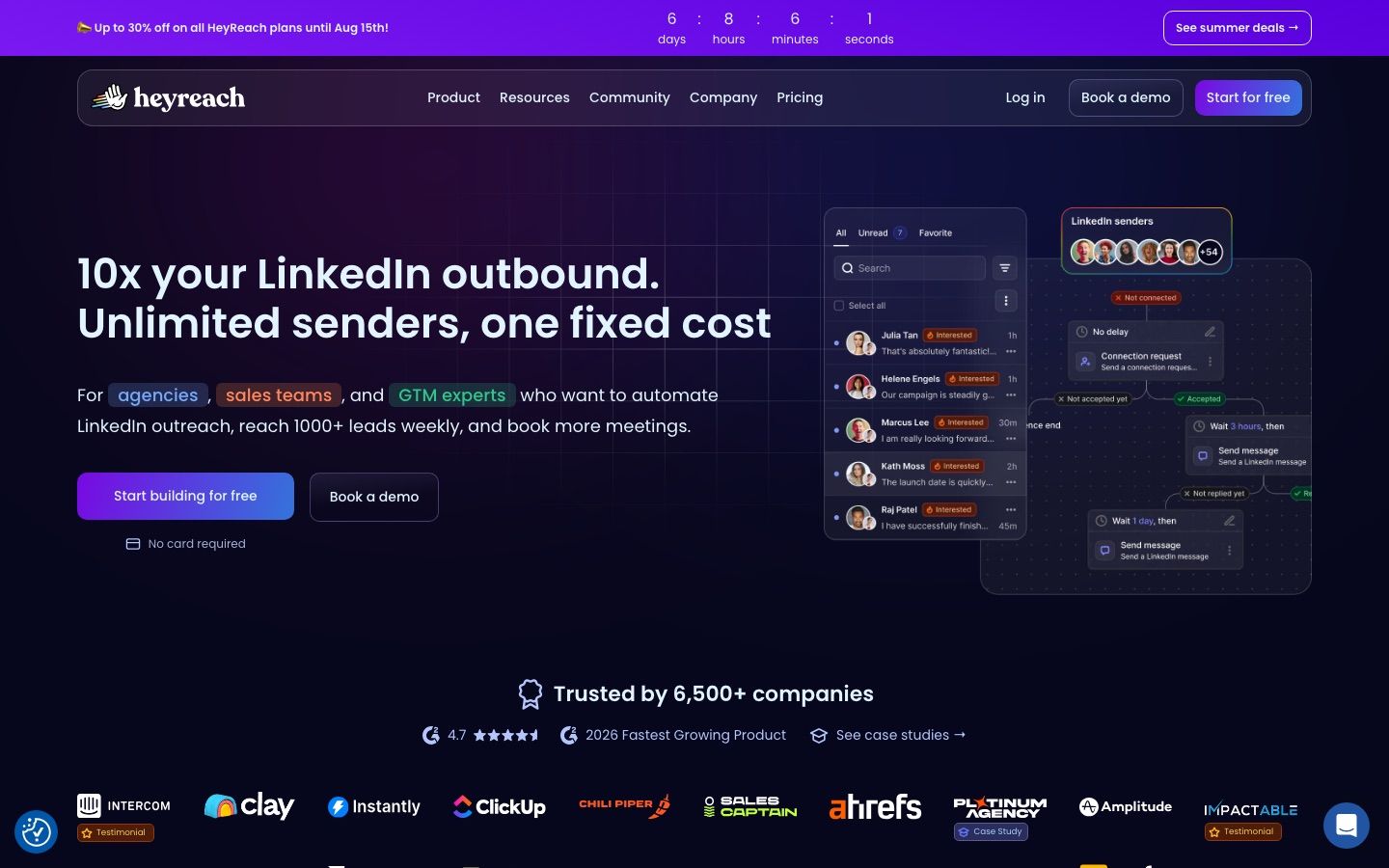
HeyReach is LinkedIn automation software built around one idea: many senders, one campaign, one inbox, priced per sender rather than per user. Every plan carries unlimited campaigns, the full set of LinkedIn actions, multichannel outreach, and integrations, so the plan you pick decides sender pricing and enrichment credits more than which features you can touch.
The product sits inside the broader field of LinkedIn automation tools, and what sets it apart there is that it charges by sender rather than by seat, so onboarding a teammate, a VA or a client login costs nothing extra as long as you are not adding another LinkedIn account. That model is why HeyReach shows up on so many agency shortlists: a five-person team running three senders pays for three senders, not five logins.
Who it suits is specific. An agency or in-house team already running several LinkedIn accounts, comfortable sourcing prospect lists from Sales Navigator or a data vendor, and wanting one inbox and one API to build reporting around, is the target buyer. A solo rep running a single account will pay $79 a month for infrastructure built to coordinate a fleet, which is a reasonable price for one sender only if the unified inbox and API matter more than the sticker.
How do HeyReach's multi-sender campaigns and unified inbox work?
A single HeyReach campaign rotates its sending volume across every connected sender in the pool, so no one account carries the full daily load, and every reply from every sender lands in one shared inbox rather than in separate logins. That is the core of the product, and every plan, including the $79 Growth tier, includes it.
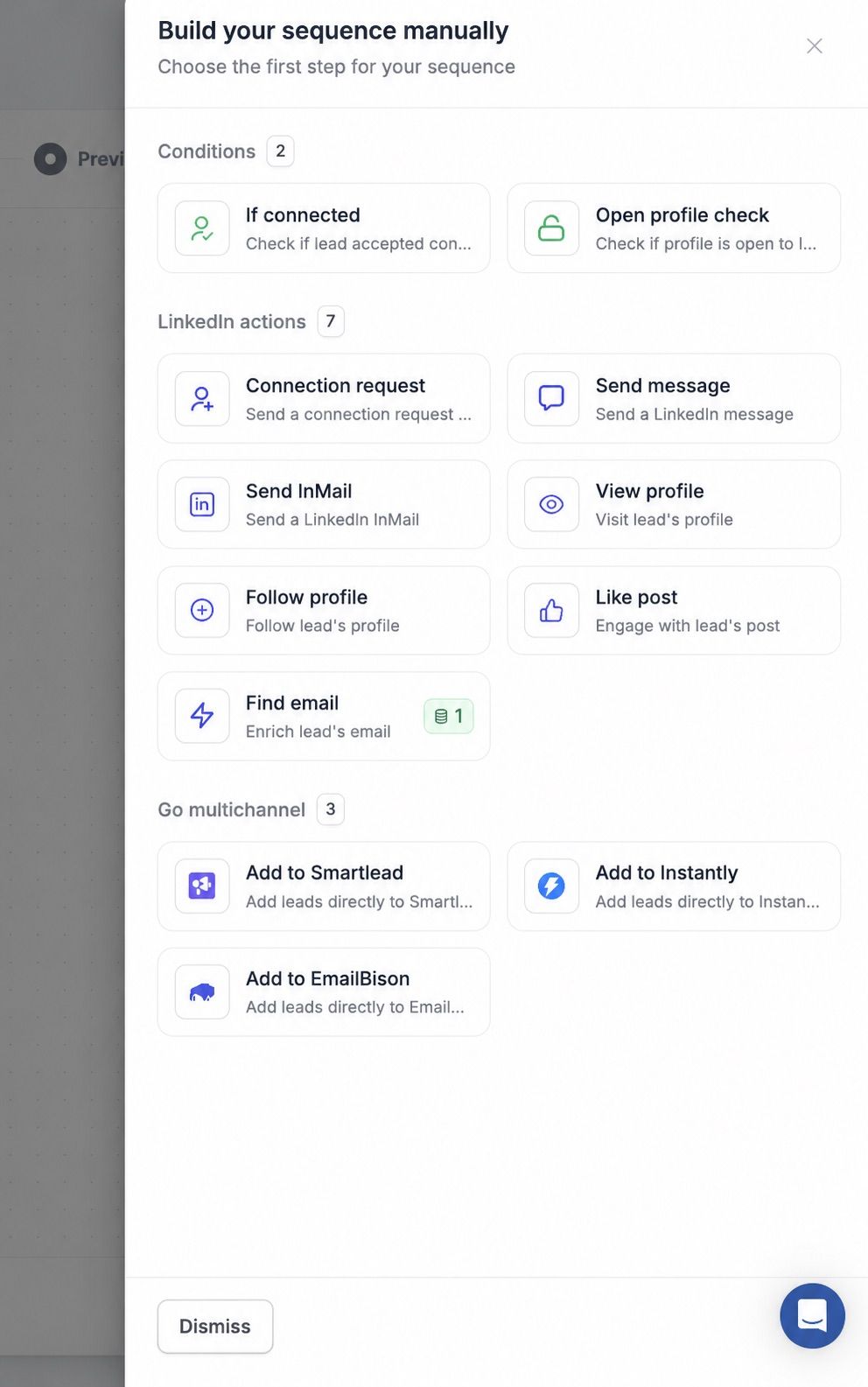
The sequence builder mixes native LinkedIn steps, connection requests, messages, InMail and finding a prospect's email, with conditional branching, and, as the screenshot above shows, blocks that hand a lead off to a separate email sending platform such as Smartlead, Instantly or EmailBison rather than sending email from inside HeyReach itself. That is the trade-off behind "multichannel outreach" on the plan list: LinkedIn is native, email is a handoff, so a true email and LinkedIn sequence needs a second subscription and a second inbox to reconcile against the first.
The unified inbox itself is the feature agencies mention most. Replies across every sender show up in one place, with the context an operator needs to respond without switching accounts, which matters once a campaign spans more senders than one person can log into in a day.
Run your LinkedIn outreach on Swarmhit
Multi-sender campaigns, safe sending limits and a unified inbox, from $29 per sender per month on annual billing.
7-day free trial. Cancel anytime.
Does HeyReach connect through API, webhooks and MCP?
Yes, and this is one of the few places HeyReach does not gate by plan: an API, webhooks and an MCP server ship on Growth, the entry tier, not just on Agency or Unlimited.
That matters for a specific kind of buyer, an agency or RevOps team that wants campaign events, reply data and enrichment results flowing into a CRM or a reporting workspace automatically rather than through manual export. Our deeper walkthrough of HeyReach's API covers the endpoints and webhook events in more detail, and if you are evaluating how an MCP server fits into an AI-agent workflow rather than a traditional integration, our guide to LinkedIn MCP servers explains what that layer actually does.
Shipping API, webhooks and MCP on the cheapest plan, rather than reserving developer access for the top tier the way some competitors do, is a genuine point in HeyReach's favor, and one worth weighing against the per-sender price if programmatic access is part of your evaluation.
In practice, the three pieces cover different jobs. The API is for pulling and pushing data on demand, senders, campaigns, leads and enrichment results, which is what an agency uses to build a client-facing dashboard outside HeyReach's own interface. Webhooks push events the moment they happen, a reply, a connection accepted, an enrichment finishing, which is the piece that keeps a CRM or a Slack channel current without anyone checking HeyReach directly. The MCP server is the newest of the three and the one built for AI agents rather than human-built integrations: it lets an AI-agent LinkedIn outreach workflow read and act on HeyReach data through natural-language tool calls instead of custom API code. An agency running fifty client workspaces is the buyer who gets the most out of all three at once; a single operator running one or two senders will use the API rarely, if at all.
What do HeyReach's enrichment credits include?
HeyReach bundles enrichment credits by plan rather than a searchable prospect database: 100 credits per sender on Growth, 1,000 on Agency, and 3,000 on Unlimited.
Credits enrich records you already hold, for example filling in a verified email or extra firmographic detail on a lead already inside a campaign, rather than letting you search a database of new prospects from scratch. Every audience still starts outside HeyReach, in Sales Navigator or a data provider, and moves in as a list or a CSV import. For teams evaluating LinkedIn prospecting tools as a category, that distinction, enrichment credits versus a built-in database, is worth checking on every vendor's pricing page before assuming "credits" means "data included".
The allowance scales with the plan, not with how many leads you are actually enriching. On Growth, 100 credits per sender means a ten-sender workspace holds 1,000 credits total, the same headline number Agency lists as a flat allowance regardless of how many of its 25 senders you are running. Unlimited's 3,000 credits look generous until you remember the plan has no sender ceiling to divide them across, so a large Unlimited workspace can burn through its monthly allowance faster than a small one on Growth. None of this is a criticism of the model, credit-based enrichment is common across the category, but it is a line item worth estimating against your actual campaign volume before comparing sticker prices across plans.
HeyReach pricing in 2026: how much does it cost?
HeyReach runs three published tiers, Growth priced per sender, Agency at a flat fee for 25 senders, and Unlimited at a flat fee for unlimited senders, plus a custom done-for-you service.
| Plan | Price | What's included |
|---|---|---|
| Growth | $79 per sender per month, monthly billing | Unlimited campaigns, all LinkedIn actions, unified inbox, multichannel outreach, 100 enrichment credits per sender, integrations, API and webhooks, workspaces and permissions, MCP server |
| Agency | $999 per month for 25 senders | Everything in Growth, plus 1,000 enrichment credits, whitelabel included, done-for-you onboarding, a dedicated Slack channel |
| Unlimited | $2,999 per month, unlimited senders | Everything in Agency, plus 3,000 enrichment credits, multi-brand whitelabels as a paid add-on, done-for-you migration, priority support |
Prices above are read from heyreach.io/pricing in September 2026. Quarterly billing takes 10 percent off, and yearly takes 20 percent off; on Unlimited the page spells out what that means in practice, $2,699 a month on quarterly and $2,399 a month on yearly. Applying the same stated discount rates to Growth's $79 per-sender list price works out to roughly $71 per sender per month on quarterly billing and $63 on yearly, though the page itself only restates the discounted dollar figure for Unlimited, so treat the Growth numbers as our own arithmetic on HeyReach's published percentages rather than a figure quoted on the page. Agency also lists a 50-sender option on the same page, which our August 2026 tracking recorded at $1,399 a month, roughly $28 per sender at that step. The done-for-you service itself is unpriced on the page and routed to a custom quote.
The number agencies actually need is what a fleet costs at a given sender count, since the per-sender rate on Growth and the flat Agency fee cross over somewhere in the middle:
| Senders | Growth, at the $79 list rate | Cheapest route we can verify |
|---|---|---|
| 1 | $79/mo | $79/mo on Growth |
| 5 | $395/mo | $395/mo on Growth |
| 10 | $790/mo | Roughly $590/mo on Growth, per our August 2026 read of the on-page per-sender stepper, which showed the rate stepping down from ten senders; the current page does not restate that exact figure |
| 25 | $1,975/mo | $999/mo flat on Agency, which includes 25 senders |
Read plainly, the flat Agency tier only pays for itself once you are near its 25-sender ceiling; below that, Growth's per-sender rate is what you are actually billed, discounted rate or not. A team running three or four senders is paying full Growth price per sender, not the volume rate our August 2026 tracking recorded further up the ladder.
HeyReach at a glance
HeyReach at a glance
Pros
- API, webhooks and an MCP server on every plan, including the entry Growth tier
- Unified inbox pulls every sender's replies into one place
- Automatic sender rotation spreads volume across the whole pool on one campaign
- Workspaces and permissions built in for managing multiple client accounts
- Flat Agency and Unlimited tiers remove per-sender math once a fleet is large enough
Cons
- $79 per sender on Growth is one of the pricier per-sender entry points we track below the flat tiers
- No searchable prospect database; enrichment credits enhance records you already have, they do not source new ones
- Email steps hand off to a separate platform, Smartlead, Instantly or EmailBison, rather than sending natively
- Agency and Unlimited require a real jump in sender count, or spend, to make financial sense
- The vendor does not state a free trial length on its pricing page
Is HeyReach safe to use on LinkedIn?
HeyReach's own pricing page focuses on plan features and sender counts rather than publishing specific daily action limits or warm-up mechanics, so we cannot state a verified number for how conservatively it paces a new sender.
That is not unusual among LinkedIn automation vendors, and it puts the responsibility for safe sending volume on the operator regardless of which tool is running the account. LinkedIn's own help center on account restrictions is the baseline every vendor's automation sits on top of, since it is LinkedIn, not HeyReach or any other tool, that decides what triggers a restriction and how long one lasts. Our broader guide to whether LinkedIn automation is safe walks through the general risk model behind any tool that sends connection requests and messages on your behalf, and it is worth reading before connecting a client's account to any platform, HeyReach included. If you want the specific behavior LinkedIn's own limits assume, our breakdown of LinkedIn's connection limits is a useful reference, and what actually triggers a LinkedIn account restriction covers the patterns worth avoiding regardless of the vendor.
None of this is specific to HeyReach, and that is the point. Multi-sender rotation across a pool of accounts, HeyReach's core design, is a mitigation, not a guarantee: it spreads volume so no single sender carries a full campaign's load, but LinkedIn evaluates each account on its own pattern, not the fleet's average. An agency signing a client onto HeyReach, or any per-sender platform, is taking on responsibility for that client's account standing, which is why the questions worth asking on a demo call are about pacing and recovery, not just price.
Two practical points apply here as much as anywhere else in this category. Multi-sender rotation, HeyReach's core design, spreads volume across accounts, which can reduce the load any single sender carries, but it does not change what LinkedIn itself tolerates per account. And an agency connecting client accounts to any automation platform should confirm what happens at a limit, a pause or a stop, before the first campaign goes live, not after.
Is there an alternative to HeyReach?
Yes, and the honest starting point is that HeyReach earned its agency following: per-sender pricing, a real unified inbox, and API, webhooks and an MCP server on every plan are a strong combination, and for a team already comfortable sourcing its own data, HeyReach is a legitimate choice. Our wider HeyReach alternatives roundup covers eight options if the fit still is not right after reading this.
Swarmhit runs the same underlying model, one campaign rotating across a pool of senders with a shared inbox, and differs on a specific set of points. Pricing runs from $29 per sender per month on annual billing ($39 monthly), and the price per sender drops sharply with volume; for larger fleets and white-label agencies, Swarmhit offers custom pricing based on the number of senders, scoped on a call. Every sender runs on a dedicated proxy with managed auto-warmup, health checks and smart sending caps, monitored by 250+ safeguards around the clock. Swarmhit also gives access to a searchable database of 1B+ contacts across 60M companies, refreshed weekly and sourced through third-party data providers, with free monthly credits then pay as you go, alongside Sales Navigator imports, so an audience does not have to start as a CSV from somewhere else. AI personalization drafts openers from each prospect's profile, recent posts and company news, and native LinkedIn actions include voice notes, post comments and InMail. CRM connectivity runs through API, webhooks and MCP, the same developer-first approach HeyReach takes, rather than a built-in two-way sync. Account-based scraping only runs through accounts you own and connect, capped at 2,500 profiles a day from Sales Navigator search and 1,000 a day from standard search, with no cookie-less scraping and no data resale. A white-label inbox and reports are available for agencies, managed senders are a paid add-on for teams that do not want to source their own accounts, and a 7-day free trial is available on the platform.
Compare the two side by side, screenshots included, in the full Swarmhit vs HeyReach comparison. Neither tool is wrong for the job it is built around; the practical difference is whether you would rather source prospect data yourself and pay HeyReach's per-sender or flat-tier rate, or start inside a platform that includes the database and the safety infrastructure at a lower per-sender price.
FAQ
How much does HeyReach cost in 2026?
HeyReach costs $79 per sender per month on the Growth plan, billed monthly, with quarterly and yearly billing available at a discount. The Agency plan is a flat $999 a month for 25 senders, and Unlimited runs $2,999 a month for unlimited senders, dropping to $2,699 on quarterly billing and $2,399 on yearly. A custom done-for-you service and a discounted early-stage program for companies under $250,000 ARR are also available, both without a published figure.
Is HeyReach worth it?
HeyReach is worth it for an agency or team already running enough senders that the flat Agency or Unlimited tier beats paying $79 per sender on Growth, and that values API, webhooks and MCP access on every plan. It is a weaker deal for one or two senders, where $79 a month each is among the highest per-sender rates in the category, and where you are paying for multi-account infrastructure you are not yet using at scale.
Does HeyReach have an API?
Yes. HeyReach ships an API, webhooks and an MCP server on every plan, including the entry Growth tier, rather than reserving developer access for higher tiers. That makes it straightforward to push campaign events, replies and enrichment results into a CRM or a custom workflow without upgrading first, which is unusual in this category and genuinely useful for teams building their own reporting layer.
What is HeyReach's Agency plan?
HeyReach's Agency plan is a flat $999 a month for 25 senders, adding 1,000 enrichment credits, whitelabel branding, done-for-you onboarding and a dedicated Slack channel on top of everything in Growth. A 50-sender option also exists on the same page, recorded in our August 2026 tracking at $1,399 a month. It makes financial sense once your sender count is close to its 25-sender ceiling; below that, Growth's per-sender pricing is what you are actually billed.
Does HeyReach come with a prospect database?
No. HeyReach bundles enrichment credits by plan, 100 per sender on Growth up to 3,000 on Unlimited, which enhance records you already have rather than letting you search a database of new prospects. Every audience still starts in Sales Navigator or a separate data provider and moves into HeyReach as a list or CSV import, which is worth budgeting for separately from the subscription price.
Can HeyReach send email as well as LinkedIn messages?
Not natively. HeyReach's sequence builder includes handoff blocks to separate email sending platforms, specifically Smartlead, Instantly and EmailBison, so a true LinkedIn-and-email sequence runs through a second subscription and a second inbox rather than one tool. LinkedIn actions themselves, connection requests, messages, InMail and finding an email address, run natively inside HeyReach.
Is HeyReach cheaper than per-sender alternatives like Swarmhit?
No, not at the entry tier. HeyReach's Growth plan lists $79 per sender per month, against Swarmhit's $29 per sender on annual billing ($39 monthly), so five senders run $395 a month on HeyReach against $145 to $195 on Swarmhit before HeyReach's flat Agency tier changes the math at 25 senders. The comparison section above walks through the numbers at every sender count.
Is there a free trial for HeyReach?
HeyReach's pricing page offers a "Try it free" button, but it does not state how many days the trial lasts, so we cannot confirm a specific length here. Anyone testing it before a client campaign should confirm the trial window and what happens to connected accounts and data once it ends, directly with HeyReach, before relying on it for a real launch.
Conclusion
HeyReach built a genuinely coherent product around one idea, many senders, one campaign, one inbox, and shipped API, webhooks and MCP access on every plan including the cheapest one. The honest limits are the price: $79 per sender on Growth is steep below real scale, there is no searchable prospect database behind the enrichment credits, and email sequences hand off to a separate platform rather than sending natively.
Buy HeyReach if you are an agency or multi-account team whose sender count is close to the Agency or Unlimited thresholds, you already have a reliable source of prospect data, and API-level access matters to how you report and operate. Look at a per-sender alternative first if you are running fewer than ten senders, want prospecting data built into the platform, or want deeper account-safety controls than a pricing page alone can promise.


