

MeetAlfred runs LinkedIn, email and X from one sequence, prices per user, and has been doing it for years. Teams leave it for three reasons: the seat model gets expensive once several people or several client accounts are involved, search imports cap at 1,000 leads per campaign, and LinkedIn is one of three channels rather than the product.
If those are not your problems, stay where you are. If they are, here are six alternatives with pricing checked against each vendor's own page between August and October 2026, and an honest note on where each one is weak.
| Tool | Entry price | Priced per | Best for |
|---|---|---|---|
| Cadency | $89 a month with 2 LinkedIn senders included ($62 on annual billing) | Plan with LinkedIn senders included | Sales teams, recruiters and agencies running several LinkedIn senders and mailboxes |
| MeetAlfred | $59 per user per month | User seat | Balanced LinkedIn, email and X sequences, on Teams or Business |
| HeyReach | $79 per sender per month | Sender | Agencies that want done-for-you onboarding |
| Expandi | $99 per account per month | LinkedIn account | Personalized images and a mature feature set |
| lemlist | $109 per user per month for LinkedIn | User seat | Email-led teams adding LinkedIn |
| Waalaxy | €39 per user per month (€19 billed yearly) | User seat | Solo users who want templates, not sequence design |
| Dripify | $79 per user per month for full features on annual billing ($99 monthly) | User seat | Small teams on a simple LinkedIn and email flow |
Why teams leave MeetAlfred
Three specific things, and it is worth being precise because two of them are not flaws so much as design decisions that stop fitting at a certain size.
Per-user pricing collides with multiple accounts
MeetAlfred lists Individual at $59, Business at $99 and Teams at $79 per user per month on monthly billing, with Teams sold from 3 seats, or $35, $59 and $47 on annual billing (checked 8 October 2026). That is reasonable for one person. It stops being reasonable when an agency runs ten client accounts, because ten accounts means ten seats. Tools that price per sender rather than per user let you add sending capacity without adding a subscription.
Search imports cap at 1,000 leads
The audience builder takes a LinkedIn search URL and caps the import at 1,000 contacts per campaign; a Sales Navigator search, available on Business and Teams, goes to 2,500 (as read on 30 September 2026). For a focused campaign that is plenty. For a team working a large market it means splitting audiences across campaigns and reconciling the results by hand.
LinkedIn is one tab of three
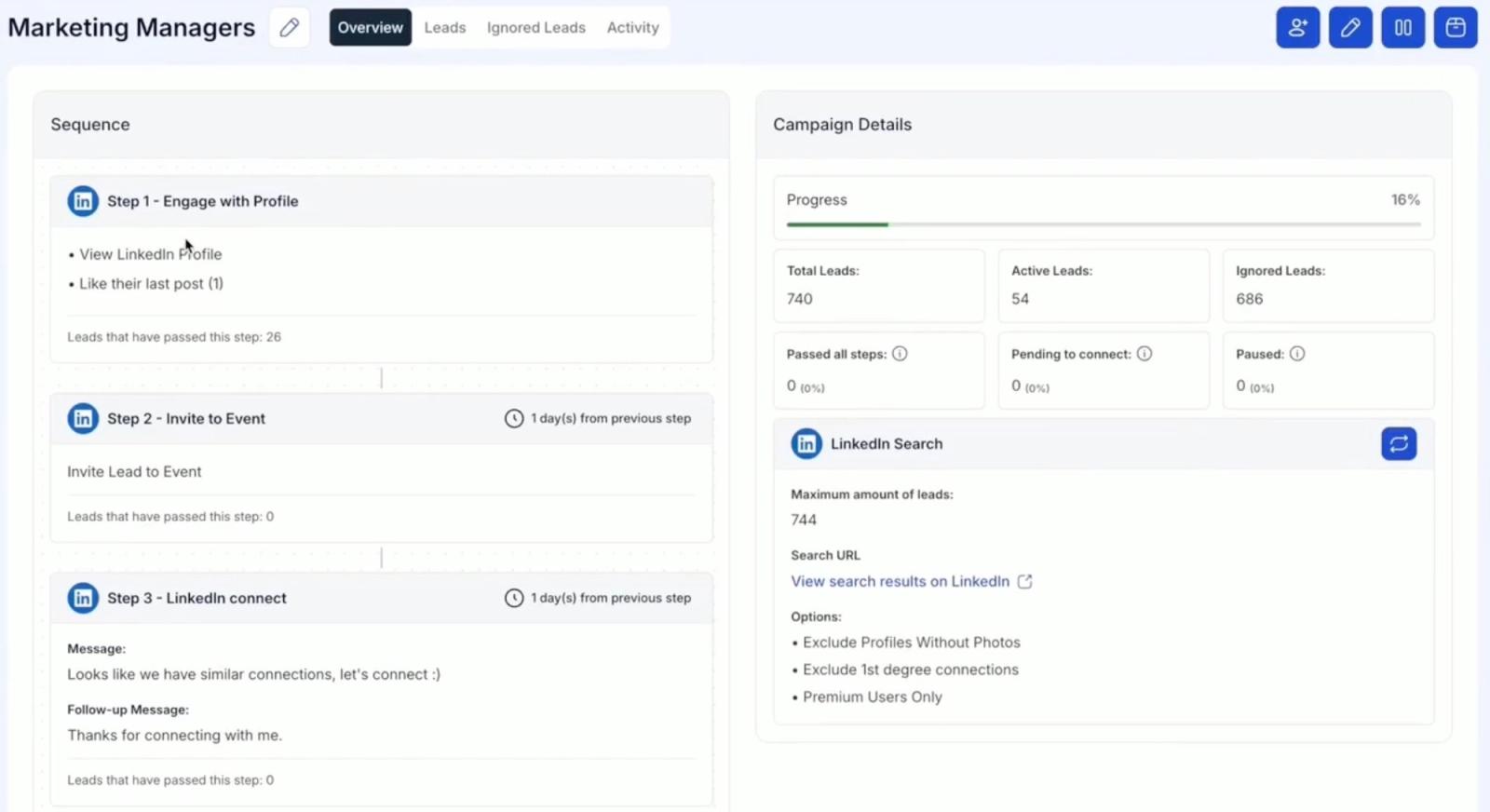
Multichannel breadth is MeetAlfred's pitch and for some teams it is exactly right. The cost is depth. A LinkedIn-first tool exposes per-action daily caps, weekly invitation ceilings and account health per sender, because LinkedIn is the whole product rather than one of three channels sharing a roadmap.
The place this shows up is not the feature list, it is campaign mechanics. In a live MeetAlfred campaign we reviewed while writing our comparison, 740 leads went in, 686 were ignored, 54 stayed active, and zero had passed all steps at 16 percent progress. None of that is a bug. It is what happens when exclusion filters run as blunt on-off toggles against a search-URL import: the filters decide more than the sequence does, and there is no per-lead reason for an exclusion to tune them with.
The 6 best MeetAlfred alternatives
1. Cadency
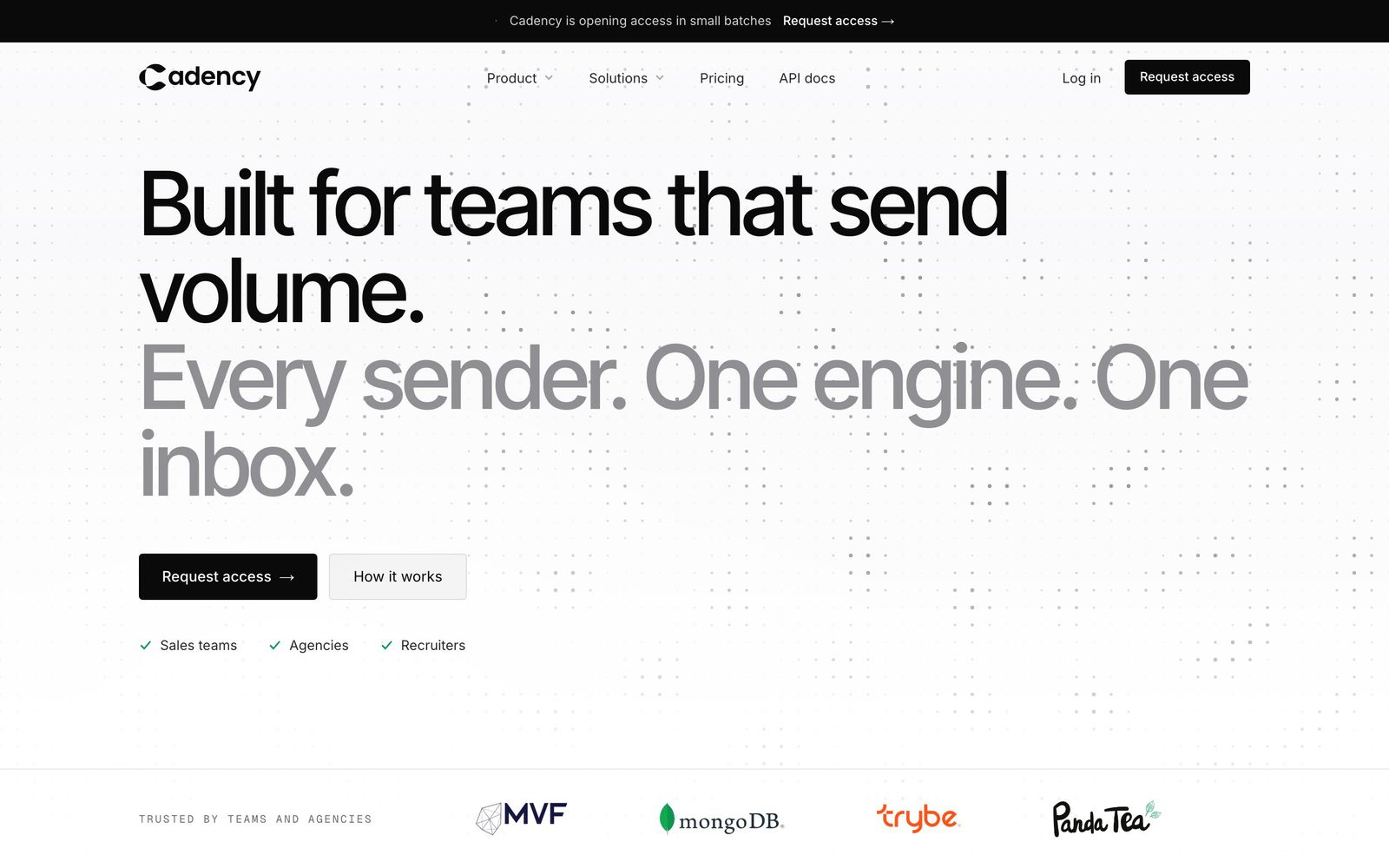
Cadency is outreach software for sales teams, recruiters and agencies that send volume on LinkedIn and email. One campaign runs across every LinkedIn sender and every mailbox you connect, with one sender per lead, so two senders never touch the same prospect, and every reply lands in one inbox: one thread per lead across LinkedIn and email, assignable, with replies sent as any sender. Sender rotation keeps each LinkedIn sender under its own ceilings and pacing, on a dedicated proxy with checkpoint handling, all running in the cloud, and vetted ambassador accounts operated for you are available on demand.
LinkedIn sequences use eight steps: profile visit, connection request, message, InMail, comment on the lead's last post (AI drafted, approved by you), voice note, like and follow, with conditions on connected, replied and email found, plus waits and A/B tests. Email runs on Google and Microsoft mailboxes with warm-up, and unlimited mailboxes rotate in the same campaign as LinkedIn. Data is built in: a native people and company database, waterfall enrichment paid per verified hit, and CSV and Sales Navigator imports. The API and webhooks come on every plan.
Pricing is monthly, with 30 percent off on annual billing. Essential is $89 a month with 2 LinkedIn senders (connected LinkedIn accounts) and 100,000 emails a month; Small Team is $199 a month with 5 LinkedIn senders included, $39 per additional sender and 100,000 emails a month; Scale is $699 with 20 senders included, $25 per additional sender and 500,000 emails a month, or 1 million for $200 more and 2 million for $500 more. Annual billing brings the three plans to $62, $139 and $489 a month, and mailboxes, teammates and workspaces are unlimited on every plan.
Where it is weak: no X or Twitter channel, so if your sequences genuinely need three channels in one flow, MeetAlfred does something Cadency does not, though MeetAlfred's X campaigns were still marked under maintenance when we checked on 8 October 2026. There is no native CRM sync, so any CRM or ATS connects through the API; only the Essential plan has a free trial, while Small Team and Scale are self-serve but paid from day one; and for a single LinkedIn account on monthly billing, every tool here except Expandi and lemlist costs less than Cadency's $89 entry price (on annual billing Essential's $62 is just under the $64 HeyReach's page displays). We also do not do cookie-less scraping, which we consider illegal, and we do not resell data. See the full comparison for the detail.
2. HeyReach
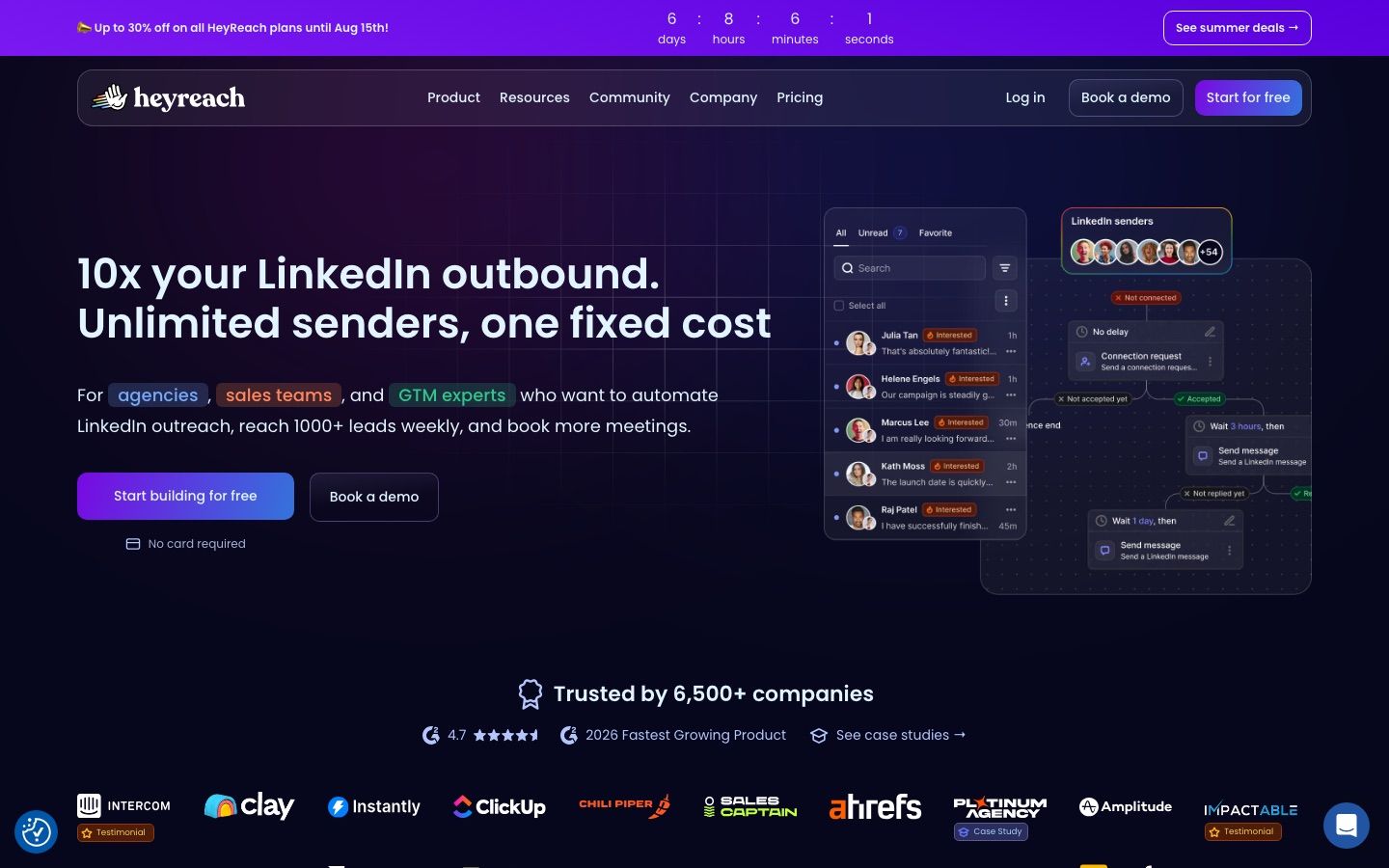
HeyReach is the closest architectural match to Cadency: multi-sender campaigns, a unified inbox, and an API and webhooks on every plan. Its reputation among agencies is genuinely strong, and its higher tiers include done-for-you onboarding, migration and a dedicated Slack channel.
Pricing, as read on 21 October 2026, is $79 per sender per month on Growth, $59 per sender from 10 senders, a flat $999 for 25 senders or $1,399 for 50 on Agency, with whitelabel included, and $2,999 for the Unlimited tier, with 20 percent off annually.
Where it is weak: no built-in prospect database, so your workflow starts in Sales Navigator or a data provider and passes through a CSV. Email steps are handed off to Instantly or Smartlead rather than sent by HeyReach.
3. Expandi
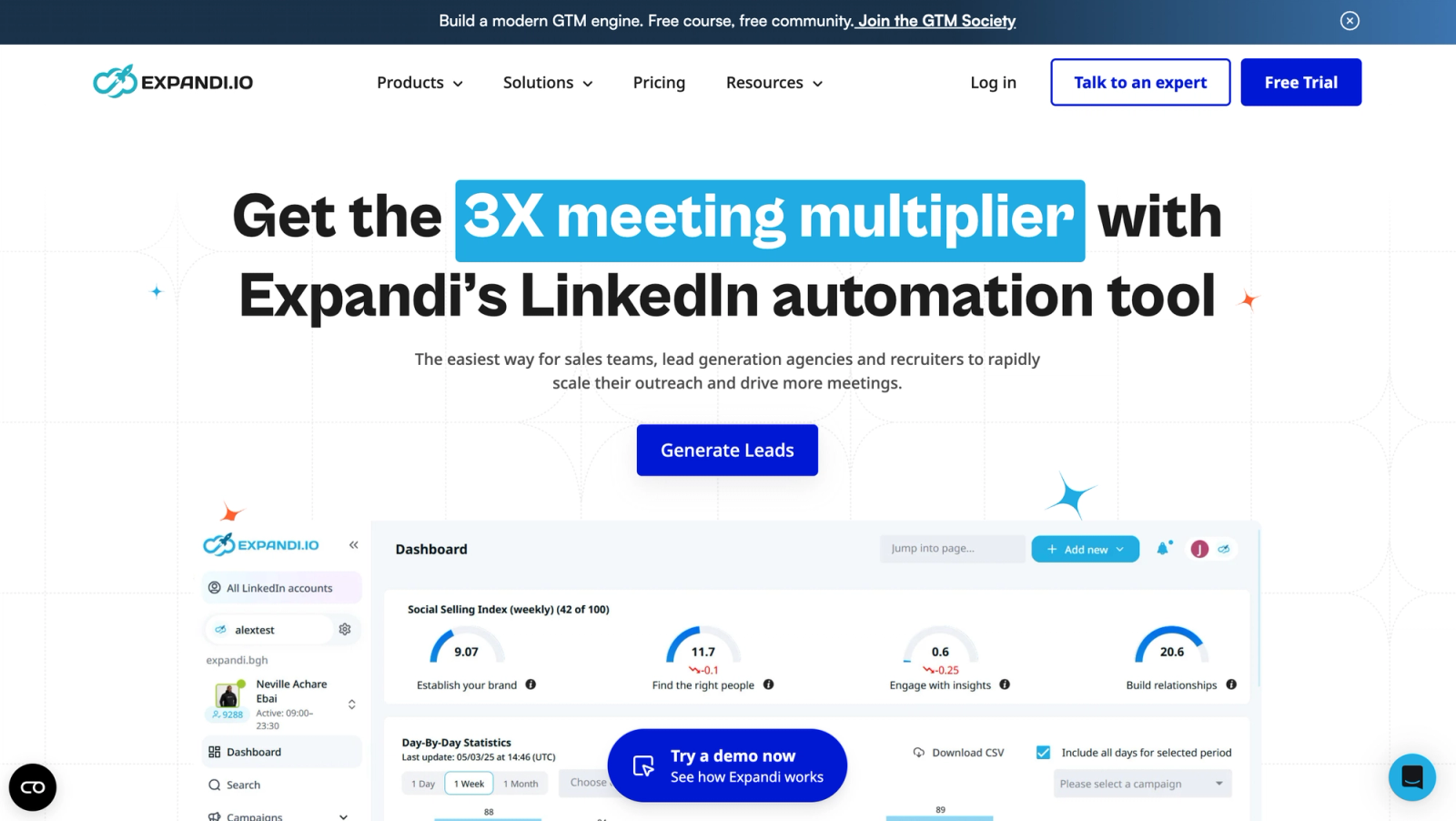
Expandi is the mature option, the one people reach for when they want personalized images and GIFs in LinkedIn messages. It has been in this market for years, and that shows in the handling of edge cases and in support depth.
Pricing is $99 per month per LinkedIn account, dropping to about $79 on annual terms, with a 7-day free trial and a custom Agency tier that starts at 10 seats.
Where it is weak: the per-account model means ten client accounts is ten seats in one workspace (as read on 30 September 2026), and while warmup and per-account IPs are automatic, the daily limit ranges are yours to tune, so a conservative configuration is on you.
4. lemlist
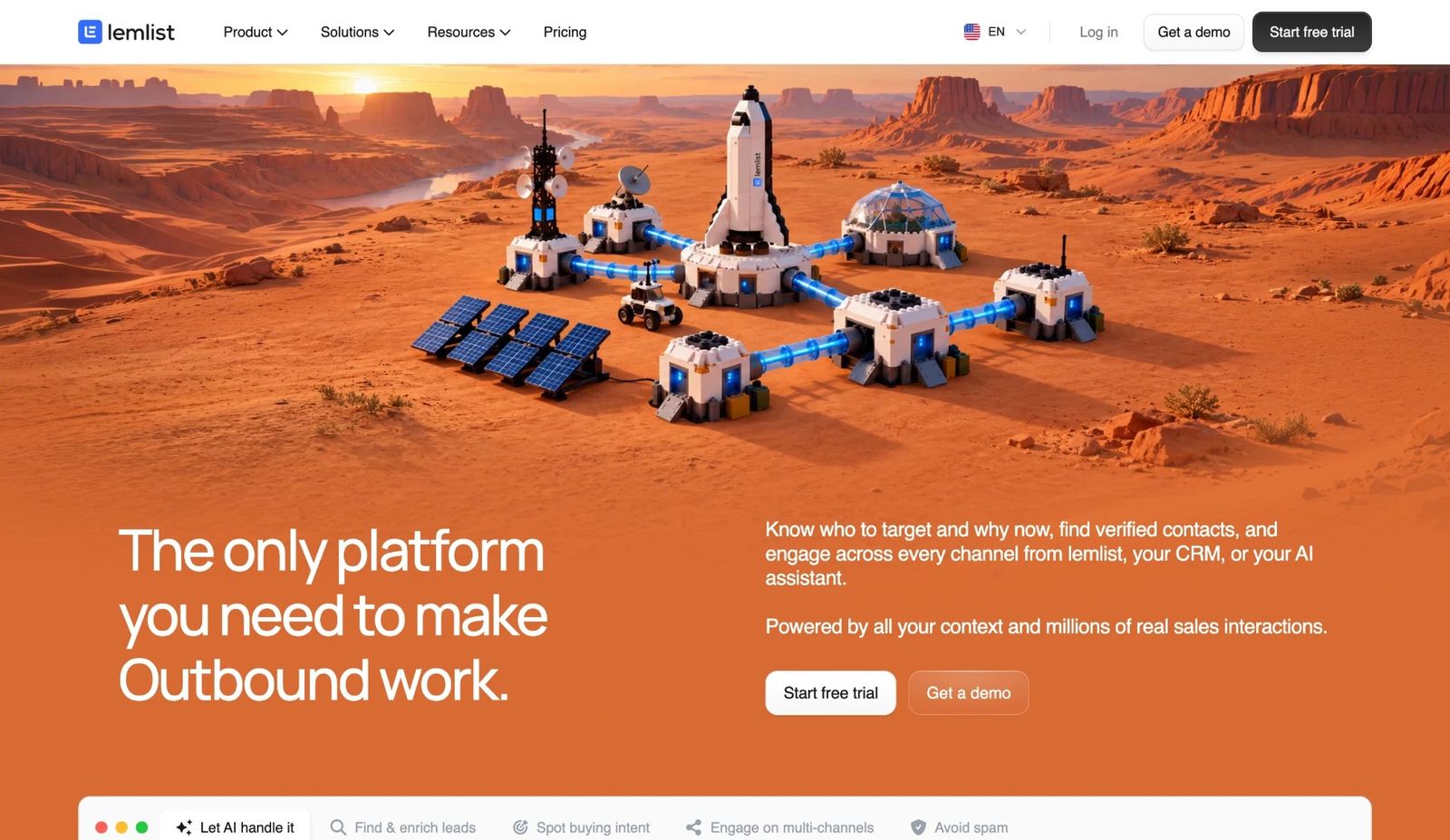
lemlist is the right answer if email is your first channel and LinkedIn is the follow-up. Its deliverability tooling, warm-up, a 650M+ lead database and a genuinely good unified inbox are all strong, and lemlist ships an API and an MCP server on every plan.
Pricing matters here in a way people miss: the Email plan at $69 per month does not include LinkedIn. LinkedIn automation starts on Multichannel at $109 per user per month, with 10 percent off quarterly and 20 percent off yearly.
Where it is weak: LinkedIn depth. Profile visits, connection requests and messages are covered, but post comments, InMail and per-action caps tuned per sender are not. If LinkedIn is your first channel, that gap decides your reply rate.
5. Waalaxy
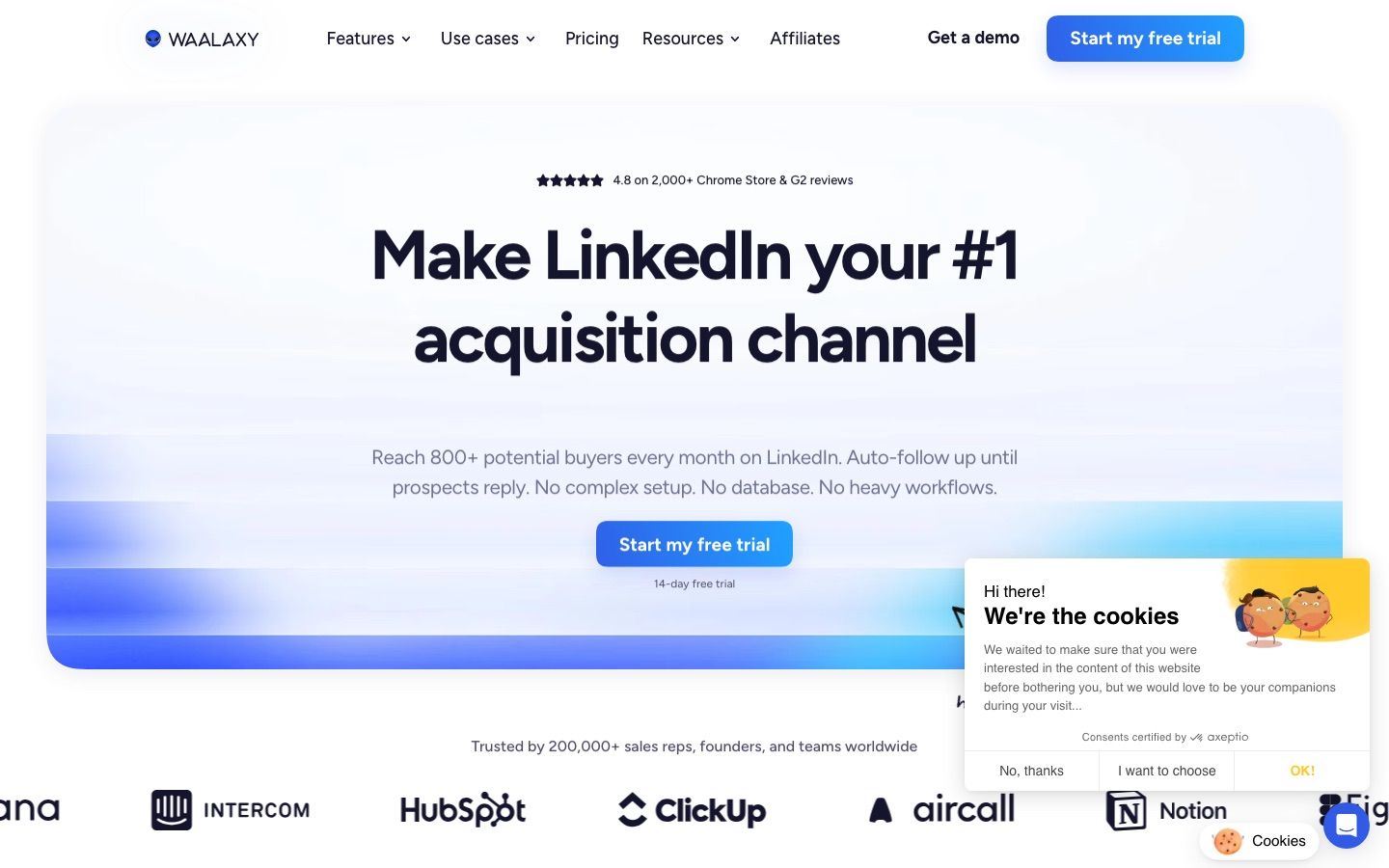
Waalaxy is the simplest tool on this list, and the cheapest way in. Campaign creation means picking from a library of prebuilt templates, which is a genuine advantage if you do not want to design sequences and a hard ceiling the moment your logic differs from the closest template.
Pricing, in euros on waalaxy.com and read on 8 October 2026, runs from €39 per user per month on Pro, capped at 300 invitations a month, through Advanced at €99 for 800 invitations plus API access, to Business at €139 where cold email sequences arrive, on monthly billing, with about 20 percent off quarterly and about half off yearly, down to €19, €49 and €69. Prices vary by country, and from outside the euro zone the page served us a lower US dollar grid, from $19 a month.
Where it is weak: no custom sequence branching, a fixed sending IP that Waalaxy says up to five users share, warm-up left to you, and monthly invitation quotas that are a billing construct rather than a safety mechanism.
6. Dripify
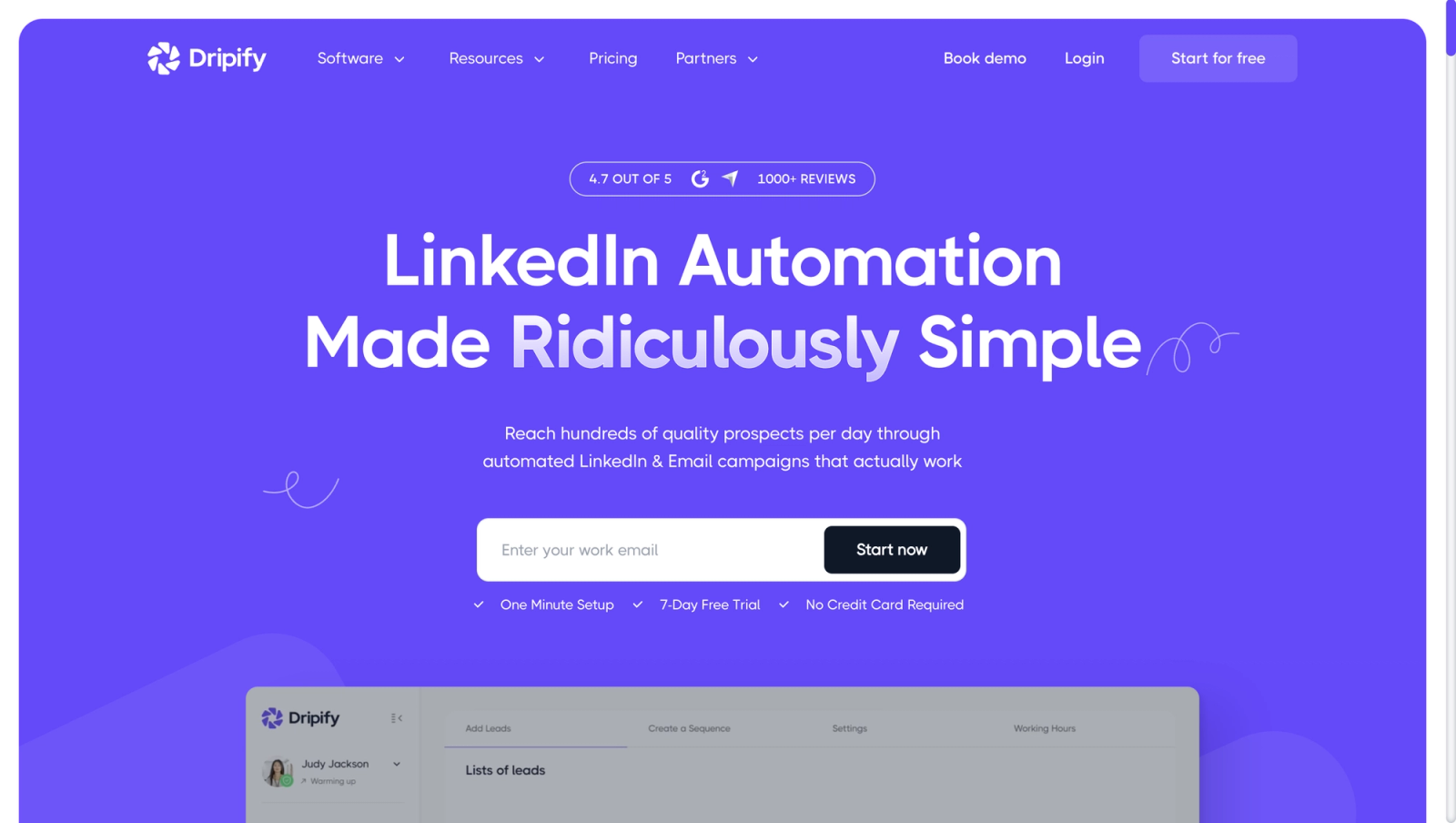
Dripify is a clean, simple LinkedIn tool with a drag-and-drop sequence builder and a reasonable entry price, aimed at individuals and small teams rather than agencies. It is not LinkedIn-only: as read on 30 September 2026, email runs natively in the same sequence on every paid plan.
Pricing is $59 or $79 per user per month on annual billing for Pro and Advanced, or $79 and $99 monthly, as read on 21 October 2026. Watch the gating: both tiers run unlimited campaigns with the same daily quotas, but team features, tagging, A/B testing and the advanced protections only arrive at the top tier.
Where it is weak: per-user pricing again, so each LinkedIn account needs its own seat, and no prospect database or multi-sender rotation.
What ten accounts actually cost on each model
Listicle tables hide the thing that decides the purchase, which is how the bill moves when you scale. Here is the same ten-account fleet priced on each vendor's published monthly rates, as read between 26 September and 8 October 2026, using each tool's cheapest tier that can actually run LinkedIn outreach.
| Tool | Model | 10 accounts, monthly | The catch |
|---|---|---|---|
| Cadency | Plans from $89 with 2 LinkedIn senders or $199 with 5, then per extra sender | $394 on Small Team ($199 plus five extra senders at $39) | No X channel or native CRM sync |
| HeyReach | $79 per sender, $59 from 10 senders | $590, or $999 flat on Agency at 25 | Data comes from elsewhere |
| MeetAlfred | $59 to $99 per user | $790, ten seats on Teams, which a second account requires | 1,000-lead cap per campaign |
| Expandi | $99 per account | $990, ten seats | Safety settings are yours to configure |
| lemlist | $109 per user for LinkedIn | $1,090, ten Multichannel seats | LinkedIn depth stops at visits, invites, messages |
| Waalaxy | €39 to €139 per user (€19 to €69 billed yearly) | €390 to €1,390 | 300 to 800 invites a month per seat, template-only sequences |
| Dripify | $79 to $99 per user | $790 to $990 | Full features only on the top tier |
Two things fall out of the table. Per-sender and per-user pricing can look close at this scale until you add the constraint columns: the cheap per-user options cap invitations or gate features, so the working price for a real outreach motion is usually the top tier, not the entry one. HeyReach flattens into a $999 Agency plan for 25 senders, which is the number to compare from about 17 senders on HeyReach's rates. Cadency moves to its Scale plan at $699 with 20 senders included, which beats Small Team plus extra senders from 18 senders.
How to choose between them
Answer one question first: is LinkedIn your primary channel or a supporting one? Everything else follows from that.
| If this is you | Pick |
|---|---|
| LinkedIn is the channel and you run several senders | Cadency or HeyReach |
| You genuinely need LinkedIn, email and X in one flow | Stay on MeetAlfred Teams or Business; its X campaigns were still marked under maintenance on 8 October 2026 |
| Email is your first channel, LinkedIn the follow-up | lemlist |
| You want personalized images and a mature product | Expandi |
| One account, small budget, templates are fine | Waalaxy or Dripify |
Then check how the bill scales. Per-user and per-account pricing look similar at one seat and diverge sharply at ten. At ten LinkedIn accounts, per-seat tools bill ten seats, often on a higher tier: MeetAlfred needs Teams for a second account and Dripify needs Advanced for team management (as read on 30 September 2026). Per-sender tools bill ten senders inside one workspace, which usually comes out cheaper.
Finally, ask each vendor what happens when an account gets restricted. Any tool can send invitations. What separates them is per-action daily caps, weekly invitation ceilings, warmup on new accounts, and whether reaching a cap pauses an action or risks the account. We wrote up where the line actually sits, and it is worth reading LinkedIn's own user agreement rather than any vendor's summary of it, including ours.
FAQ
What is the best MeetAlfred alternative in 2026?
For LinkedIn-led outreach across several senders, Cadency and HeyReach are the two serious options, and they differ mainly on price and on whether you want a built-in prospect database (with waterfall enrichment paid per verified hit) and email sent from the same campaign. For balanced multichannel work across LinkedIn, email and X, MeetAlfred on Teams or Business remains a reasonable choice and switching may not be worth the migration, though its X campaigns were still marked under maintenance on 8 October 2026.
How much does MeetAlfred cost in 2026?
Individual is $59, Business is $99 and Teams is $79 per user per month on monthly billing, with Teams sold from 3 seats; annual billing brings them to $35, $59 and $47, as advertised on the pricing page. Pricing is per user, so each person or client account needs a seat.
Is there a free MeetAlfred alternative?
Not a serious one. None of these tools has a free plan that automates anything (Waalaxy's free Freemium mode keeps your data but runs no automation), and most offer trials instead: Expandi runs 7 days, lemlist and Waalaxy 14, while Cadency offers one on its Essential plan. Free LinkedIn automation almost always means a browser extension running on your own machine, which is the riskiest way to automate an account.
Which MeetAlfred alternative is best for agencies?
The deciding factor is how the bill scales with client accounts. Cadency's Small Team plan is $199 a month with 5 LinkedIn senders included, and Scale is $699 with 20 senders and $25 per additional sender, with unlimited mailboxes, teammates and workspaces on every plan, and white label scoped on a sales call. HeyReach covers 25 senders at a flat $999 on Agency with whitelabel included, as read on 21 October 2026. Both beat per-seat pricing at agency scale once you compare full-feature tiers. Compare the sender count you actually need rather than the headline price.
Can I migrate my MeetAlfred campaigns to another tool?
Sequences do not transfer between platforms, so plan to rebuild them, which usually takes an hour per campaign. Your audiences do transfer: MeetAlfred exports campaign and CRM data to CSV on the Business tier and up, or you re-run the LinkedIn search in the new tool. The part worth care is the accounts themselves. Disconnect from the old tool before connecting to the new one, and give each account a few days of lower volume rather than resuming at full pace. HeyReach's Unlimited tier includes done-for-you migration if you want the switch handled; everywhere else it is an afternoon of setup.
The short version
MeetAlfred is a competent multichannel tool that charges per user and caps search imports at 1,000 leads. If LinkedIn is genuinely one of three channels for you, those are fair trades and you should stay.
If LinkedIn is the channel, the per-seat model is the thing that will cost you, and a tool built around a pool of senders, with ceilings on every sender and a shared inbox, is the upgrade. Cadency and HeyReach are the two to shortlist, and our head-to-head with MeetAlfred covers the detail if you want it.
Cadency began as our internal test bed for the Swarmhit engine, was never meant to be public, and we kept it running for the sales teams, recruiters and agencies who asked for it. If you are leaving MeetAlfred over per-seat pricing, it runs one campaign across every LinkedIn sender and mailbox you connect, with one inbox for the replies. Swarmhit itself is the API for developers who build their own outreach product.


