

LinkedIn Sales Navigator pricing has three tiers in 2026. Core starts at US$119.99 per month or US$1,079.88 per year, a 25 percent saving on annual billing. Advanced starts at US$159.99 per month or US$1,799.88 per year, a 6 percent saving. Advanced Plus has no published number: it is custom, scoped through a demo call around a sales team's size, CRM integration and onboarding needs. All three plans carry 50 InMail credits a month.
Which tier is worth paying for depends on what you actually need from the seat. Core suits an individual seller who wants LinkedIn's own search filters and InMail allowance. Advanced adds team seat management and centralized billing for a sales floor. Advanced Plus exists for teams whose CRM needs to talk to LinkedIn directly. The rest of this guide breaks down what each plan includes, how the cost compares to LinkedIn Premium Business, and whether Sales Navigator earns its price over a free account paired with a separate prospecting tool.
How much does LinkedIn Sales Navigator cost in 2026?
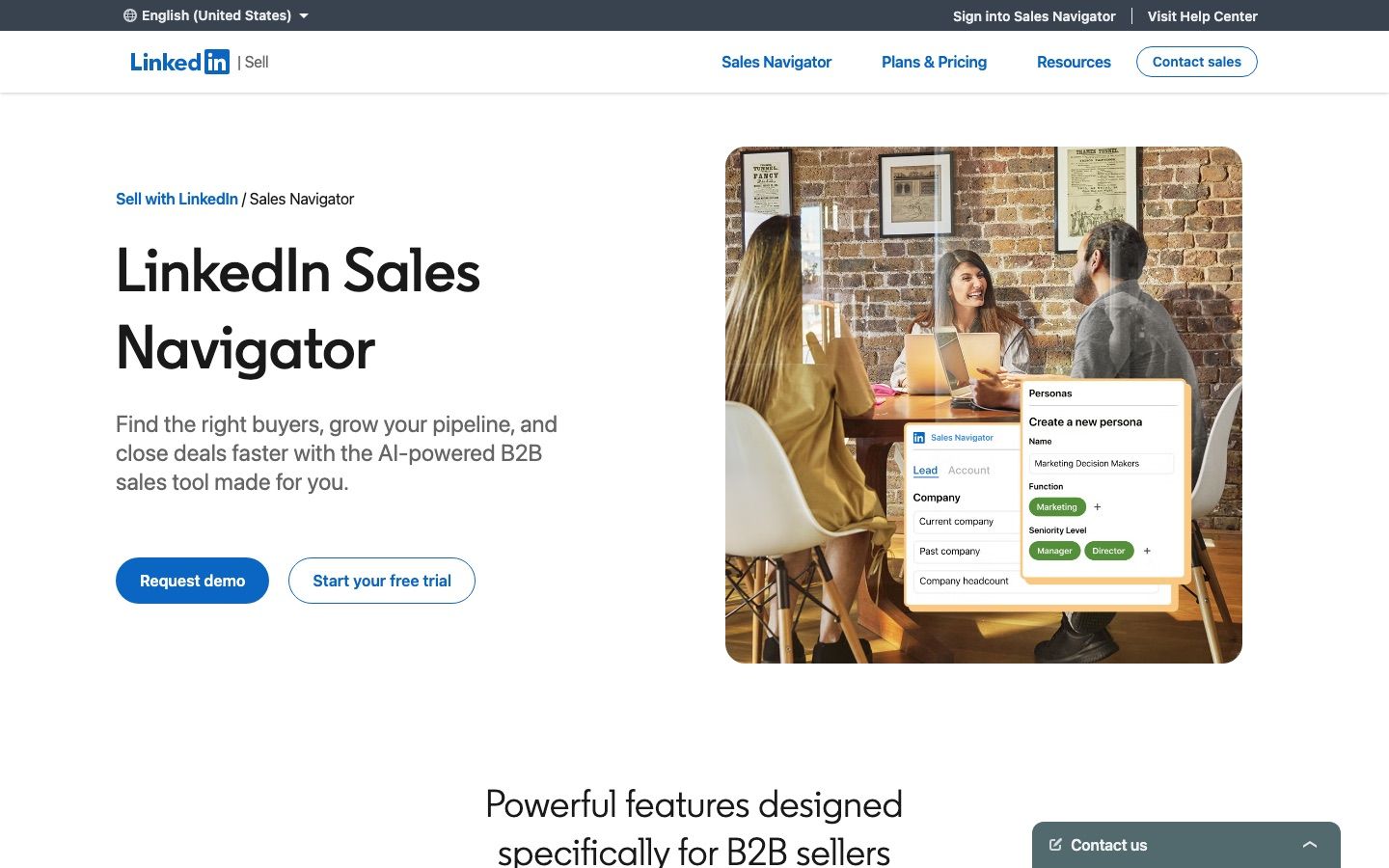
LinkedIn publishes Sales Navigator pricing on its own compare plans page, last updated August 1, 2026, and the numbers below come straight from it. Core, the entry tier for individual sellers, starts at US$119.99 per license on monthly billing or US$1,079.88 per license on annual billing, which LinkedIn states is a 25 percent saving. Advanced, built for sales teams, starts at US$159.99 monthly or US$1,799.88 annually, a 6 percent saving. Advanced Plus does not appear with a number on the page at all: LinkedIn prices it "based on your sales team's size, CRM integration, and onboarding/training needs" and sells it through a demo request rather than a checkout button.
| Plan | Monthly billing | Annual billing (per year) | Annual saving |
|---|---|---|---|
| Core | US$119.99/month | US$1,079.88/year | 25% |
| Advanced | US$159.99/month | US$1,799.88/year | 6% |
| Advanced Plus | Custom, by demo | Custom, by demo | Not published |
$119.99
Sales Navigator Core, monthly billing, verified September 2026
Sales Navigator pricing is not only quoted in US dollars. LinkedIn's compare page localizes billing into euros, Australian dollars and Canadian dollars, and none of those are a straight currency conversion of the US price, they are the numbers LinkedIn's own page displays for each market.
| Currency | Core, monthly | Core, per year | Advanced, monthly | Advanced, per year |
|---|---|---|---|---|
| EUR | €120.99 | €1,088.88 | €148.21 | Not published |
| AUD | A$154.99 | A$1,499.88 | A$189.99 | A$2,159.88 |
| CAD | C$144.99 | C$1,199.88 | C$179.99 | C$2,039.88 |
LinkedIn's page does not list an annual EUR figure for Advanced, only the monthly rate, so we are not inventing one here. LinkedIn states the 25 percent and 6 percent annual savings for the US dollar price only, and the discount is not uniform once you work it out from the local monthly and annual figures above. On Core, the annual price is a 25 percent saving on EUR billing but roughly 19 percent on AUD and roughly 31 percent on CAD; on Advanced it stays close to the US figure everywhere LinkedIn publishes an annual number, at roughly 5 to 6 percent. Use the local figures in the table above rather than assuming one saving percentage travels across every market.
What does each Sales Navigator plan include?
All three Sales Navigator plans, Core, Advanced and Advanced Plus, ship with 50 InMail credits a month, LinkedIn's 50-plus advanced search filters, and the Account IQ and Lead IQ features that surface account and lead changes automatically. What separates the tiers is not the InMail allowance, it is how the account is meant to be used: alone, as part of a managed team, or bolted onto a CRM.
Core is built for an individual seller working their own list. It has the full search filter set, the InMail credits, Account IQ and Lead IQ, but nothing built for managing a team of licenses: no shared seat administration, no centralized billing across users.
Advanced adds exactly that: team seat management and centralized billing, so a sales manager can provision and bill several licenses from one place. The search, InMail and IQ features are identical to Core; the difference is entirely about running Sales Navigator across a team rather than one person.
Advanced Plus adds the piece Advanced does not touch: deep CRM integration with Salesforce, HubSpot, Microsoft Dynamics and Oracle, plus the ability to create leads and contacts directly inside the CRM from a Sales Navigator record. That is the tier that answers whether a CRM sees what reps see in Sales Navigator, and it is the one LinkedIn will not price without a call, because the CRM setup and onboarding scope the cost.
| Feature | Core | Advanced | Advanced Plus |
|---|---|---|---|
| InMail credits per month | 50 | 50 | 50 |
| Advanced search filters (50+) | Yes | Yes | Yes |
| Account IQ and Lead IQ | Yes | Yes | Yes |
| Team seat management and centralized billing | No | Yes | Yes |
| Advanced CRM integration (Salesforce, HubSpot, Dynamics, Oracle) | No | No | Yes |
| Lead and contact creation into the CRM | No | No | Yes |
Read that table by what is missing, not what is present. Every plan gives the same search and the same InMail allowance; nobody pays more for a bigger InMail credit pool at any tier. What Advanced buys is team administration, and what Advanced Plus buys is the CRM plumbing. If neither of those is a problem you have, Core already gives you everything Sales Navigator does on the LinkedIn side.
Run your LinkedIn outreach on Swarmhit
Multi-sender campaigns, safe sending limits and a unified inbox, from $29 per sender per month on annual billing.
7-day free trial. Cancel anytime.
Is Sales Navigator worth it?
Sales Navigator is worth it if the 50 InMail credits, the 50-plus search filters and the relationship signals change how many qualified conversations you start each month, not just how tidy your prospecting looks. Put a number on the seat before deciding: Core's US$1,079.88 annual price works out to roughly $4.15 a business day across a 260-day working year, and Advanced's US$1,799.88 works out to roughly $6.92 a business day. Framed that way, the question is not whether $120 a month is affordable, it is whether one Sales Navigator-sourced conversation a week covers $4 to $7 a day.
That math favors Core for most individual sellers. At roughly $89.99 a month when billed annually, an individual seller only needs a handful of InMail responses or relationship-map introductions a month to justify the seat, since replicating 50 InMail-equivalent sends through cold email tooling or a data vendor with no InMail equivalent would cost real money on its own.
Who it pays off for: an individual seller or account executive running targeted outbound into named accounts, where InMail reaches second and third degree prospects a free account cannot message, and where Account IQ and Lead IQ save real research time by surfacing account changes automatically. It also pays off for a sales floor that needs Advanced's centralized billing to avoid managing individual card payments per rep, and for a CRM-heavy team on Advanced Plus where lead creation flowing straight into Salesforce or HubSpot removes a manual step from every qualified conversation.
Who should stay on free plus a prospecting tool: anyone whose real bottleneck is contact data rather than LinkedIn search or InMail. Sales Navigator does not sell email addresses or phone numbers at any tier, so a team blocked on finding verified contact details is paying $120 to $160 a month for a problem it does not solve. Our Sales Navigator alternatives guide covers the data-vendor side of that trade, and our roundup of LinkedIn prospecting tools covers where a seat still earns its place alongside one.
Sales Navigator vs LinkedIn Premium Business
LinkedIn Premium Business is the cheaper, narrower tier: US$69.99 a month or US$539.88 a year, a 36 percent saving on annual billing, with 15 InMail credits a month. Sales Navigator's own comparison page states that a Sales Navigator subscription includes everything in Premium Business and then adds what Premium Business does not have: 50-plus advanced search filters, a relationship map, CRM integration and TeamLink, which surfaces your team's combined network for warmer introductions.
| LinkedIn Premium Business | Sales Navigator | |
|---|---|---|
| Monthly billing | US$69.99 | From US$119.99 |
| Annual billing (per year) | US$539.88 | From US$1,079.88 |
| Annual saving | 36% | 25% (Core) / 6% (Advanced) |
| InMail credits per month | 15 | 50 |
| Premium Business features | Included | Included |
| 50+ advanced search filters | No | Yes |
| Relationship map | No | Yes |
| CRM integration | No | Yes (Advanced Plus) |
| TeamLink | No | Yes |
Premium Business is the right call for someone whose goal is a general Premium upgrade and profile visibility, with 15 InMail credits, without needing LinkedIn's sales-specific search or relationship tooling. Sales Navigator is the right call the moment prospecting is the job: 50 InMail credits instead of 15, filters built around company and lead attributes rather than general search, and TeamLink turning a whole team's connections into warm paths instead of cold ones. The price gap, roughly $50 a month at the Core tier, is close to the InMail difference alone, since 35 extra credits a month would cost real money to replicate through any other channel.
How does the Sales Navigator free trial work?
Sales Navigator's free trial runs one month, the same length as any LinkedIn Premium trial, according to LinkedIn's own help page. Cancel at least one day before the trial ends to avoid being billed, and LinkedIn sends a reminder email seven days before the trial closes so the deadline does not sneak up on you.
That one-day cancellation window matters more than it sounds. If the trial ends on a Friday and the plan is to cancel Friday morning, LinkedIn's help page is specific that cancellation needs to land at least a day earlier, so treat the reminder email as the real deadline, not the trial's own end date. See LinkedIn's help page on the Sales Navigator free trial for the exact mechanics, including how to cancel from account settings.
How do InMail credits work on Sales Navigator?
Sales Navigator Core, Advanced and Advanced Plus all grant 50 InMail credits a month, and unused credits accumulate up to a cap of 150 before they stop building up further. Credits also expire after 90 days regardless of the accumulation cap, which is a separate rule: a credit sitting unused for 90 days is gone even if the pool is nowhere near the 150 ceiling. Sales Navigator credits renew on the last day of every month, unlike Premium plans, which renew on the first day of the billing cycle.
A credit comes back when the recipient responds within 90 days of the InMail being sent, whether that response is an accept, a decline or a reply, so a well-targeted send that gets answered effectively costs nothing. InMails to first-degree connections, Open Profiles and job applicants are free and never touch the credit pool at all, since InMail exists specifically to reach people outside your network. One rule has no workaround: Sales Navigator does not sell extra InMail credits. There is no top-up purchase at any tier, so 50 a month, or 150 banked, is the entire allowance regardless of how much you are willing to spend. Our guide to LinkedIn InMail covers how to write InMails that actually clear that 90-day response window. Full detail on credits, caps and expiry sits on LinkedIn's own InMail help page.
Does Sales Navigator raise your connection limits?
No, not officially, and LinkedIn is explicit about it: a numeric invitation limit exists, LinkedIn does not publish the number, and LinkedIn states that limit cannot be raised by purchasing any subscription, Sales Navigator included. That is the official layer, and it applies the same to every account regardless of plan.
In practice, a second layer sits underneath the official one. Operators running LinkedIn outreach report sustained higher weekly volume on mature, paid accounts than on new or free ones, because enforcement leans on behavioral signals, account tenure and trust profile rather than a fixed plan-based ceiling. For Sales Navigator specifically, operators report a sustained range of roughly 150 to 250 invitations a week, though sources disagree on where the top of that range actually sits, and none of it is a number LinkedIn confirms. Treat both layers as true at once: LinkedIn will not sell a higher limit, and real accounts on paid plans do appear to sustain more volume than fresh free ones, for reasons LinkedIn does not disclose.
That gap between the official and the practiced is exactly where account risk lives. Sending at the high end of an unconfirmed range on a new account is a different bet than doing it on an established one, and pushing past what an account's history supports is the fastest way to get an account restricted. Our guide to LinkedIn connection limits goes deeper into both layers, and our piece on whether LinkedIn automation is safe covers what actually triggers a restriction beyond raw volume. LinkedIn's own help page on invitations and restrictions is the primary source behind the official layer above.
How do teams pair Sales Navigator with outreach execution?
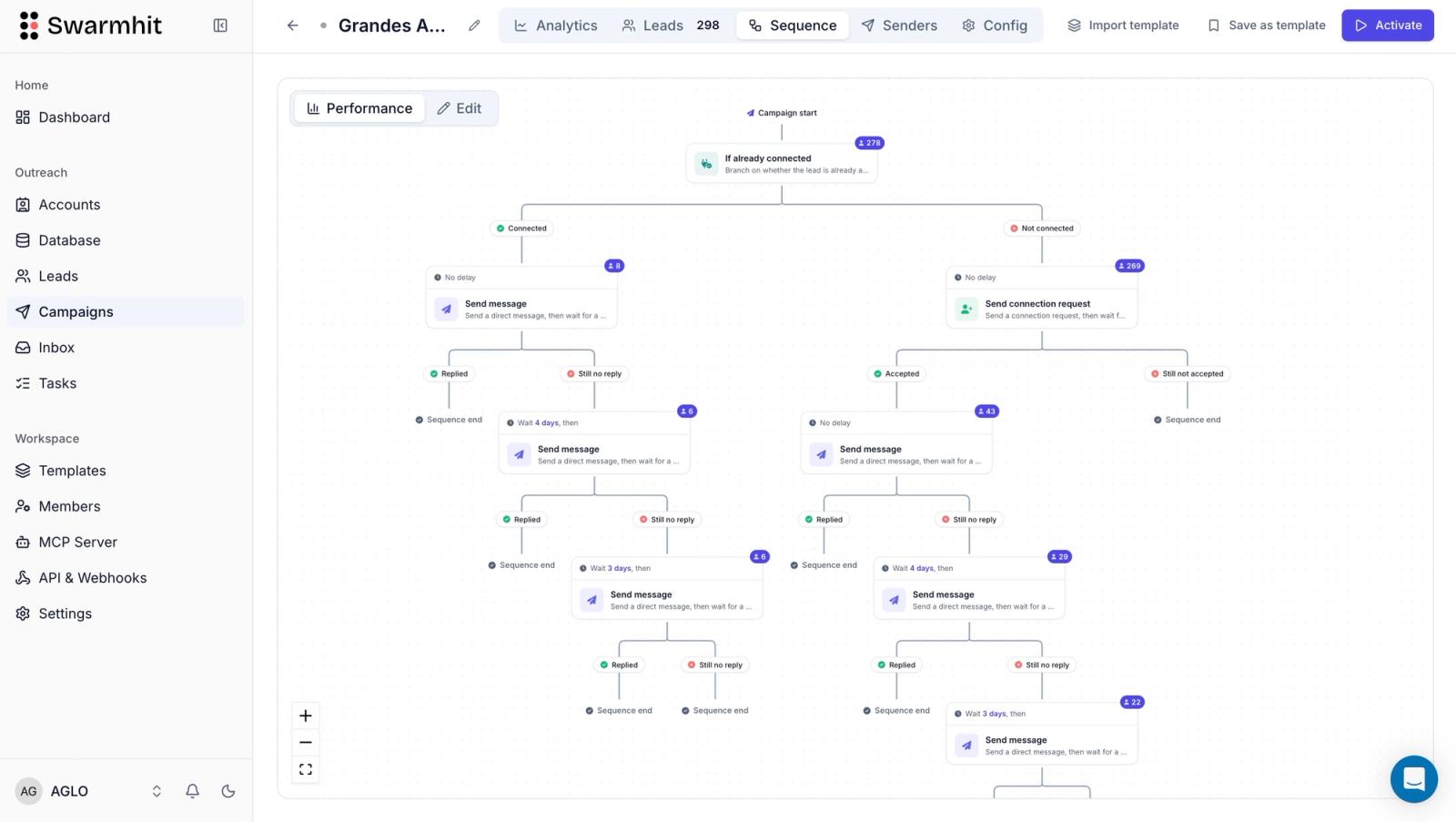
Sales Navigator finds; it does not send at scale on its own. Its search, filters and relationship signals are excellent at narrowing a market down to the right list, but running a sequence of connection requests, messages and InMails against that list, across more than one sender, is not what the product is built to do.
That is the gap Swarmhit fills, and only that gap: Swarmhit imports a Sales Navigator search directly, then runs the outreach on LinkedIn accounts the customer already owns and connects, rotating across multiple senders inside one campaign rather than one identity per seat the way Sales Navigator's own team plans are structured. Scraping a Sales Navigator search into Swarmhit is capped at 2,500 profiles a day per connected account, a limit Swarmhit enforces on its own infrastructure, not a number LinkedIn publishes.
That division of labor is deliberate. Swarmhit is not a Sales Navigator replacement: it does not build the list, it does not sell InMail credits, and it does not replicate Account IQ or the relationship map. What it replaces is the manual work of turning a saved search into an outreach cadence by hand, across a pool of senders with dedicated proxies, managed auto-warmup, health checks and 250+ safeguards monitored around the clock, landing replies in one shared inbox with assignment and interest tags. See our roundup of LinkedIn automation tools for how that category compares more broadly, and our guide to the Sales Navigator API for a build-it-yourself route instead of a managed one.
FAQ
How much does Sales Navigator cost per month in 2026?
Core costs US$119.99 a month or US$1,079.88 a year on annual billing, a 25 percent saving. Advanced costs US$159.99 a month or US$1,799.88 a year, a 6 percent saving. Advanced Plus has no published monthly price: LinkedIn prices it individually and sells it through a demo call rather than a checkout page.
Is Sales Navigator worth it in 2026?
It is worth it if InMail, the 50-plus search filters and relationship signals like Account IQ change how many qualified conversations you start each month. Core works out to roughly $4.15 a business day on annual billing, which a handful of InMail responses a month easily covers. It is a harder yes if your real bottleneck is contact data, which Sales Navigator does not sell at any tier.
What is the difference between Sales Navigator and LinkedIn Premium?
LinkedIn Premium Business costs US$69.99 a month with 15 InMail credits and general profile visibility features. Sales Navigator includes everything in Premium Business and adds 50-plus advanced search filters, a relationship map, CRM integration and TeamLink, alongside a larger 50-credit InMail allowance. Sales Navigator is built for prospecting; Premium Business is a general upgrade.
How long is the Sales Navigator free trial?
One month, the same length as any LinkedIn Premium trial. Cancel at least one day before the trial ends to avoid being billed, and LinkedIn sends a reminder email seven days before the trial closes.
Can you buy more InMail credits on Sales Navigator?
No. Sales Navigator does not sell extra InMail credits at any tier. The allowance is 50 credits a month, accumulating to a cap of 150, and unused credits expire after 90 days regardless of the cap.
Does Sales Navigator Core include team features?
No. Core has the same search filters, InMail credits and Account IQ as every other tier, but team seat management and centralized billing only start on Advanced. A team of Core seats has to be provisioned and billed one license at a time.
How much does Sales Navigator Advanced cost per year?
US$1,799.88 a year on annual billing, or US$159.99 a month on monthly billing, a 6 percent saving on the annual rate. Advanced adds team seat management and centralized billing on top of everything Core includes.
Does Sales Navigator increase how many connection requests you can send?
Not officially. LinkedIn states its invitation limit is undisclosed and cannot be raised by purchasing any subscription. Operators report higher sustained volume on mature paid accounts in practice, with Sales Navigator users reporting roughly 150 to 250 invitations a week, but that figure is never confirmed by LinkedIn.
What is Sales Navigator Advanced Plus and who is it for?
Advanced Plus is the tier built for CRM-integrated teams: it adds deep integration with Salesforce, HubSpot, Microsoft Dynamics and Oracle, plus the ability to create leads and contacts directly inside the CRM from Sales Navigator. It has no published price; LinkedIn scopes it on a demo call around team size, CRM setup and onboarding needs.
Conclusion
Sales Navigator's 2026 pricing is straightforward even where Advanced Plus is not: Core at US$119.99 a month or US$1,079.88 a year, Advanced at US$159.99 a month or US$1,799.88 a year, and Advanced Plus scoped through a demo call. The plans do not differ on search or InMail, every tier gets 50 credits and the same 50-plus filters, they differ on whether the seat needs team administration or CRM plumbing wrapped around that search.
Buy Core if you are an individual seller who wants LinkedIn's own prospecting tools and a meaningful InMail allowance. Buy Advanced once you are managing more than one seat. Buy Advanced Plus once your CRM needs to see what Sales Navigator sees. And if the actual blocker is contact data rather than search or InMail, a free account paired with a dedicated prospecting tool will save $120 to $160 a month that was not going toward what Sales Navigator actually does.


