

Waalaxy vs Expandi comes down to two tools solving the same problem, automating LinkedIn outreach, from opposite ends of the price and control spectrum. Waalaxy, fully cloud-based now that its Chrome extension is retired, is priced from €39 a user a month, or €19 billed yearly, with invitation quotas by tier and a template library instead of a sequence builder. Expandi is a cloud platform at $99 per LinkedIn account a month, with a real branching sequence builder, a dedicated IP per seat and an agency tier built for multi-client teams.
If you are one person sending a modest volume from one account, Waalaxy is cheaper and faster to launch. If you run several LinkedIn accounts, need a dedicated IP per seat, or manage clients, Expandi's architecture and agency tooling earn its $99 a seat, more than twice Waalaxy's entry tier on monthly billing, whether Waalaxy bills you in euros or dollars. We priced both from their own pages, Expandi on 30 September and Waalaxy on 8 October 2026, and worked the numbers at 1, 5 and 10 seats so the answer is not just a gut call, and our wider LinkedIn automation tools roundup covers where the rest of the category sits around them.
Waalaxy vs Expandi in 2026: the quick comparison
Before the tier-by-tier detail, here is how the two tools and a multi-sender alternative stack up, as checked on 30 September 2026 (Waalaxy on 8 October 2026), on the five things that actually decide a purchase: how the tool runs, what it costs, what limits your sending, how it protects the account, and what it offers a team.
| Waalaxy | Expandi | Cadency | |
|---|---|---|---|
| Model | Cloud-based (Chrome extension retired by July 2026), per-user seat, template library | Cloud-based, per-seat (one LinkedIn account), branching sequence builder | Cloud-based, priced per LinkedIn sender, one campaign runs across every sender and mailbox, one sender per lead |
| Pricing | €39 to €139 per user a month, €19 to €69 billed yearly; lower US dollar grid in some countries outside the euro zone | $99 per seat a month, $79 a month on annual (20% off) | Small Team $199 a month with 5 LinkedIn senders, Scale $699 with 20, 30% off on annual |
| Quotas or limits | 300 to 800 invitations a month by tier | Daily limit ranges you set per action; Mobile Connector campaigns add up to 100 connection requests a week | Per-sender ceilings and pacing, applied by the platform |
| Safety | Runs in Waalaxy's cloud from a fixed VPN IP near you, shared by up to 5 users; warm-up left to you; published daily ranges per plan | Dedicated country-based IP per seat, automated profile warmup, limit ranges you configure | Dedicated proxy per sender, checkpoint handling, runs in the cloud |
| Team features | One seat per account, "team prospecting" coordination, no rotation | Workspaces on every plan with a Global Inbox and Shared Campaigns across accounts; Agency tier (10+ seats or white label): roles and permissions, client reports, dedicated CSM | One campaign across the sender pool with sender rotation, unified inbox with assignment, unlimited teammates and workspaces |
The sections below give the numbers behind each row, starting with what each tool actually is and ending with what a one, five and ten seat team pays on each.
What is Waalaxy?

Waalaxy is a LinkedIn prospecting tool built around a library of prebuilt campaign templates rather than a sequence builder you draw yourself. It runs 100% in the cloud: paid plans have sent from Waalaxy's cloud since 2022, and by July 2026 the Chrome extension was gone from the Chrome Web Store. You sign in to the web app with your LinkedIn account, choose a template such as invite-then-message, add a list, and Waalaxy runs the sequence in the background, without your browser or LinkedIn staying open. It imports lead lists from a standard LinkedIn search, from Sales Navigator, and from Recruiter Lite, so a Sales Navigator subscription elsewhere is not wasted.
Three self-serve tiers sit behind a 14-day free trial, plus a custom Enterprise tier for five or more seats (checked 30 September 2026). Pro allows 300 invitations a month, Advanced and Business both raise that to 800, and only Business adds cold email sequences on top. The unified inbox most competitors bundle into a base plan is a separate paid add-on on Waalaxy, with 500 free conversations to try before you commit. Waalaxy displays a 4.5 rating on G2 on its own pricing page, a claim we attribute to Waalaxy rather than verify independently, alongside a claim of over 200,000 users. Full tier detail sits on Waalaxy's own pricing page; our full Waalaxy review and our Waalaxy compare page cover the tiers and the sending model against a multi-sender alternative.
What is Expandi?
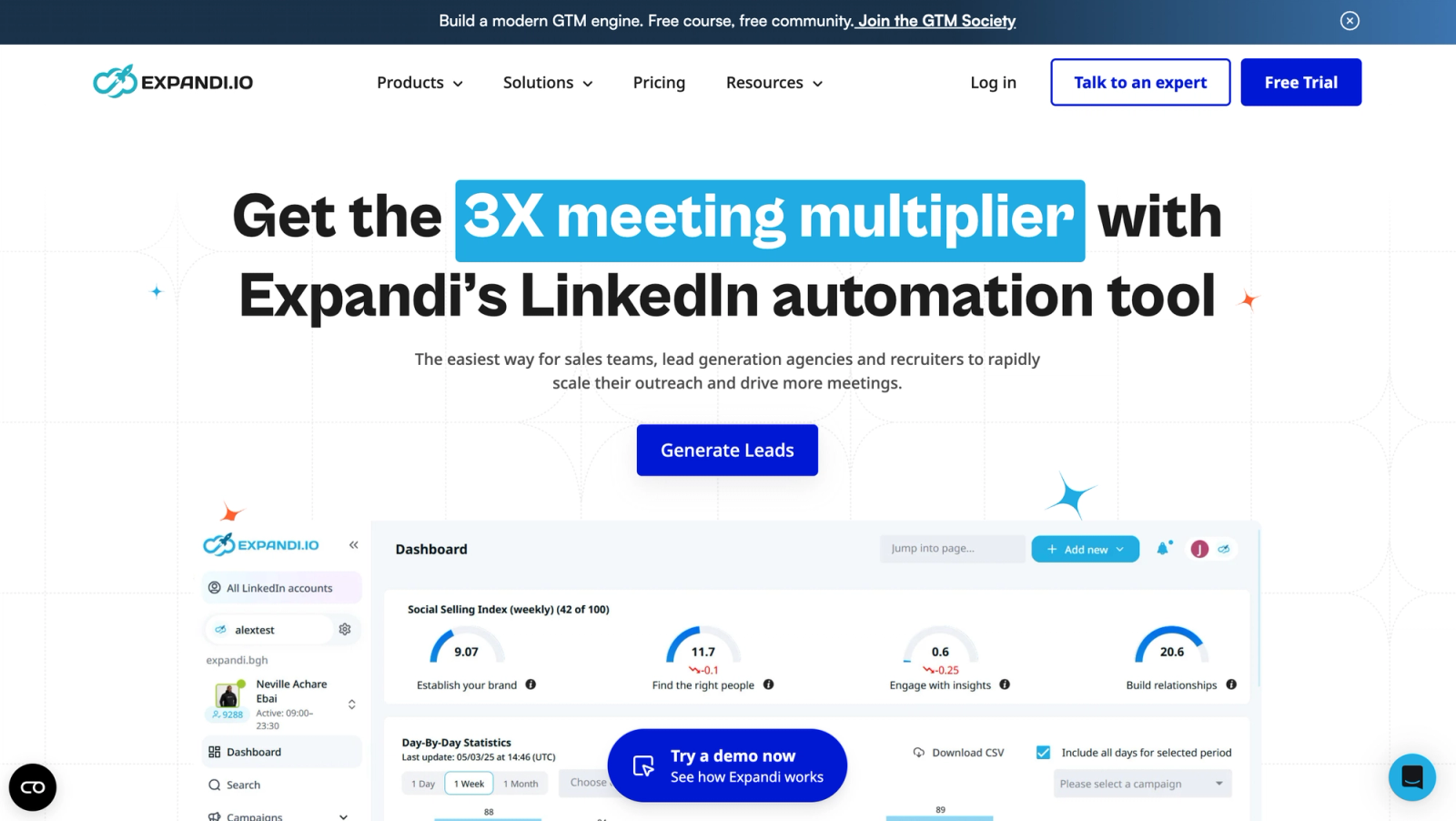
Expandi is a cloud-based LinkedIn automation platform where one seat maps to one LinkedIn account, each running from a dedicated country-based IP address with automatic profile warmup. Campaigns are built with a sequence builder that supports if and action branching rather than a fixed template, mixing connection requests, messages and email follow-ups in a single flow, with engaging actions available between follow-up steps.
The Business plan is $99 a month per seat on monthly billing, with a 7-day free trial and 20 percent off on annual billing. Instead of a fixed monthly quota, Expandi has you set your own daily limit ranges per action type, which its "smart algorithms" then hold to; certain campaign types are built to add volume within that model, such as the Mobile Connector campaign, which adds up to 100 connection requests a week on top of your standard limits. Image and GIF personalization cost extra, and video personalization through Sendspark is a separate paid add-on. Above Business, Expandi's Agency tier is custom pricing for 10 or more seats, or for anyone who wants white label, reached through a sales call rather than a self-checkout page. Tier detail sits on Expandi's own pricing page; our full Expandi review and our Expandi compare page break down the Business and Agency tiers against a multi-sender alternative.
Run several LinkedIn senders from one campaign with Cadency
One campaign across every LinkedIn sender and mailbox, one sender per lead, a dedicated proxy per sender and every reply in one unified inbox.
Private access. From $199 a month with 5 LinkedIn senders.
Which is safer for your LinkedIn account, Waalaxy or Expandi?
Waalaxy and Expandi run on two different theories of account safety, and neither one is a promise. Waalaxy runs in its own cloud, as it has on paid plans since 2022, and by July 2026 it had removed its Chrome extension, so setup stays trivial, with no server or proxy to configure. On the sending side, Waalaxy says each user is assigned a fixed VPN IP as close as possible to their location, shared by up to five users, so there is no dedicated IP per account, and it leaves warm-up to you. Volume is capped by the monthly quota on your tier, 300 to 800 invitations, and Waalaxy's help centre publishes daily ranges per plan: around 11 invitations a day on Pro, and 80 to 100 a day with a maximum of 200 a week on Advanced and Business.
Expandi is cloud-based, so campaigns run on Expandi's own infrastructure through a dedicated, country-based IP address assigned to your seat, with automatic profile warmup on new accounts. Rather than a monthly quota, you set daily limit ranges per action type yourself and Expandi's algorithms are built to stay inside them, which puts the actual safety margin in your hands: a conservative configuration is safer, an aggressive one is not protected just because it is Expandi.
What LinkedIn itself says about invitation limits
Neither vendor controls the ceiling that matters most. LinkedIn confirms that invitation limits exist and can restrict an account that sends too many, but it does not publish the exact number, and both vendors operate around that uncertainty rather than inside a documented rule. That official layer is the same for every plan: LinkedIn states the limit cannot be raised by buying any subscription. Separately, operators report sustained sending well above a free account's baseline on mature, paid accounts, roughly 100 to 250 invitations a week depending on plan and account tenure, though sources disagree on the top end; treat that as a reported pattern, not a published rule. LinkedIn's own help page on invitation limits and restrictions is the closest thing to an authoritative source here, and it is worth reading directly rather than trusting a vendor's summary of it. Neither Waalaxy's cloud nor Expandi's dedicated IP address changes what LinkedIn itself is willing to tolerate; they change how consistent your sending pattern looks in the meantime. Our guide to whether LinkedIn automation is safe covers the platform-level risk in more detail, and our connection limits breakdown covers the weekly invitation math for both free and paid accounts.
What will you actually pay, Waalaxy or Expandi?
The honest answer changes with team size and with where you are billed. Waalaxy prices by country: its help centre gives a euro price as standard, and from outside the euro zone its pricing page served us a separate, lower US dollar grid, not a conversion. Expandi prices in US dollars per seat. Here is what each tier costs on monthly and annual billing, with Expandi as read on 30 September 2026 and Waalaxy on 8 October 2026.
| Plan | Monthly | Annual (per month) | What you get |
|---|---|---|---|
| Waalaxy Pro | €39/user ($19 on the dollar grid) | €19/user ($16 on the dollar grid) | 300 invitations a month, CRM sync, automatic follow-ups |
| Waalaxy Advanced | €99/user ($39 on the dollar grid) | €49/user ($32 on the dollar grid) | 800 invitations, API access, Make, Zapier and n8n modules |
| Waalaxy Business | €139/user ($69 on the dollar grid) | €69/user ($55 on the dollar grid) | 800 invitations, cold email sequences, 500 email finder credits a month |
| Expandi Business | $99/seat | $79/seat | Unlimited campaigns, dedicated country IP, if/action branching, multichannel sequences |
| Expandi Agency | Custom | Custom | 10+ seats or white label, roles and permissions, client reports, dedicated CSM |
What does a team of 1, 5 or 10 actually cost?
Run the entry-level tier of each vendor across a growing team and the gap compounds fast. Waalaxy Pro at €39 a month, $19 on its US dollar grid, scales linearly with seats at list price, and Expandi Business at $99 a seat does the same. The table shows Waalaxy's euro prices with its US dollar prices in brackets, at list prices as read on 8 October 2026 for Waalaxy and 30 September 2026 for Expandi, so it leaves out one discount: Waalaxy's Team plan, available on any tier from 2 licenses, is discounted from 5 licenses.
| Seats | Waalaxy Pro, monthly | Waalaxy Pro, annual (per month) | Expandi Business, monthly | Expandi Business, annual (per month) |
|---|---|---|---|---|
| 1 | €39 ($19) | €19 ($16) | $99 | $79 |
| 5 | €195 ($95) | €95 ($80) | $495 | $395 |
| 10 | €390 ($190) | €190 ($160) | $990 | $790 |
At one seat, the currencies mean the sticker prices are not directly comparable, and the gap depends on which Waalaxy grid you get: Expandi's $99 seat is about five times Waalaxy Pro's $19 on the US dollar grid, and a little over twice Pro's €39 on the euro grid at early October 2026 exchange rates. Either way, Expandi has one self-serve plan while Waalaxy has three tiers under it, and the entry comparison is not entirely fair on features: Expandi's Business plan already bundles multichannel sequences and branching logic, while Waalaxy adds email sequences only at its own Business tier and advertises no custom builder on any tier. At that closer feature match, the price gap closes or flips. On monthly billing, Waalaxy Business at €139 a seat costs more than an Expandi seat at $99; on yearly billing, Waalaxy Business at €69 sits close to Expandi's $79, so at 10 seats it runs €690 a month before any Team plan discount, against $790 for Expandi. Only on Waalaxy's US dollar grid, at $69 a month or $55 billed yearly, does Business stay clearly cheaper. Whichever tier you price, annual billing is the single biggest lever on the bill: it cuts Waalaxy's monthly-equivalent rate roughly in half on the euro grid and takes roughly a fifth off Expandi's.
Apart from Waalaxy's Team plan discount, neither vendor's page states a lower per-seat rate at volume the way infrastructure-first tools do; otherwise both are flat per-seat pricing all the way up, until Expandi's Agency tier switches to a custom quote at 10 or more seats. That is a meaningful difference from a platform priced per sender with a rate that drops as you add senders, which is the model we cover in the alternative section below.
Which is better for agencies, Waalaxy or Expandi?
Waalaxy and Expandi are not close on multi-account operations, because only one of them was built for them. Waalaxy prices and runs one LinkedIn account per seat with no rotation between them: running outreach from three accounts means three separate seats, three separate invitation quotas and, unless you add the inbox add-on, which can centralize several accounts (checked 30 September 2026), three separate places to check for replies. The feature Waalaxy calls "team prospecting" is coordination tooling for teammates each running their own seat, not campaign rotation across multiple senders, and Waalaxy's pages show no white-label option on any tier.
Expandi's Agency tier exists specifically for this problem, though it requires 10 or more seats, or a request for white label, and is reached through a sales conversation rather than a self-checkout page. What it adds over Business is volume discounts, roles and permissions, client reports, template sharing between campaigns, and a dedicated customer success manager; the multi-account basics come earlier, since Workspaces on every plan include a Global Inbox across all accounts and Shared Campaigns that run one campaign across several accounts (checked 30 September 2026). That is real agency infrastructure, built by a vendor that has clearly sold to agencies before, and it is the reason Expandi wins this question outright against Waalaxy: Waalaxy simply was not built to manage several client accounts from one workspace, while Expandi was, from its Business plan up.
Which campaign types and sequence logic do you get, Waalaxy or Expandi?
Waalaxy's homepage advertises "99+ ready-to-use outreach sequences," built from the LinkedIn actions Waalaxy lists as of 30 September 2026: connection requests, messages, follows, profile visits and message requests to members of a group or event. InMail, likes, comments and voice messages are not among them.
Expandi's homepage claims "11 campaign types," though its own guide names ten: Connector, Messenger, Mobile Simulation (Mobile Connector adds up to 100 additional connection requests a week), Open InMail, Company Follow Invite, Group, Event Invite (up to 1,000 attendees), Inbound, Recovery, and Campaign Builder for custom sequences. Its Smart Campaigns page lists the branching conditions as If connected, If followed by you, If visited your profile, If email opened, If Open InMail, and If post liked. Expandi's own pages do not agree on the builder's size either, so we list the actions instead of counting them: connection request, message, InMail and Open InMail, profile visit, follow, like a post, skill endorsement, event invite, invite to follow company, group message and engage with recent post, plus email steps, as read on 30 September 2026.
| Capability | Waalaxy | Expandi |
|---|---|---|
| Ready-made sequences | 99+ ready-to-use outreach sequences (vendor claim) | 10 named campaign types plus a Campaign Builder for custom sequences |
| Automated actions listed | Connection requests, messages, follows, profile visits, message requests to group or event members | Connection requests, messages, InMail and Open InMail, profile visits, follows, post likes, skill endorsements, event invites, company follow invites, group messages, engaging with recent posts, email steps |
| Conditional branching | Not documented on the prospecting page | If connected, If followed by you, If visited your profile, If email opened, If Open InMail, If post liked |
| Weekly or one-off volume boosts | Not documented | Mobile Connector adds up to 100 connection requests a week; Event Invite reaches up to 1,000 attendees |
Waalaxy's list is shorter and better documented; Expandi's is longer and covers more edge cases, such as InMail, post likes and event invites, though its own pages cannot agree on how large the builder actually is.
Whose sequence builder is more capable, Waalaxy or Expandi?
Expandi's sequence builder supports if and action branching, letting a campaign change direction based on whether a prospect accepted, replied or went cold, and it mixes connection requests, messages and email follow-ups inside that one branching flow, with engaging actions available between steps. Personalization goes further too: image and GIF personalization is available at extra cost, and video personalization through the Sendspark integration is a separate paid add-on, options that simply do not exist in Waalaxy's tier list.
Waalaxy's campaign creation means choosing from a library of ready-made sequences rather than drawing your own logic: pick the template closest to what you want, invitation then follow-up message then, on the Business tier, an email step, and Waalaxy runs it. That library is genuinely the fastest way to a first live campaign in the category, and it is also the ceiling, since there is no way to add a conditional branch a template does not already contain. If your outreach logic is simple and matches a standard flow, that ceiling never shows up; if it does not, Expandi's branching builder is the one built to hold it.
Which inbox and team features win, Waalaxy or Expandi?
Waalaxy's Inbox page describes a shared LinkedIn inbox built for outreach teams: saved templates, scheduled follow-ups, labels and lead lists, with message history that stays "synchronized across your team" so a team will, in Waalaxy's words, "never message the same prospect twice." The page also lists roles, permissions and team dashboards, and calls the whole thing a lightweight CRM that runs "directly inside LinkedIn." All of it sits behind the paid add-on noted above, with 500 free conversations before it costs extra.
Expandi's answer is Workspaces: several LinkedIn accounts in one workspace, teammates or customers invited "at no additional cost," and access controlled through predefined or custom roles backed by "100+ permission settings." Its agency page separately advertises "up to 70% off per account with published volume pricing," a rate "locked in for 12 months," and "under 15 accounts? Buy one, get one free," none of which matches the pricing page's own Agency tier, which still routes agencies above 10 seats, or anyone wanting white label, to a sales call rather than a published rate.
Which personalizes messages better, Waalaxy or Expandi?
Expandi's personalization page lists dynamic fields, personalized images and GIFs, dynamic image layers, and a Hyperise sync that requires its own subscription, plus A/B testing of campaigns and icebreakers. Where that sits on the bill depends on which page you read: the pricing page lists image and GIF personalization as an additional cost, while the personalization page itself states no price at all.
Waalaxy's personalization runs through saved templates and sequence templates rather than dynamic image layers. The one different product in its lineup sits outside the Pro, Advanced and Business ladder entirely: Waalaxy.ai, a separate $99 a month product in early access, built around an AI conversation manager and "Unlimited Agents" that source prospects, write sequences and reply to conversations end to end.
Which is easier to set up, Waalaxy or Expandi?
Waalaxy is the faster tool to get running: setup means signing in to its web app with your LinkedIn account, pasting a LinkedIn search URL to import prospects and picking a template from the library, all covered by a 14-day free trial before you pay anything.
Expandi asks for more upfront: each seat gets a dedicated, country-based IP address and its own profile warm-up ramp, which makes the first day heavier to configure, backed by a 7-day free trial instead of 14. Both tools keep sending after you close the browser, and both still bill per LinkedIn account, Waalaxy per user and Expandi per seat, so neither one removes the per-account setup step; the pricing section above already carries the cost side of that trade-off.
Which integrates better, Waalaxy or Expandi?
Waalaxy's homepage claims "2,000+ integrations," delivered mainly through native HubSpot and Pipedrive connections plus Zapier and Make, with CSV, n8n or Make also serving as import paths. Its API uses Bearer-token authentication against endpoints for prospect lists, campaigns and adding a prospect from an integration; the docs do not state which plan the API requires, though the pricing page lists API access from Advanced.
Expandi's integration story is narrower but covers the main CRMs natively: HubSpot, Pipedrive and Salesforce, plus Zapier and webhooks, a route its workspaces page describes as needing "no coding skills," as read on 30 September 2026. On the personalization side it names Hyperise for images and GIFs and Sendspark for video, both paid add-ons. Comparing the two means comparing a wide, pre-built network against three native CRMs plus Zapier and webhooks.
What if you outgrow both Waalaxy and Expandi?
Cadency, built on Swarmhit, is outreach software for sales teams, recruiters and go-to-market agencies that send volume on LinkedIn and email. Like Expandi and Waalaxy, it runs in the cloud, but with a dedicated proxy per sender, where Waalaxy says up to five users share each fixed IP, plus per-sender ceilings and pacing, and checkpoint handling. One campaign runs across every LinkedIn sender and every mailbox, one sender per lead, and every reply lands in one unified inbox, one thread per lead across LinkedIn and email, assignable, with replies sent as any sender. Expandi's Shared Campaigns and Global Inbox also put several accounts behind one campaign and one inbox, as checked on 30 September 2026, but every account there is a $99 seat, while Cadency prices a pool of senders and includes unlimited teammates, mailboxes and workspaces. For more options, see our Waalaxy competitors and Expandi alternatives guides.
Cadency's campaigns have eight LinkedIn steps: profile visit, connection request, message, InMail, a comment on the lead's last post that AI drafts and you approve, voice note, like and follow, with branches on connected, replied or email found, plus waits and A/B tests. Voice notes and post comments are steps neither Waalaxy nor Expandi lists as of 30 September 2026, and InMail is one Waalaxy does not offer. Unlimited Google and Microsoft mailboxes with warm-up rotate in the same campaign as LinkedIn, and leads come from a native people and company database, waterfall enrichment paid per verified hit, or CSV and Sales Navigator imports.
Pricing is monthly, with 30% off on annual billing. Small Team is $199 a month ($139 on annual) with 5 LinkedIn senders and 100k emails a month; Scale is $699 a month ($489 on annual) with 20 senders and 500k emails a month, raised to 1M for +$200 or 2M for +$500. Both plans let you add senders one at a time, $25 each on Scale, and both include unlimited mailboxes, teammates and workspaces, plus the API and webhooks, so any CRM or ATS connects through the API rather than a native sync. Access is private and granted on request. Cadency is not a fit for someone who genuinely wants one seat and nothing else, since at one account it costs more than Waalaxy Pro or an Expandi seat; it is built for the moment either Waalaxy's per-seat ceiling or Expandi's per-account pricing starts costing you replies.
The verdict: Waalaxy, Expandi or Cadency?
Waalaxy wins on entry price and simplicity. €39 a month, or €19 billed yearly, for a first working campaign, no server to configure, and a template library that gets a solo seller or freelancer sending within an afternoon is a genuinely good trade for someone running one account at a modest volume. Where that trade turns, and Expandi's higher price starts to earn itself back, is the moment safety infrastructure or multi-account operations become the actual requirement rather than a nice-to-have: Expandi's dedicated country IP per seat, configurable daily limit ranges, branching sequence builder and agency tier for 10 or more seats are built for exactly that case, at more than twice Waalaxy's entry price on monthly billing.
Where both hit a wall is scaling past a handful of accounts without either per-seat pricing or manual per-account configuration piling up. That is the specific gap Cadency is built to close: one workspace with unlimited teammates, one campaign spread across every LinkedIn sender and mailbox with one sender per lead, and a lower price per additional sender on the larger plan. If you are choosing purely between the two named tools, match the tool to the account count you actually have today, not the one you might have in a year.
Waalaxy at a glance
Pros
- Lowest entry price in this comparison, €39 a user a month or €19 billed yearly
- Fastest route to a first live campaign, thanks to the prebuilt template library
- Steep quarterly and yearly discounts, with annual billing halving the monthly rate
- Sales Navigator and Recruiter Lite list imports built in
Cons
- No custom sequence builder, only a choice of prebuilt templates
- Priced and built one LinkedIn account per seat, with no rotation across senders
- Unified inbox is a separate paid add-on, not included in the base price
- Cloud sending from a fixed VPN IP shared by up to five users, with no managed warm-up
Expandi at a glance
Pros
- Cloud-based with a dedicated country-based IP address on every seat
- Sequence builder with if and action branching, not just templates
- Campaign types built to add volume within limits you configure, such as Mobile Connector
- Agency tier bundles white label, client reports and a dedicated CSM
Cons
- $99 a month per seat, more than twice Waalaxy's entry price on monthly billing
- Image, GIF and video personalization cost extra on top of the base plan
- Agency pricing needs 10 or more seats or a sales call, no self-checkout for larger teams
- You set your own daily limit ranges, so the safety margin depends on how conservative you make them
FAQ
Is Waalaxy or Expandi better in 2026?
Neither is better outright; they are built for different team sizes. Waalaxy is better for one person sending a modest, steady volume who wants the cheapest, fastest setup. Expandi is better once you need a dedicated IP per seat, a real branching sequence builder, or agency tooling for multiple client accounts, at more than twice the entry price.
Which is cheaper, Waalaxy or Expandi?
Waalaxy is cheaper at the entry tier and at every team size on Pro: €39 a user a month, or €19 on yearly billing, against Expandi's only self-serve tier at $99 a seat a month, $79 on annual billing. At 10 seats on yearly billing, Waalaxy Pro runs €190 a month before any Team plan discount, against Expandi Business at $790. At the closest feature match the gap closes: Waalaxy Business costs €139 a month, more than an Expandi seat, or €69 billed yearly. On Waalaxy's US dollar grid, every tier stays cheaper than Expandi, from $19 to $69 a month (Waalaxy checked 8 October 2026, Expandi 30 September 2026).
Is Waalaxy safer than Expandi?
Not necessarily. Both run in the cloud, but Expandi gives each seat a dedicated country-based IP and automated warmup, while Waalaxy says each user gets a fixed IP near their location, shared by up to five users, and leaves warm-up to you. Neither publishes LinkedIn's actual invitation thresholds, and Expandi's safety margin depends on the daily limit ranges you configure yourself.
Is Expandi better than Waalaxy for a growing team?
Once you need more than one LinkedIn account coordinated in one workspace, Waalaxy's per-seat model with no rotation becomes the limiting factor rather than the invitation quota. Expandi is one option, since Workspaces with a Global Inbox and Shared Campaigns come with every plan at $99 per LinkedIn account (checked 30 September 2026); Cadency is a cloud-based alternative from $199 a month with 5 LinkedIn senders included, where one campaign runs across every LinkedIn sender and mailbox, one sender per lead.
Is Waalaxy better than Expandi for a solo seller?
If Expandi's $99 a month per seat is more than a single account needs, Waalaxy's Pro tier at €39 a month, or €19 billed yearly, covers a modest invitation volume with prebuilt templates and no server to configure. The trade is a fixed monthly quota, 300 invitations, and no custom sequence branching, which Expandi's Business plan includes.
Which has a longer free trial, Waalaxy or Expandi?
Waalaxy's free trial runs 14 days; Expandi's runs 7 days. Neither trial requires a paid account count decision upfront, since both let you test the entry tier's features before the daily or monthly limits start to matter at real sending volume.
Does Expandi or Waalaxy support multiple LinkedIn accounts in one workspace?
Expandi does, through Workspaces: several LinkedIn accounts sit in one workspace, teammates or customers get invited at no additional cost, and access runs through predefined or custom roles backed by more than 100 permission settings on Expandi's own workspaces page. Waalaxy only partly: its Team plan, open on any tier from 2 licenses and discounted from 5, puts several LinkedIn accounts on one payment, and the paid Inbox add-on can centralize their conversations, but each license still drives one LinkedIn account, with a coordination feature for teammates rather than true multi-account rotation (checked 30 September 2026).
Is Waalaxy or Expandi easier to set up in 2026?
Waalaxy is easier to set up. Signing in to its web app with your LinkedIn account and picking a prebuilt template takes minutes, with no proxy or IP configuration involved. Expandi asks more upfront, since a dedicated country IP, warmup and your own daily limit ranges need to be reviewed before a campaign should go live at real volume.
Which one should agencies choose, Waalaxy or Expandi?
Expandi, once an agency clears the 10-seat threshold for its Agency tier, which bundles white label, client reports, roles and permissions and a dedicated CSM. Expandi's own agency page also advertises up to 70 percent off per account on published volume pricing with the rate locked in for 12 months, though the pricing page still routes agencies above 10 seats to a sales call rather than a published number. Waalaxy has no comparable agency tooling in its tier list.
Is Waalaxy enough if I only send LinkedIn invitations?
Yes, for a single account at a modest volume. Pro's 300 invitations a month averages to about 10 a day, which is a conservative pace, and Pro, at €39 a month or €19 billed yearly, is the lowest entry point in this comparison. The trade is the fixed monthly quota and the template-only campaign logic, neither of which flexes if your outreach needs change.
Conclusion
Waalaxy vs Expandi is a genuine trade-off, not a close call decided by marketing copy. Waalaxy wins on entry price and simplicity: a cloud app, prebuilt templates and an entry tier at €39 a month, or €19 billed yearly, get a solo seller sending within an afternoon. Expandi wins on documented safety infrastructure and multi-account operations: a dedicated IP per seat, a branching sequence builder and an agency tier built for 10 or more accounts justify its $99 price for teams that have outgrown a single seat.
Buy Waalaxy if you are one person, sending a steady, modest volume from one LinkedIn account, and the template library covers your outreach logic. Buy Expandi if you need a dedicated IP per seat, custom sequence branching, or you are managing client accounts and can clear the Agency tier's seat threshold. If you are past both of those shapes, running several senders as one team, a per-sender platform built to rotate campaigns and consolidate replies is worth pricing against either one.
That per-sender platform is Cadency: one campaign across every LinkedIn sender and mailbox, one sender per lead, with every reply in one unified inbox. It began as our internal test bed for the Swarmhit engine and was never meant to be public, but sales teams, recruiters and agencies asked for it, so we kept it running. Swarmhit itself is the API, for developers who build their own outreach product.


