

Dripify is a cloud-based LinkedIn automation tool built for one person running one LinkedIn account, and for that job it does the job well. Pricing on the vendor's own page, verified September 2026, runs $39 per user per month on Basic when billed annually ($59 monthly), up to $79 on Advanced annually ($99 monthly), plus a 7-day free trial with no credit card required. If you are a solo seller, an independent recruiter or a founder doing your own outreach and want LinkedIn and email sequences in one interface, Dripify is worth trying.
This Dripify review walks through the plans, the campaign builder, the pricing table and the account safety questions people actually search before they buy, so you know exactly what the $39 tier gates and where the per-user model starts working against a team.
Dripify review: what is Dripify and who is it for?
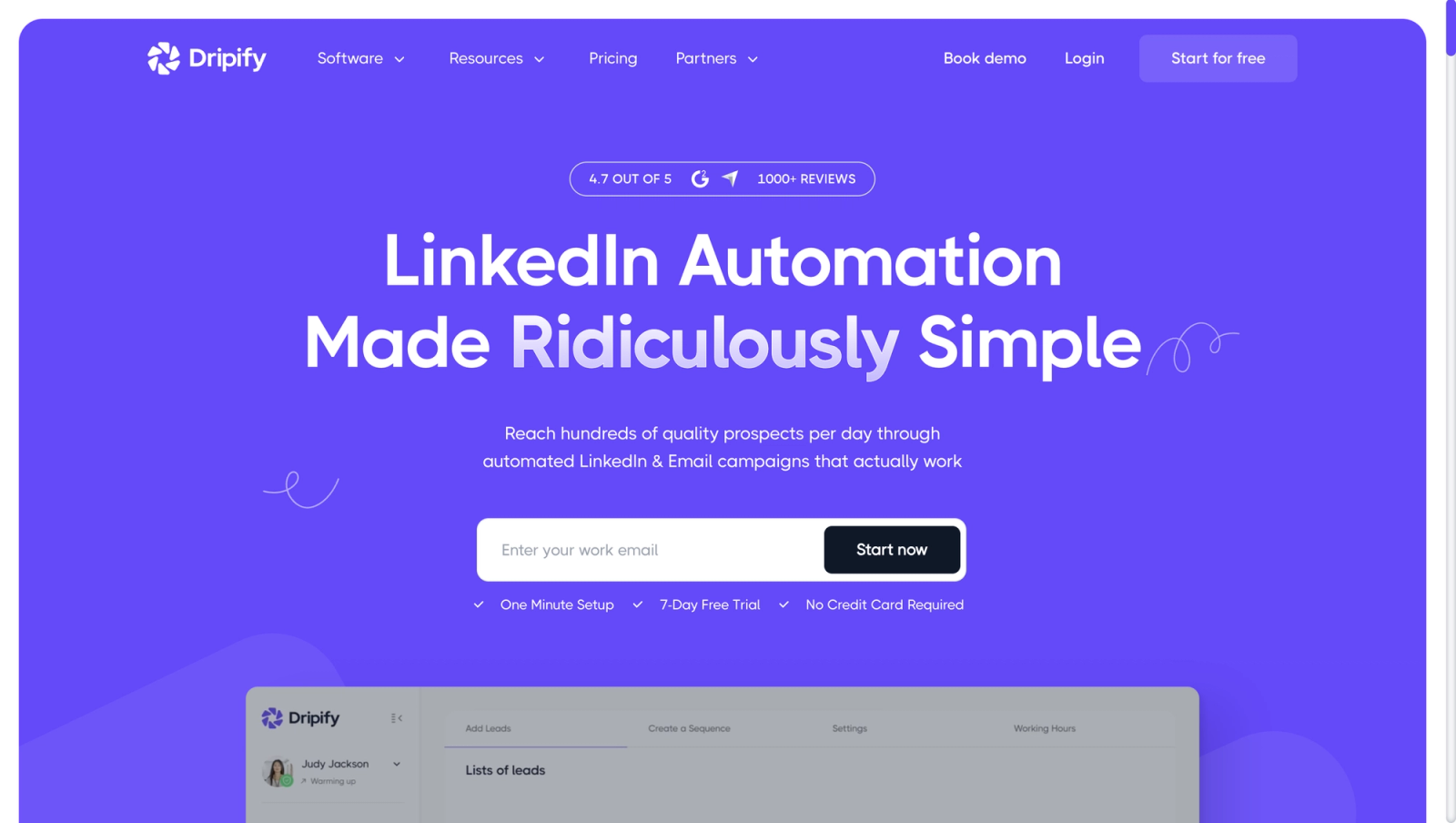
Dripify is a cloud-based LinkedIn automation platform: campaigns run on Dripify's own servers rather than through a browser extension, so a sequence keeps sending after you close the laptop. It combines LinkedIn actions, connection requests and follow-up messages, with email sequences and a built-in email finder inside one drag-and-drop campaign builder.
The product sits within the broader field of LinkedIn automation tools, and what sets it apart there is interface polish rather than raw feature count. It suits a solo seller, an independent recruiter or a founder who wants LinkedIn and email combined without stitching two tools together. Every tier is billed per user per month rather than per sender, so a sales manager who wants reports across five reps' accounts is buying five separate subscriptions rather than one shared workspace, which is worth understanding before the free trial runs out.
What can you do with Dripify's campaign builder and email sequences?
Dripify's core product is a drag-and-drop sequence builder that mixes LinkedIn actions and email steps into one campaign, so a prospect can get a connection request, a follow-up message and an email nudge without you switching tools.
Basic already includes LinkedIn and email sequences plus advanced analytics and reports, so even the entry-level plan gives visibility into how each step is performing, not just how many messages went out. The catch, covered in the pricing section below, is that Basic allows exactly one active drip campaign, which is workable for testing a single message sequence but tight for anyone running more than one audience segment at a time.
Before a campaign goes live, it is worth comparing Dripify against the wider set of LinkedIn prospecting tools, since a campaign builder is only as good as the list feeding it.
Run your LinkedIn outreach on Swarmhit
Multi-sender campaigns, safe sending limits and a unified inbox, from $29 per sender per month on annual billing.
7-day free trial. Cancel anytime.
How does Dripify handle prospecting, the email finder and analytics?
Dripify ships an email finder with 100 credits included on the Basic plan, plus advanced analytics and reporting to track how each campaign step performs.
The finder attaches to whatever prospect list you build inside a campaign, turning a LinkedIn profile into an email address without leaving the tool, which matters if your outreach also runs email follow-ups. Analytics and reporting are listed on the Basic plan, so a solo user is not paying extra just to see which message variant is landing.
What Dripify's own pricing page does not describe is a built-in prospect database. Dripify works from whatever list you already have, whether that is a LinkedIn search, a CSV export or a Sales Navigator list. If cold email carries more of your pipeline than LinkedIn does, it is worth comparing dedicated cold email software rather than treating Dripify's email step as a full replacement.
What does Dripify pricing look like in 2026?
Dripify runs three paid tiers, Basic, Pro and Advanced, each priced per user per month, with annual billing cutting the bill by roughly a fifth to a third depending on the tier.
| Plan | Annual billing (per user/month) | Monthly billing (per user/month) |
|---|---|---|
| Basic | $39 | $59 |
| Pro | $59 | $79 |
| Advanced | $79 | $99 |
| Enterprise | Custom | Custom |
The vendor's pricing page advertises "up to 35% off" on annual billing, and the biggest saving lands on Basic: $39 a month annually against $59 paid month to month, a difference of just over a third. Enterprise pricing is not published; Dripify routes that conversation to a sales call. Every paid tier includes a 7-day free trial with no credit card required, and the vendor's own copy promises a "one minute setup".
What a team actually pays scales in a way that is easy to underestimate from the single-seat price alone. On Basic, one user runs $39 a month on annual billing against $59 on monthly billing; three users run $117 annually against $177 monthly; ten users run $390 annually against $590 monthly. Pro follows the same shape one tier up: $59, $177 and $590 a month annually for 1, 3 and 10 users, against $79, $237 and $790 monthly. Advanced runs $79, $237 and $790 a month annually for the same three headcounts, against $99, $297 and $990 monthly. The detail worth noticing is that the annual discount is a flat $20 per user per month on every tier, Basic, Pro and Advanced alike, so the percentage saving looks biggest on Basic, just over a third, and smallest on Advanced, about a fifth, purely because the base price climbs while the dollar gap stays fixed.
Seven days is a tight window to judge a tool meant to run in the background for weeks, so it is worth deciding in advance what the trial needs to prove. Use it to confirm the drag-and-drop builder matches how you actually sequence a LinkedIn touch and an email follow-up, check that the 100 included email finder credits return addresses you can actually send to rather than bounces, and watch how the one drip campaign cap on Basic feels once you are mid-sequence rather than reading about it on the pricing page. The vendor's "one minute setup" claim refers to getting a first campaign live, not to fully testing account safety behavior, which needs a longer sending window than a week provides.
1
Drip campaign allowed on Dripify Basic, verified September 2026
What tier you land on decides more than the invoice. Basic includes LinkedIn and email sequences, a 100-credit email finder allowance and advanced analytics and reports, but it caps the account at one drip campaign total and limits daily action quotas. Pro is positioned by the vendor for "sellers launching LinkedIn and email campaigns", and Advanced is aimed at "professionals who need stronger account safety and continuous lead flow, solo or as a team". Dripify does not publish the exact quota numbers that Pro and Advanced unlock, so budget the free trial or a sales call to confirm the ceiling matches your sending volume. Our guide to LinkedIn's connection limits is a useful reference point for what a sustainable weekly pace looks like, regardless of which tool enforces it.
The 100 email finder credits bundled into Basic run out fast for anyone prospecting daily. Extra credits are sold in fixed packs on top of the subscription:
| Email finder credits | Price |
|---|---|
| 1,000 | $29 |
| 2,000 | $49 |
| 5,000 | $69 |
| 10,000 | $99 |
At the smallest pack that works out to roughly three cents a credit, dropping toward one cent at the 10,000 pack, so anyone doing heavy email finding should model the credit spend on top of the subscription before comparing Dripify's sticker price to a competitor's.
Broken down per thousand credits, the packs get steadily cheaper the larger you buy: the 1,000-credit pack works out to $29 per thousand, the 2,000-credit pack to $24.50 per thousand, the 5,000-credit pack to $13.80 per thousand, and the 10,000-credit pack to $9.90 per thousand, a difference of roughly two thirds per credit between the smallest and largest pack. Anyone burning through the 100 credits Basic includes within the first week or two of prospecting is generally better off buying the 5,000 or 10,000 pack once, rather than topping up with the smaller packs every month, since the per-credit price roughly triples at the entry pack size.
How does Dripify pricing compare to other LinkedIn tools?
Dripify's $39 annual entry price sits in the middle of the field once you line it up against the other per-seat and per-sender LinkedIn tools we track, based on the figures verified on each vendor's own pricing page.
| Tool | Entry price | Notes |
|---|---|---|
| Dripify | $39 per user/month, Basic, annual | $59 monthly; one campaign cap on Basic |
| Swarmhit | From $29 per sender per month on annual billing ($39 monthly) | Price per sender drops sharply with volume |
| HeyReach | $79 per sender/month, Growth, monthly | Agency tier $999/month for 25 senders |
| Expandi | $99 per seat/month, Business, monthly | 20% off on annual billing |
| Waalaxy | Euro 19 to euro 69 per user/month | Local currency shown on the live pricing page |
For a single seller comparing sticker prices, Dripify's $39 annual entry undercuts HeyReach, Expandi and Swarmhit on a strict per-seat basis, and only Waalaxy's lowest tier comes in lower. The comparison changes once a second or third sender enters the picture. HeyReach and Expandi both price per sender or per seat the same way Dripify does, so their totals scale the same way Dripify's do: roughly three or four times the entry price for three or four accounts. Swarmhit is the outlier in this table because its per-sender price drops with volume rather than staying flat, which matters most once a team is well past the single-seat comparison that decides most solo-seller purchases.
Daily sending volume is a second variable the entry-price table does not show. HeyReach's Growth tier and Expandi's Business tier both compete on flexible campaign logic and configurable daily limits rather than on being the cheapest option, so a team already running near the ceiling of what LinkedIn tolerates in a day is often comparing those two tools on features, not price. Waalaxy's tiers cap the number of monthly invitations directly rather than leaving daily pacing to the user, which suits a lower-volume account better than a team trying to push maximum daily throughput. Where a buyer lands on this table should follow from how many senders are running and how close to the account's tolerances the outreach already sits, not from which entry price looks smallest on the page.
Is Dripify safe for your LinkedIn account?
Dripify is safe in the sense that matters most for LinkedIn's detection patterns: it runs from the cloud rather than a local browser extension, and account safety gets its own callout on the pricing page, as a benefit reserved for the Advanced tier.
Dripify's pricing page does not publish specific daily action limits or the mechanics behind the "stronger account safety" it promises on Advanced. Whether Advanced includes dedicated infrastructure, warmup pacing, or simply looser caps than Basic and Pro is not detailed on the page we checked. Read our breakdown of whether LinkedIn automation is safe for the general risk model behind any tool that automates connection requests and messages, and what triggers a LinkedIn account restriction if you want the specific patterns LinkedIn flags. LinkedIn's own guidance on invitation limits and restrictions is the primary source on what the platform itself watches for, regardless of which automation tool is sending the invitations.
Two practical points apply regardless of which automation tool you pick. The safest setting is usually whatever the vendor ships as its default, because vendors that get customers restricted tend to hear about it. And a tool's marketing claim about safety is a starting point for your own daily volume decisions, not a substitute for them.
Dripify at a glance
Pros
- Cloud-based execution, no browser extension to keep open
- LinkedIn and email sequences combined in one drag-and-drop builder
- Advanced analytics and reporting included even on the entry Basic tier
- 7-day free trial, no credit card required
- 24/7 live support listed on every tier
Cons
- Basic caps you at one drip campaign with limited daily quotas
- Priced per user, so a second or third LinkedIn seat means another subscription
- Stronger account safety is reserved for the top Advanced tier, not the default
- Extra email finder credits are sold in packs on top of the subscription
- Enterprise pricing is not published; you need a sales call to get a number
Is there an alternative to Dripify?
Yes, several, and the right one depends on why you are looking. If you are one person running one LinkedIn account with straightforward drip logic, Dripify's simplicity is genuinely hard to beat, and switching tools rarely pays off. Our Dripify alternatives guide covers the wider field by use case, including budget extension-based tools and multi-sender platforms.
The case for looking elsewhere usually shows up once you add a second sender. Every Dripify subscription is priced per user, so a team of five reps running LinkedIn outreach means five separate subscriptions.
Swarmhit is built around the sender as the unit rather than the seat. Pricing runs from $29 per sender per month on annual billing ($39 monthly), and the price per sender drops sharply with volume. Multi-sender campaigns rotate automatically across whatever pool of accounts you connect, and a unified inbox pulls every reply into one place with assignment and interest tags, so a team is not depending on who happens to be logged into which account. AI personalization drafts from each prospect's profile, recent posts and company news rather than name and company variables alone. Every plan includes a dedicated proxy per sender, managed auto-warmup, health checks and 250+ safeguards monitored 24/7, and CRM connectivity runs through API, webhooks and MCP. For larger fleets and agencies, Swarmhit offers custom pricing based on the number of senders, scoped on a call, including a white-label inbox and reports.
None of this is a knock on Dripify for the job it is built to do. It is a different operating model: Dripify treats each LinkedIn account like a separate rented seat, while Swarmhit treats a pool of senders like one fleet you scale by adding a number, not a new login.
FAQ
How much does Dripify cost in 2026?
Dripify costs $39 per user per month on Basic, $59 on Pro and $79 on Advanced when billed annually, verified on the vendor's pricing page in September 2026. Paying monthly instead costs $59, $79 and $99 on the same three tiers. Enterprise pricing is not published and requires a sales call. A 7-day free trial is available on every paid tier, no credit card required.
Is Dripify worth it?
Dripify is worth it if you are one person running one LinkedIn account who wants LinkedIn and email sequences without juggling two tools, since even the entry tier includes analytics and an email finder. It is a weaker deal once you add a second or third sender, because pricing is per user, not per sender, so every added seat is a new subscription.
Is Dripify safe?
Dripify runs from the cloud rather than a browser extension, which is generally the safer architecture for LinkedIn automation. The vendor does not publish specific daily action limits behind the stronger account safety it promises on Advanced, and that feature sits behind the Advanced tier rather than being the default on Basic. No automation tool can guarantee LinkedIn will never flag an account, so treat any vendor's safety claim as a starting point, not a guarantee.
Does Dripify work without a Chrome extension?
Yes. Dripify is cloud-based, so campaigns run on Dripify's own servers rather than through a browser extension you have to keep open. That is a meaningful difference from extension-based tools, which stop sending the moment you close the tab or shut your laptop; Dripify keeps working in the background once a sequence is live.
How many LinkedIn accounts can one Dripify subscription run?
Dripify prices every tier per user per month rather than per sender, and the vendor's pricing page does not publish a separate multi-account allowance. In practice, running LinkedIn outreach from a second or third account means paying for another user seat, which is the main reason teams running several senders end up comparing Dripify's total bill against per-sender alternatives.
What happens to my Dripify data if I cancel?
Dripify's pricing page does not detail data retention or export policy after cancellation, so we cannot state a verified answer here. Before cancelling any LinkedIn automation subscription, export your prospect lists, tags and campaign results while the account is still active, and confirm directly with support what happens to stored conversation history once billing stops.
Is there a free trial for Dripify?
Yes, Dripify offers a 7-day free trial with no credit card required, and the vendor advertises a one minute setup to get a campaign running. That is enough time to test the campaign builder and email finder on Basic, though it is short for judging deliverability or account safety over a longer sending window.
How does Dripify compare to alternatives?
Dripify compares well on simplicity for a single LinkedIn account, but its per-user pricing and one-campaign Basic cap become limiting once a team runs multiple senders. See the full Swarmhit vs Dripify comparison for a side-by-side on pricing, the campaign model and the inbox, or the broader list of LinkedIn automation tools to see where Dripify sits against the rest of the category.
Conclusion
Dripify earns its reputation as a clean, well-documented tool for one person running one LinkedIn account: the campaign builder is genuinely easy to use, analytics are included from the entry tier, and the 7-day free trial is enough to know if it fits. The honest limits are the one-campaign cap on Basic, per-user pricing that adds up once you run more than one sender, and a safety feature that only ships on the top plan.
Buy Dripify if you are a solo seller, recruiter or founder who wants LinkedIn and email sequences in one interface on a single account. Look elsewhere, including at multi-sender platforms built for teams, if your outreach already runs across two or more LinkedIn accounts and you need one workspace instead of several logins.


