

LinkupAPI is a Paris-based API that connects AI agents and B2B software to LinkedIn, WhatsApp and email mailboxes through one interface. Since its 2026 pricing change it bills per connected account, not per credit: $55 a month for up to 10 accounts, then $5.50 down to $4.50 per account, with usage unlimited and the bill capped at $3,000 a month. An MCP server ships on every plan. That puts its entry price level with Unipile's, and the cap is what sets it apart for large fleets; it is also one of the youngest products in the category, with the gaps that youth implies.
This LinkupAPI review covers what the API actually does, its verified 2026 pricing, the safety model, the places where the documentation contradicts the marketing, and when a managed engine makes more sense than raw endpoints. Every claim was re-checked against LinkupAPI's own site, pricing page, docs, terms, privacy policy and sub-processor list on 5 October 2026, the same way we reviewed Unipile and the rest of the LinkedIn infrastructure field.
What is LinkupAPI, and which Linkup is this?
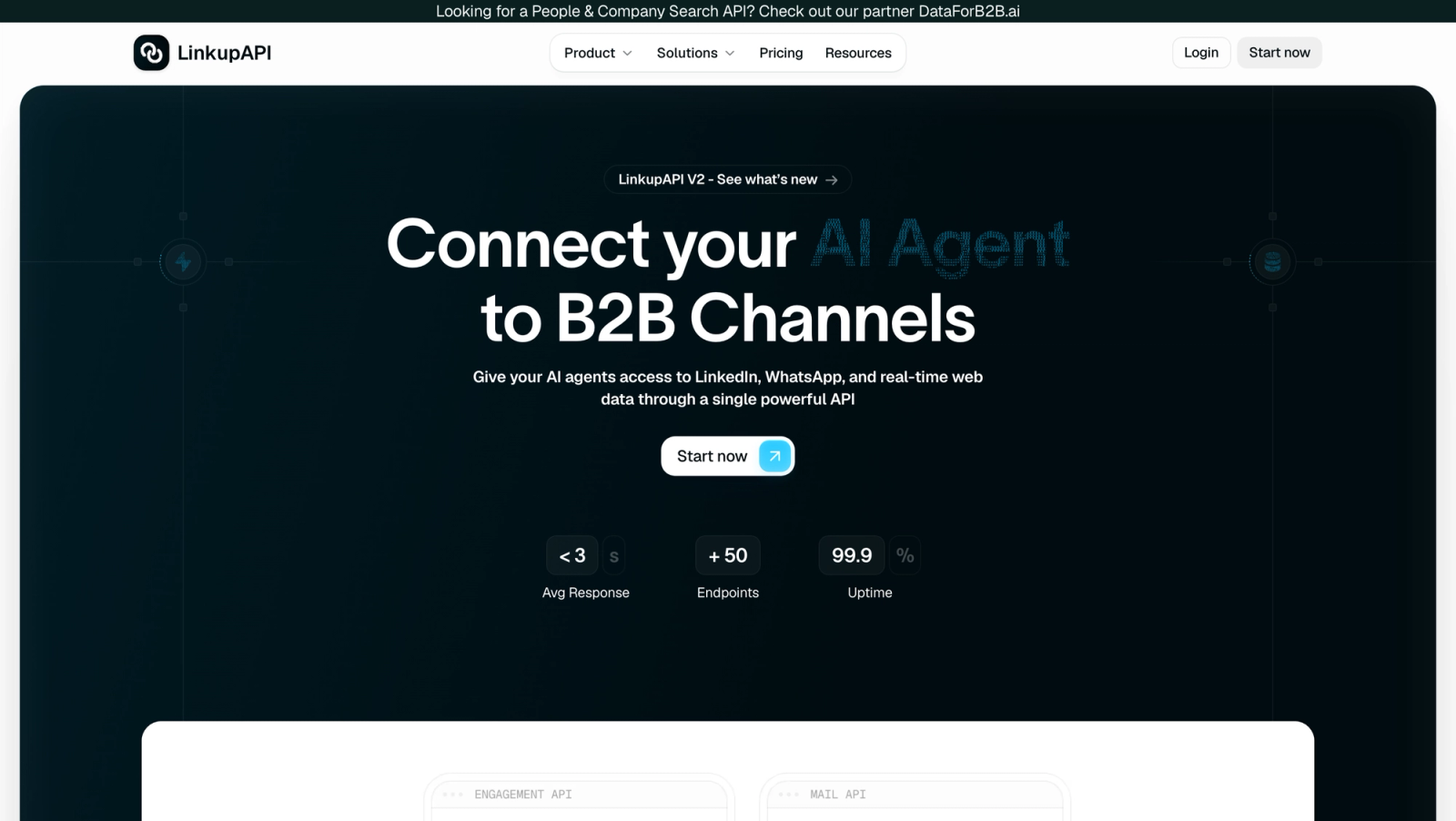
Three unrelated products share this name, and most search results confuse them. Linkup at linkup.so is an AI web search API used for retrieval pipelines. LinkUp at linkup.com sells job market data. LinkupAPI at linkupapi.com, the subject of this review, is a LinkedIn and WhatsApp automation API for developers, operated by LINKUPAPI SAS in Paris. Its terms of use are dated February 2025, which makes it one of the youngest vendors in the category. Check the domain before you compare pricing or reviews, because directories regularly mix the three up.
The pitch is one API between your software and B2B channels. Three products sit behind 50+ endpoints: an Engagement API for LinkedIn actions (messages, invitations, Sales Navigator InMails, comments, likes, posts and searches), WhatsApp messaging and email sending from Gmail, Outlook or any SMTP and IMAP mailbox; a Prospect Data API for people search, full profiles, company data, job postings and funding rounds; and a Mail API for finding and verifying professional email addresses. Version 2 is action-based, one endpoint per category with an action field selecting the operation, and its documentation index lists 67 actions, while the published OpenAPI file still describes only the 33 version 1 routes. An unusual extra is a set of recruiter endpoints for job postings and candidate CVs, which most direct competitors do not expose.
Accounts are the customer's own. The API accepts the account's email and password, a session token, or SMTP credentials for a mailbox, and the pricing page now lists a hosted login as well, so your application no longer has to collect LinkedIn passwords itself if you route users through it. Each connected account gets a dedicated IP, and a dedicated checkpoint endpoint handles two-factor codes and in-app validations when LinkedIn challenges a login.
The documentation is better page by page than at the machine-readable layer. Most of the 74 version 2 pages carry a parameter reference and a response example, there is a full error-code table, the webhook signature guide ships code in several languages, and a hosted webhook mode streams events over SSE with 30 days of history. But the OpenAPI file the docs publish still describes the V1 API, 33 routes with no examples and no authentication scheme, so Postman or a code generator gets the API being deprecated; version 2 uses one POST endpoint per category with an action field; no idempotency key is documented for sends; and webhook signing is off by default. Our Swarmhit vs LinkupAPI page compares both developer surfaces line by line.
How much does LinkupAPI cost in 2026?
Pricing is per connected account, in US dollars excluding VAT, billed upfront each month, as read on the LinkupAPI pricing page on 5 October 2026. One account is one LinkedIn profile, one Gmail or Outlook mailbox, or one WhatsApp number. Accounts added during the month are billed at the end of the cycle on the peak number connected at the same time, then added to your plan, unless you turn auto-upgrade off to cap the count. There is no annual option, no free tier and no published trial.
$55/mo
LinkupAPI's entry price for up to 10 connected accounts, with unlimited usage and a $3,000 monthly cap (verified October 2026)
| Connected accounts | Price | Monthly bill, LinkupAPI's own example |
|---|---|---|
| Up to 10 | $55 a month, flat | $55 for 10 accounts |
| 11 to 50 | $5.50 per account | $275 for 50 accounts |
| 51 to 200 | $5.00 per account | $1,000 for 200 accounts |
| 201 to 640 | $4.50 per account | $2,880 for 640 accounts |
| Unlimited | $3,000 a month, flat | $3,000 for 2,000 or 10,000 accounts |
Two details decide what those numbers mean. First, the band rate applies to every connected account, not only to the ones inside the band: LinkupAPI's own examples bill 200 accounts at $1,000, which is 200 times $5.00, and 640 at $2,880, which is 640 times $4.50. So 60 accounts cost $300 a month, not $55 plus a mix of rates. Second, usage is unlimited on these plans, so a busy sender costs the same as an idle one, the reverse of the old credit model. Credits survive in two places only: the documentation still meters actions in credits as a unit, and email finder and verifier lookups are billed in credits on every plan, at a price the pricing page does not publish. Against Unipile the grid is identical in dollars up to 640 accounts ($55 for 10, then $5.50, $5.00, $4.50, applied the same way), so the real difference is the cap: Unipile keeps billing $4.50 per account up to 1,000 and $4.00 then $3.50 beyond, while LinkupAPI stops at $3,000, which is cheaper from roughly 670 accounts.
Two soft spots are worth knowing before you subscribe. The terms of use, dated 28 February 2025, were not updated for the new model: they still describe "subscription plans that include API credits", a credit expiration rule "as described in the pricing documentation" that the pricing page no longer contains, and a refund policy that applies "only if no API credits have been consumed". And a security page still promises "priority support for premium plans", a plan name that no longer exists. Neither is disqualifying; both are the paperwork of a very young product that changed its business model faster than its legal pages.
Does LinkupAPI run campaigns, or just actions?
The homepage says you can "run multi-step LinkedIn outreach campaigns" and "launch sequences". The documentation says otherwise: across the version 2 action index there are no campaign, sequence or scheduling endpoints, only primitives, and LinkupAPI's own MCP page says it plainly: "No campaign builder, no settings." Its campaign tutorial is a client-side recipe built on webhooks, and its architecture guidance tells you to process API calls through a queue with random delays between jobs. The sequencing engine, campaign state, reply handling and retry logic are yours to build, now with the help of Claude Code skills from the web app that scaffold the integration. That is the same gap we documented for Unipile, and it is the most underestimated line item in the build-versus-buy decision for outreach products.
Is LinkupAPI safe for LinkedIn accounts?
On LinkedIn, LinkupAPI enforces no limits of its own. Its best practices page states that nothing is limited on their side and your account hits the same ceilings as in the LinkedIn interface. What it publishes instead are recommendations: 80 to 100 invitations a day on a paid account, about 200 a week, 30 to 50 messages, around 100 profile views, a two to three week warm-up on new accounts, and real accounts only; for WhatsApp, 20 to 30 new conversations and about 100 messages to existing chats a day. Email is the exception: connected mailboxes carry a LinkupAPI-side daily limit, 40 sends by default in its examples. Nothing stops your LinkedIn code from exceeding the recommendations, and the terms are blunt about where the risk lands: providers may restrict or suspend accounts at their discretion, LinkupAPI is not liable for those restrictions, and you remain responsible for actions as if you had performed them from the account yourself. Our guide to whether LinkedIn automation is safe covers what actually decides account health.
One compliance claim deserves scrutiny. Solution pages advertise a "zero-storage architecture" that will "never store credentials", and the homepage narrows it to "passwords never stored". The legal pages say otherwise: the terms store "connected-account tokens and credentials (encrypted at rest)" and message data, the privacy policy lists session tokens, OAuth tokens and SMTP or IMAP credentials encrypted at rest and keeps API logs, including message data, for up to 12 months, and a sub-processor page dated September 2026 places that data at rest on servers in the European Union. The legal notice, meanwhile, says LinkupAPI "does not store or process any personal data on its servers", which its own privacy policy contradicts. Encrypted credential storage is a normal design for this category; advertising zero storage while documenting the storage is not. The same pattern touches reliability: the homepage advertises 99.9% uptime while the terms provide access "on a best-effort basis" with no SLA. Read the legal pages, not the landing pages, before your compliance review.
What do users say about LinkupAPI?
Little that can be checked. The homepage now shows nine well-known logos, including Accenture, Bain & Company, ColdIQ, a16z and Index Ventures, under the line "trusted by teams building outreach into their product", but nothing on the site says whether they are customers, partners or investors, and no case study or named quote backs any of them; the only names on the page belong to fictional personas in product mockups. We could not verify a G2 profile: G2 blocked our requests and a G2-restricted search returned none. Adopting LinkupAPI still makes you an early customer, with the pricing leverage and the platform risk that implies. If an account restriction costs you a client relationship, the terms cap the vendor's liability at twelve months of fees.
LinkupAPI at a glance
Pros
- A $3,000 monthly cap for unlimited accounts, cheaper than Unipile from roughly 670 accounts
- Unlimited usage on every plan: a busy sender costs the same as an idle one
- LinkedIn, WhatsApp and email mailboxes on one API and one per-account price
- MCP server on every plan, with setup guides for Claude, ChatGPT, Cursor, Gemini, VS Code and Windsurf
- Dedicated IP per account, hosted login, and a first-class checkpoint endpoint for 2FA
- Recruiter endpoints for job postings and candidate CVs that most direct competitors do not expose
Cons
- No campaign or sequence endpoints despite the marketing; the orchestration layer is yours to build
- No SDKs, no annual billing and no published free trial; refund terms still written for credits
- Terms dated February 2025 still describe the retired credit plans
- Legal pages contradict the zero-storage marketing: tokens and credentials are stored encrypted at rest
- Logos without a customer label, no named testimonials, no verifiable G2 profile
- No enforced LinkedIn safety limits: recommendations only, with account risk contractually on you
Is there an alternative to LinkupAPI?
It depends on which half of the product you are buying. For raw LinkedIn primitives, Unipile now matches LinkupAPI's dollar grid up to 640 accounts and adds Instagram, Telegram and calendars, SDK tooling and a longer track record; Linked API prices per seat, $49 a month on annual billing, for LinkedIn only; and Edges meters records and sending identities separately. Our guide to Unipile alternatives compares that raw API field with verified pricing.
If what you actually need is outreach that works from day one, the comparison changes category. Swarmhit is the managed layer: multi-sender campaigns with rotation, a unified inbox with AI interest tags, AI personalization drawn from each prospect's profile, posts and company news, and managed account safety on every plan, with a dedicated proxy per sender, auto-warmup, health checks, smart caps and 250+ safeguards monitored 24/7. The same engine is exposed to your product or agents through the API and webhooks, and our Swarmhit vs LinkupAPI page compares the two side by side. Pricing is public: LinkedIn is tiered per connected sender, from $16.90 a month for the first 50 down to $6.90 between 1,501 and 2,500 senders, and cold email, in beta, starts at $59 a month for 50,000 sends. Each band is priced at its own rate, so adding senders lowers what the next ones cost rather than repricing the fleet you already have.
| LinkupAPI | Unipile | Swarmhit | |
|---|---|---|---|
| What you get | LinkedIn, WhatsApp and email primitives, billed per account | Unified messaging API across many channels, per account | Managed outreach engine plus API and webhooks |
| Campaigns and sequencing | None; build your own queue | None; build-it-yourself guide | Built in: multi-sender campaigns with rotation |
| Account connection | Credentials, session token or hosted login | Hosted auth flow for end users | Accounts you own and connect, with managed safety |
| Safety model | Recommendations only, no enforced limits | Transport protections, pacing left to your code | Warmup, health checks and smart caps enforced |
| Verified 2026 pricing | $55 for 10 accounts, then $5.50 to $4.50 per account, $3,000 cap | From 49 EUR or $55 a month for 10 accounts, then per account | From $16.90 per sender a month, tiered down to $6.90 |
| Best for | Cost-sensitive builders wiring their own engine | Multi-channel products that need hosted auth | Teams and AI builders who want the engine already running |
Want the engine, not just the endpoints?
Swarmhit ships multi-sender LinkedIn campaigns, a unified inbox, and managed account safety, with API and webhook access. Pricing is public: LinkedIn is tiered per connected sender, from $16.90 a month for the first 50 down to $6.90 between 1,501 and 2,500 senders, and cold email, in beta, starts at $59 a month for 50,000 sends.
We do the sequencing work. You build the rest.
FAQ
Is LinkupAPI the same as Linkup?
No. LinkupAPI (linkupapi.com) is a LinkedIn and WhatsApp automation API for developers. Linkup (linkup.so) is an AI web search API for retrieval, and LinkUp (linkup.com) sells job market data. The three companies are unrelated, and search results and directories regularly mix them up, so verify the domain before trusting any pricing or review you find.
How much does LinkupAPI cost in 2026?
LinkupAPI costs $55 a month flat for up to 10 connected accounts, then $5.50 per account from 11 to 50, $5.00 from 51 to 200 and $4.50 from 201 to 640, and an Unlimited plan at $3,000 a month flat, all in US dollars excluding VAT. The band rate applies to every connected account, so 60 accounts cost $300 a month. Usage is unlimited, with credits kept only for email finder and verifier lookups. Billing is monthly and upfront, with no annual option and no published free trial.
Is LinkupAPI safe for LinkedIn accounts?
LinkupAPI ships proxies, checkpoint handling and conservative recommendations, but it enforces no limits of its own and its terms place restriction risk entirely on you. Outcomes depend on the pacing and warm-up behavior your code implements. Our LinkedIn automation safety guide covers the behavioral rules that actually decide account health.
Does LinkupAPI have an MCP server?
Yes. An MCP server is included on every plan at no extra cost, at mcp.linkupapi.com, authenticated with OAuth 2.1 with PKCE or an API key, with setup guides for Claude, ChatGPT, Cursor, Gemini, VS Code and Windsurf. An AI agent can drive LinkedIn actions through it directly, though it works with primitives rather than campaigns, so durable outreach state still needs to live somewhere else; our LinkedIn MCP vs API guide covers when each interface fits.
Does LinkupAPI run outreach campaigns?
No. The documentation exposes no campaign, sequence or scheduling endpoints, and LinkupAPI’s own guidance tells you to build a queue with random delays. You write the sequencing logic, reply stops and retries yourself, or use a managed engine such as Swarmhit that ships them behind an API.
What is the best LinkupAPI alternative?
Unipile is the closest raw-API alternative, with the same dollar grid up to 640 accounts, more channels and a longer track record; Linked API and Edges are the LinkedIn-only options. For teams that want a working outreach engine with programmatic access through API and webhooks, Swarmhit is the managed alternative. Our Unipile alternatives guide compares the whole field with verified pricing.
Conclusion
LinkupAPI earns a place in the 2026 LinkedIn infrastructure field for two reasons: the $3,000 cap makes it the cheapest raw API on this list for fleets above roughly 670 accounts, and the MCP server is genuinely useful for agent builders. Below that size, its price is Unipile's price, and the choice comes down to channels, tooling and track record. The reservations are equally real: it is a very young product whose marketing runs ahead of its documentation on campaigns, storage and uptime, whose legal pages still describe a pricing model it retired, and everything above the primitives is still your engineering. Builders comparing the raw APIs should read our Unipile review and the wider outreach API roundup next; teams that want the outcome rather than the plumbing can skip the assembly entirely.
Want the engine, not just the endpoints?
Swarmhit ships multi-sender LinkedIn campaigns, a unified inbox, and managed account safety, with API and webhook access. Pricing is public: LinkedIn is tiered per connected sender, from $16.90 a month for the first 50 down to $6.90 between 1,501 and 2,500 senders, and cold email, in beta, starts at $59 a month for 50,000 sends.
We do the sequencing work. You build the rest.


