

Unipile is a unified messaging API priced per connected account: EUR 49 ($55) a month covers your first 10 accounts, then the whole fleet bills at EUR 5.00 per account, falling to EUR 3.00 with volume. Edges is a LinkedIn-only action API with two meters, identities plus credits, and a realistic outreach floor near $198 a month. Neither ships a sequencer, lead storage or an inbox: whichever you pick, the outreach layer is yours to build.
Every figure below comes from the two vendors' own pricing pages and calculators, verified August 30 and re-checked September 5, 2026. That matters here more than usual, because the only head-to-head either vendor publishes is Edges' own comparison page about Unipile, and it does not contain a single price for either product. Unipile's site, as far as we could find, does not mention Edges at all. Both pages also skip the same third topic: the sequencer, storage and inbox that neither product includes. This article covers all three.
What are Unipile and Edges actually selling?
They overlap on LinkedIn and diverge everywhere else.
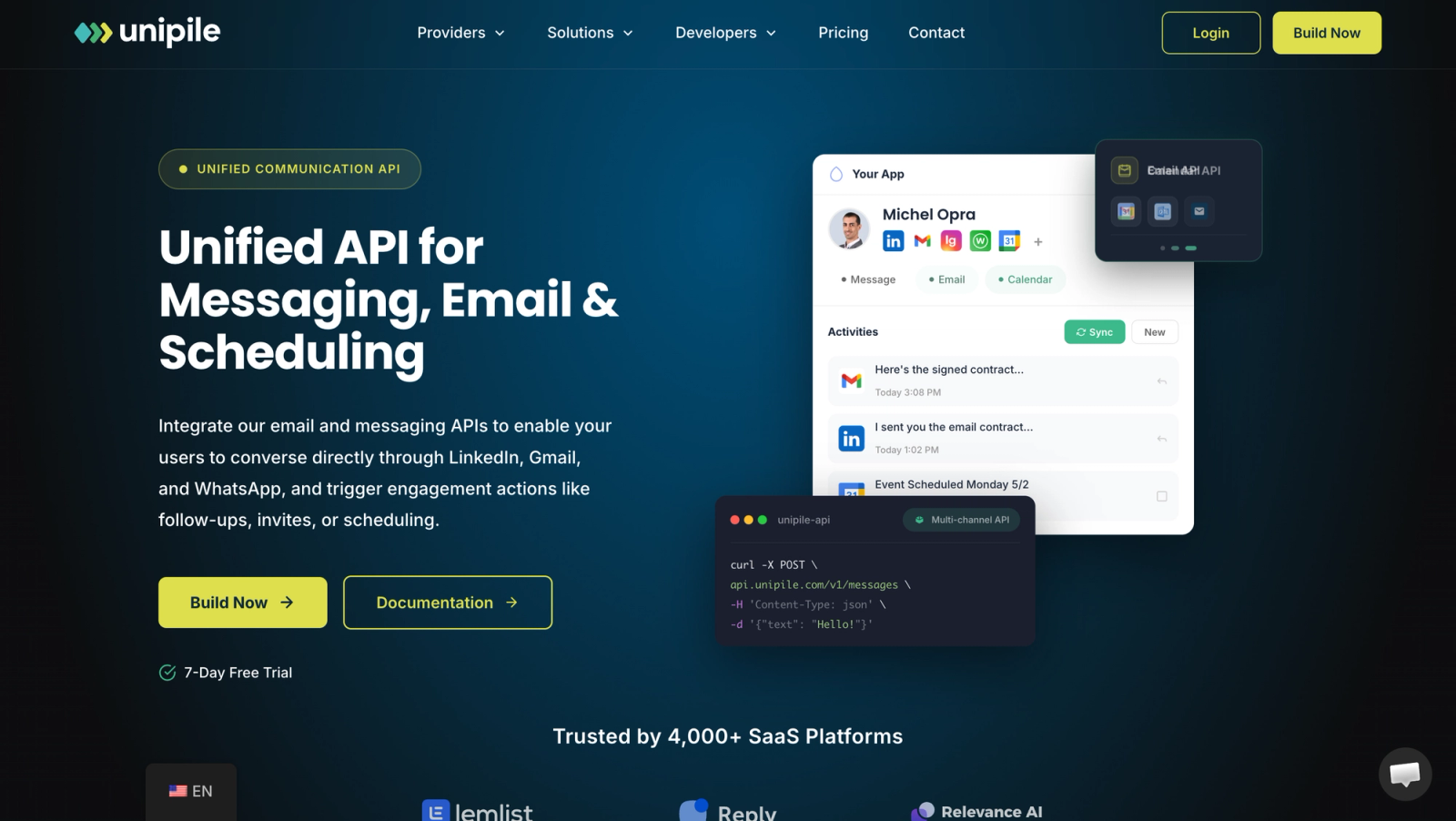
Unipile is a unified multichannel messaging API: LinkedIn, WhatsApp, Instagram, Telegram, Gmail, Outlook, IMAP email and Google and Outlook calendars behind a single REST schema, with hosted white-label authentication, realtime webhooks, and built-in proxy and quota management. It is built for SaaS products that embed messaging: your users connect their own accounts, your code acts through them. Our full Unipile review takes it apart feature by feature.
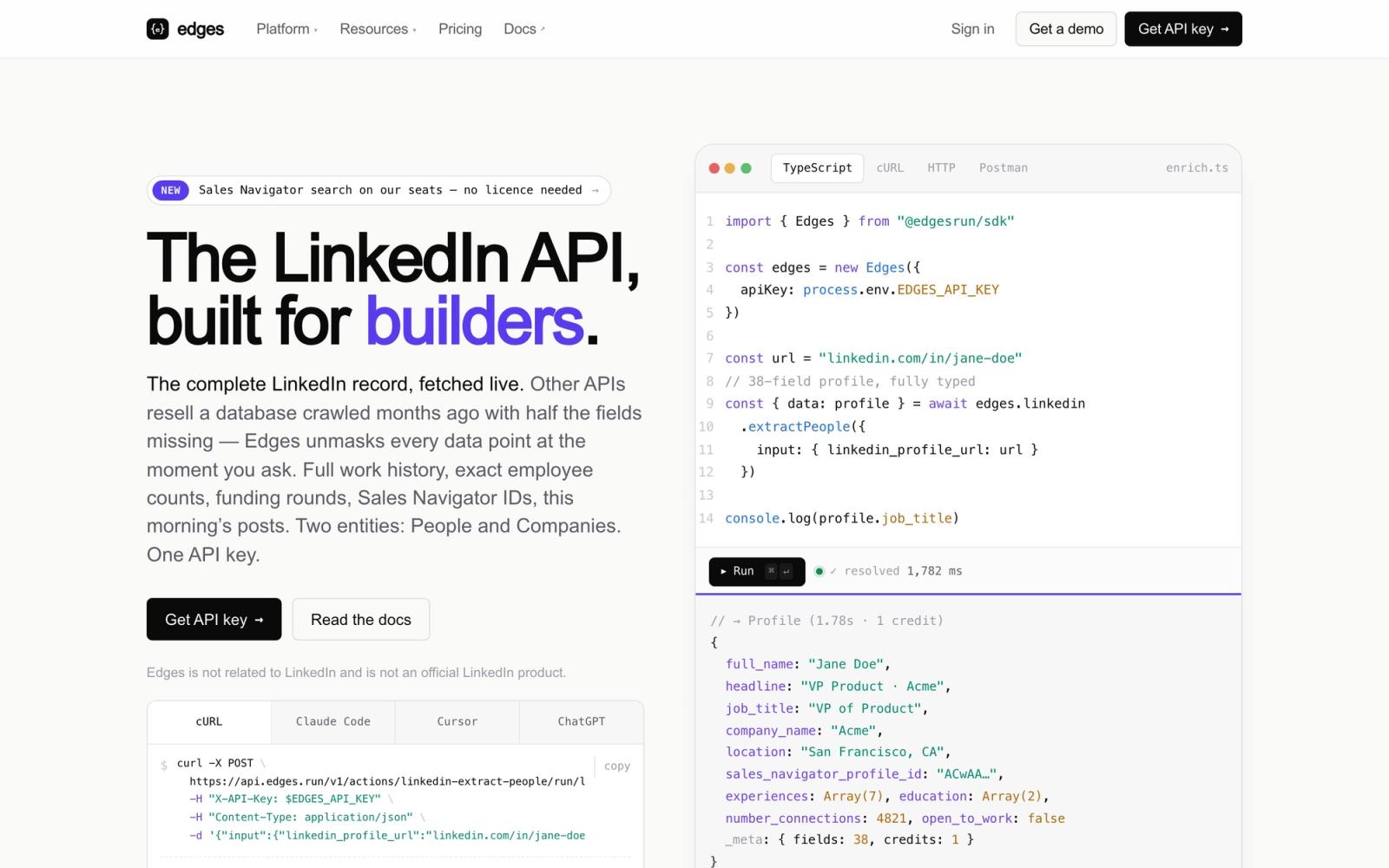
Edges (edges.run) is a LinkedIn action API and nothing else: 70+ endpoints per its pricing page, with Sales Navigator as a first-class surface, scheduled and async runs, cron triggers, and pools of automation identities with per-seat rate limits and automatic ramp-up. Its comparison page positions Edges as an action API for LinkedIn work and frames Unipile as a narrower inbox-style connector. Our Edges review covers the product on its own terms, including the 81 documented base actions we counted in its docs.
The asymmetry in how they talk about each other is telling. Edges dedicates a whole comparison page to Unipile, stamped last reviewed April 20, 2026, that concedes Unipile's strength in email and WhatsApp and even suggests the two can coexist. Unipile ignores Edges entirely. Neither page prints one concrete number for the competitor, which is why the tables below exist.
How does each one get LinkedIn access: your accounts or a managed pool?
This is the structural fork, and it decides more than pricing does.
Unipile is open about its method: for LinkedIn, WhatsApp and Instagram it works through reverse engineering, acting as a technical intermediary between your application and accounts that you or your users connect. Actions run on behalf of the authenticated user, within workflows that user initiates, and Unipile explicitly disclaims building any independent database of LinkedIn profile data. Proxies and quota management are built into the service, but its FAQ pushes the judgement calls back to you, advising customers to implement conservative usage rules including message pacing.
Edges sells the opposite promise on its homepage: "No cookies, no LinkedIn account". That pitch covers the data side, where reads run on a managed session pool Edges operates. The outreach side is different, and worth being precise about because the homepage line blurs it: an Edges identity is a real LinkedIn or Sales Navigator account that sends invites, messages or InMails, connected by you. Its pricing FAQ confirms that reads on a connected seat are free and engagement-mode sends cost 0 credits precisely because the identity is already paid for. A managed identity mode bills 1.5x standard credits, and rented-account monthly rates are no longer published on the pricing page, so we could not verify what renting a seat currently costs.
Legally, neither model is sanctioned: LinkedIn's user agreement prohibits third-party automation and unauthorized scraping regardless of whose sessions do the work. The difference is where the exposure sits. With Unipile, the accounts at risk are yours and the actions are user-initiated. With Edges' pool-based reads, you are consuming data from sessions you do not control, under terms that push responsibility back onto the customer. We unpacked that lineage, the indemnification language and the liability cap in the risk section of our Edges alternatives guide, and it belongs in your evaluation.
How do the two pricing models compare in 2026?
One meter versus two.
Unipile: one meter, connected accounts. EUR 49 ($55) per month minimum covers up to 10 linked accounts, then the entire fleet bills at a single per-account rate set by your volume tier. Verified August 30 and re-checked September 5, 2026 on Unipile's pricing page, exclusive of VAT:
| Linked accounts | EUR per account/month | USD per account/month |
|---|---|---|
| Up to 10 | EUR 49 flat | $55 flat |
| 11 to 50 | 5.00 | 5.50 |
| 51 to 200 | 4.50 | 5.00 |
| 201 to 1,000 | 4.00 | 4.50 |
| 1,001 to 5,000 | 3.50 | 4.00 |
| 5,001 and above | 3.00 | 3.50 |
Two prints worth knowing. First, billing is post-paid on the peak number of accounts linked simultaneously in each 30-day window, a model that produces surprise invoices if test accounts linger; our Unipile review covers how that bites. Second, Unipile's own page disagrees with itself on the 51 to 200 band: the FAQ price table says EUR 4.00 while the calculator and the FAQ's own worked example, 60 accounts billed at EUR 4.50 each for EUR 270, both say 4.50. The USD column reads $5.00 in both places. We priced everything below with the calculator's 4.50.
Edges: two meters, identities plus credits. Verified September 5, 2026 on Edges' pricing page. Identities start at $8.79 each and graduate with volume: 50 identities cost $439 a month, 200 cost $1,423 (an average of $7.12), 1,000 cost $5,764 ($5.76 average) and 10,000 cost $42,020 ($4.20 average). Credits meter data operations at a base rate of $43.99 per 1,000, dropping to $27.49 per 1,000 at the Bronze 10k tier, $275 a month; the slider's floor is 2,500 credits, about $110, once you buy any credits at all. All 70+ endpoints are available on every tier. Annual discounts run 8% on a 1-year commitment, 12% on a 1-year one-shot prepay, 10% on a 2-year contract and 15% on a 3-year contract.
Trials. Unipile offers 7 days, no card, all endpoints. Edges offers a renewable free tier of 100 credits and 1 identity, also without a card.
For how these models compare to the rest of the category, our LinkedIn API pricing guide prices every major vendor on one page.
What does each cost at 10, 50 and 200 accounts?
Here is the table neither vendor will print. Unipile totals are computed from its EUR ladder, with the USD figure from its own published USD list, not converted by us. Edges totals combine its identities ladder with a credits range from the $110 minimum to a $275 Bronze 10k block; heavier data use costs more.
| Fleet size | Unipile (monthly) | Edges (monthly) |
|---|---|---|
| 10 accounts | EUR 49 ($55), flat minimum | $88 identities + $110 credit minimum: about $198 |
| 50 accounts | EUR 250 ($275), at EUR 5.00 each | $439 identities + $110 to $275 credits: $549 to $714 |
| 200 accounts | EUR 900 ($1,000), at EUR 4.50 each | $1,423 identities + $110 to $275 credits: $1,533 to $1,698 |
The method matters, so we tested it rather than assumed it: Unipile applies the tier rate to the whole fleet, not to marginal bands. Its calculator prices 11 accounts as 11 x EUR 5.00 = EUR 55, and the 60-account FAQ example bills all 60 at EUR 4.50. That produces a quirk the page never mentions: 51 accounts bill EUR 229.50, less than the EUR 250 that 50 accounts cost, so the 51st account lowers your invoice. And if the FAQ table's EUR 4.00 rate is what actually lands on invoices, the 200-account row drops to EUR 800.
Two honest caveats before you read the gap as a verdict. Edges' identity price buys more per unit: enforced per-seat rate limits, automatic ramp-up for new identities, and messaging at 0 credits in engagement mode. And Unipile's column assumes you already own 50 or 200 warmed LinkedIn accounts, because sourcing and warming them is entirely your problem. Edges' own FAQ also says a customer who only sends and never enriches pays $0 on credits, which would bring its 10-account floor down to $88, but any real outreach build searches and enriches before it sends.
What can each API actually do on LinkedIn?
| Capability | Unipile | Edges |
|---|---|---|
| Messaging and InMail | Yes, 10 messaging endpoints in the unified schema | Yes, 0 credits in engagement mode on a paid identity |
| Invitations | Send and cancel | Yes, with per-identity pacing |
| Profile retrieval and editing | Yes, plus relations and followers lists | Yes, via extract and enrich actions |
| LinkedIn search | Yes | Yes, with Sales Navigator search as a first-class surface |
| Account types | Classic, Recruiter and Sales Navigator | LinkedIn, Sales Navigator, Recruiter Lite |
| Scheduled actions | No | Yes, async jobs and cron schedules with chained pipelines |
| Channels beyond LinkedIn | WhatsApp, Instagram, Telegram, email, calendars | None |
| Inbound events | Realtime webhooks | Action callbacks on async and scheduled runs |
| Hosted auth for end users | Yes, white-label | Not advertised |
| Compliance posture | SOC 2 Type II claimed on all plans, effective October 19, 2025 per its FAQ | DPA and SOC 2 report withheld on the Pilot tier, included from Growth up |
Two flags on this table. Edges' comparison page calls Unipile's LinkedIn data narrower, and on the Sales Navigator search surface that framing has substance, but it underplays that Unipile does support Sales Navigator and Recruiter account types outright. In the other direction, Unipile's pricing FAQ still lists X and Messenger as coming soon while its own hosted-auth docs mark both as no longer maintained, a freshness catch neither vendor's marketing admits. Compliance claims on both sides are self-reported; we did not audit either. For what full messaging coverage on LinkedIn involves, see our LinkedIn messaging API breakdown.
Who handles rate limits, pacing and account safety?
The fine print both marketing pages skip: "managed" is partial on both sides.
Unipile enforces no limits of its own. It builds proxy rotation and quota management into the transport and respects each platform's restrictions, but its FAQ states it does not cap your usage, and its LinkedIn page delegates pacing strategy to the customer. Transport-level protection is real; behavioral safety is your code. Our Unipile review separates those two layers in detail.
Edges enforces per-identity rate limits in its infrastructure and ramps new identities automatically, per its pricing FAQ. Its Smart Limits quotas apply in every execution mode, but the modes behave differently at the ceiling: async and scheduled work that goes over quota is postponed and resumes automatically, while an over-limit live call simply fails with a limit error rather than being queued. Pacing live calls, which the quotas alone won't do for you, is explicitly your responsibility. Run data is also archived after 90 days, so the history you might tune pacing against expires unless you store it yourself.
Whoever runs live-mode volume is, on either vendor, their own safety layer. If you are writing that layer, start from the real ceilings in our LinkedIn connection limits data page and the failure modes in is LinkedIn automation safe.
What do both leave you to build?
The decision this article covers picks your transport layer. It does not shorten the product build, because the two vendors leave the same gaps:
- No sequencer. Neither ships campaign or sequence endpoints. Both publish guides teaching you to assemble sequencing yourself from primitives. The arithmetic is unforgiving either way: at the 30 to 50 invitations a day Unipile's docs recommend, contacting 1,000 profiles takes about 5 weeks, and the scheduling, follow-up and stop-on-reply logic across those weeks is all custom code. The full math is in our Unipile review.
- No lead storage. Unipile disclaims building a database by design; Edges archives run data after 90 days. Persistent lead state lives in your database or nowhere.
- No inbox product. Unipile gives you messaging endpoints and webhooks to build one; on Edges, reading conversations is a pair of extract actions, as we detail in Edges alternatives.
Weeks to months of engineering sit on top of either API before a user sees an outreach tool. We itemized that build, component by component, in how to build a LinkedIn outreach tool, and what a finished outreach API layer should hand you in our outreach API guide.
When should you switch from Unipile to Edges?
Honest triggers, not vendor talking points:
- LinkedIn is 100% of your use case and you resent paying a multichannel product for one channel.
- You need Sales Navigator search depth and scheduled, chained actions as API primitives instead of building schedulers around synchronous calls.
- You cannot or will not source, warm and maintain your own account fleet, and pool-based reads plus managed identity ramp-up are worth their premium to you.
- You have read Edges' terms and accept where they place liability, with eyes open. Our Edges alternatives risk section is the pre-read.
Edges' own comparison page includes a migration section, and its FAQ concedes the honest middle path: the two coexist, Edges for LinkedIn actions, Unipile for every other channel. Plenty of teams should land there rather than switch outright.
When should you switch from Edges to Unipile?
- You need email, WhatsApp, Instagram or calendars in the same schema as LinkedIn, under one per-account price.
- Compliance, or your customers, require user-initiated actions on user-connected accounts, with no shared session pool anywhere in the pipeline.
- You want one predictable meter instead of forecasting identities and credits separately.
- You are building multi-tenant SaaS and want hosted, white-label auth so end users connect their own accounts.
- You were burned by the 90-day run archive and want to own the data flow end to end through webhooks into your own store.
If neither model fits, we maintain field guides to Unipile alternatives and the adjacent head-to-head, Unipile vs Linked API, which prices a third architecture: dedicated cloud browsers per account.
What if you need the outreach layer, not another API?
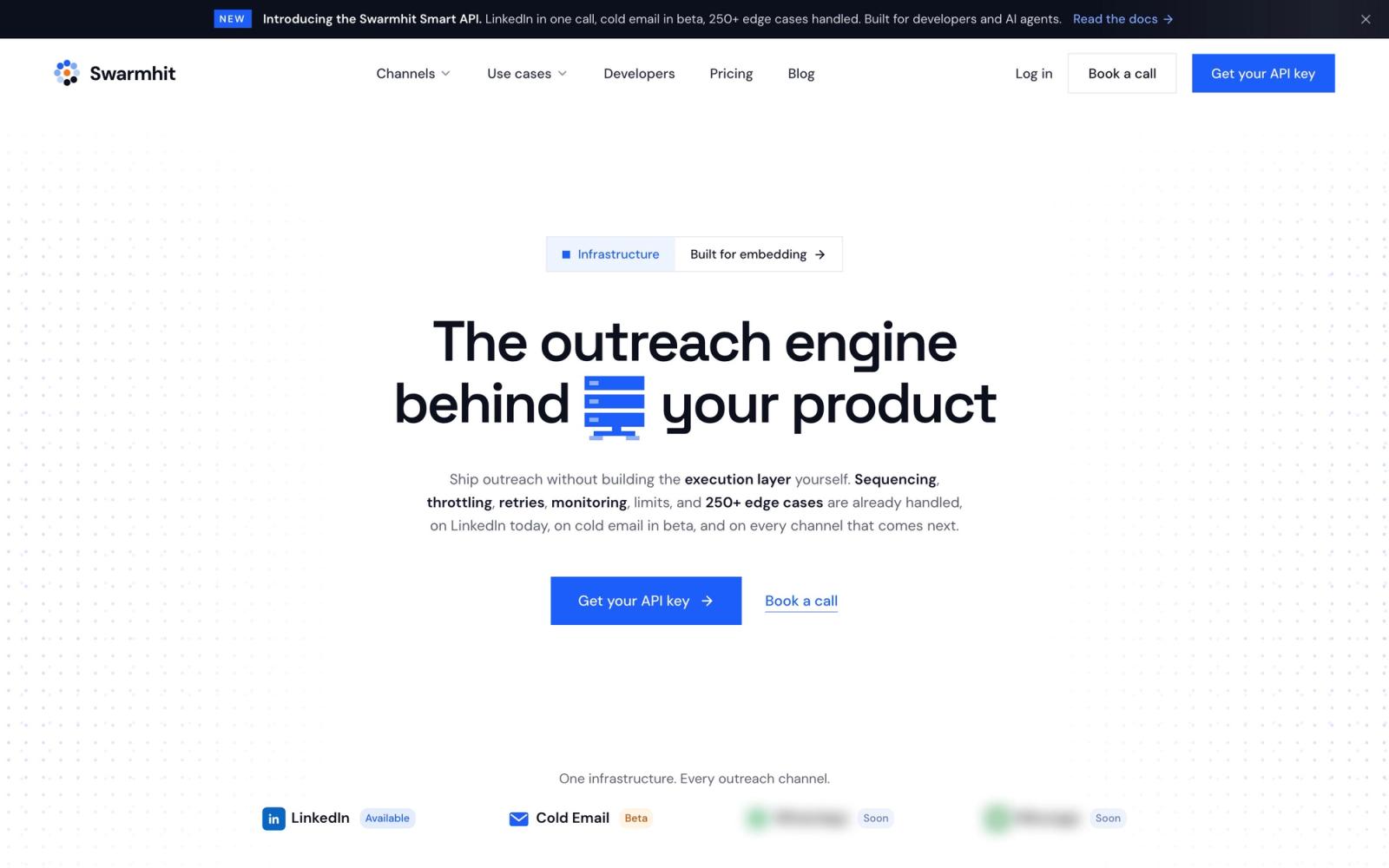
If you are comparing these two because you are building outreach, the cheapest path may be not building. Swarmhit sits in a different category from both: it is a LinkedIn outreach platform that ships the layer both APIs leave to you, campaigns and multi-sender sequencing, a unified inbox, reply detection, AI personalization, managed auto-warmup, then exposes an API and webhooks so developers drive all of it programmatically. CRM connectivity runs through those same two surfaces. A database of 1B+ contacts across 60M companies, refreshed weekly and sourced through third-party data providers, is available with free monthly credits, then pay as you go.
| Unipile | Edges | Swarmhit | |
|---|---|---|---|
| Category | Multichannel messaging API | LinkedIn action API | LinkedIn outreach platform with an API |
| Sequencer, stop-on-reply, inbox | You build them | You build them | Included |
| LinkedIn access model | Accounts you connect | Managed read pool plus identities you connect | Accounts you connect, one dedicated proxy per sender |
| Safety model | Transport protection, pacing is yours | Smart Limits quotas on all modes, live pacing is yours | 250+ safeguards monitored 24/7, managed warmup, caps enforced by Swarmhit |
| Pricing | EUR 49/month minimum, then per-account tiers | Identities plus credits, two meters | From $16.90 per sender a month, tiered down to $6.90 |
Pricing is public: LinkedIn is tiered per connected sender, from $16.90 a month for the first 50 down to $6.90 between 1,501 and 2,500 senders, and cold email starts at $59 a month for 50,000 sends. Each band is priced at its own rate, so adding senders lowers what the next ones cost rather than repricing the fleet you already have.
Scraping runs only through accounts you own and connect, capped at 2,500 profiles a day from Sales Navigator and 1,000 a day from standard search, ceilings Swarmhit enforces rather than leaves to your code. The full head-to-heads live at Swarmhit vs Unipile and Swarmhit vs Edges.
If you are weighing a Unipile or Edges build against shipping on Swarmhit's infrastructure, book a call and we will scope the integration and sender count against your roadmap in 30 minutes.
Unipile vs Edges: FAQ
Is Edges cheaper than Unipile?
No, not at comparable fleet sizes. At 10 accounts, Unipile's EUR 49 ($55) minimum stands against a realistic Edges floor near $198, combining $88 in identities with the $110 credit minimum. At 200 accounts it is EUR 900 ($1,000) against $1,423 in identities before any credits. Edges' per-identity price falls with volume but never crosses under Unipile's ladder on like-for-like fleets. The gap narrows only if you value what identities bundle: enforced limits, ramp-up and 0-credit engagement sends.
Does Unipile support Sales Navigator?
Yes. Unipile's LinkedIn API page lists Classic, Recruiter and Sales Navigator account support, so a connected Sales Navigator seat works through the same endpoints. Edges' comparison page calls Unipile's data coverage narrower, and the fair reading of that claim is about surface depth: Edges exposes Sales Navigator search as a first-class action set, which is real depth if SalesNav search is your core workload. It is not a claim that Unipile lacks Sales Navigator accounts.
Can you use Unipile and Edges together?
Yes, and Edges itself suggests the split: its comparison FAQ describes running Edges for LinkedIn actions alongside Unipile for email, WhatsApp and other channels. The pairing is coherent because the products barely overlap outside LinkedIn. You would carry two vendors, two auth flows and two bills, so it suits teams whose LinkedIn workload genuinely needs action-level depth while the rest of their messaging lives in Unipile's unified schema.
Does either replace a LinkedIn outreach tool?
No. Neither ships sequencing, campaign logic, lead storage or an inbox product: Unipile provides messaging primitives with a build-it-yourself sequencing guide, and Edges provides actions and schedules with docs that teach the same. Multi-day drips, stop-on-reply, reply handling and a place for humans to answer conversations are all left for you to build, on either vendor. If you want those shipped as product, you need an outreach platform, which is a different category from both.
Is Edges' cookie-less model safe?
The pitch covers reads, not sends: data operations run on a managed session pool, while outreach requires a real LinkedIn account connected as a paid identity, so "No cookies, no LinkedIn account" describes half the product. LinkedIn's user agreement prohibits unauthorized automation and scraping under either model, and Edges' terms place responsibility for use on the customer. The full risk picture, including where pool-based data models have ended up legally, is in our Edges alternatives risk section.
What do the free tiers include?
Unipile offers a 7-day free trial with no card, with all channels and endpoints open, converting to post-paid billing on your peak linked accounts. Edges offers 100 free credits and 1 identity, no card, and the tier is renewable monthly for personal use, which makes it the better fit for slow-burn evaluation. Unipile's window is short but uncapped in scope; Edges' is small but does not expire on a clock.


