

The best Expandi alternatives in 2026 are Cadency, HeyReach, Dripify, Dux-Soup, Waalaxy, Linked Helper, PhantomBuster. The strongest choice depends on why you are switching. A solo seller, an agency operating 50 accounts and a developer embedding LinkedIn actions are buying different systems, even when every vendor calls the product LinkedIn automation.
Expandi remains a capable cloud automation product. Buyers usually look elsewhere because $99 per account is difficult to scale, the public page does not expose agency economics, or their workflow now requires stronger multi-client operations, API access or MCP-based agent control. A shared inbox alone is not a reason to switch, because Expandi includes a Global Inbox across the accounts in a workspace (checked 30 September 2026). A cheaper sticker price is useful only when the replacement covers the same operating job. Prices and packaging in this guide were checked on vendor pages in August 2026, and figures re-read in September 2026 carry their date. Temporary promotions are excluded from the comparison.
Before choosing, review whether LinkedIn automation is safe, how account restrictions happen and the broader list of LinkedIn prospecting tools. Those pages cover operational risk and category definitions that should not be repeated in every comparison.
How did we rank the best Expandi alternatives?
We ranked products by buyer fit rather than feature count. The first test is whether the alternative solves the reason a team is leaving: operating cost at the real sender count, cloud execution, account infrastructure, inbox workflow, agency controls, API access or broader automation. A product loses points when its cheapest tier omits the capability that makes the comparison fair.
The second test is verifiability. Pricing and features come from vendor pages, not competitor listicles. A quote-only tier is labeled quote-only. A promotion is not treated as the normal rate. Published safety features are described as vendor controls, not as a guarantee that LinkedIn approves automation.
The policy baseline is LinkedIn’s User Agreement and its help guidance on prohibited software. Every product in this category operates around platform rules that can change.
| Alternative | Published starting point | Best for |
|---|---|---|
| Cadency | $199 a month with 5 LinkedIn senders (Small Team); Scale $699 with 20; 30% off on annual billing | Teams and agencies that send volume on LinkedIn and email from one campaign |
| HeyReach | $79 per sender monthly; agency plans from $999 | Agencies and GTM operators that want a mature LinkedIn-first workflow |
| Dripify | $59, $79 or $99 monthly; lower on annual billing | Individual sellers that want polished LinkedIn and email sequences |
| Dux-Soup | STACKED local $55 or cloud $99 monthly (checked 30 September 2026) | Price-sensitive users choosing between local desktop and cloud execution |
| Waalaxy | EUR 19, EUR 49 or EUR 69 monthly; half that on yearly billing (checked 30 September 2026) | Beginners that want templates and a simple LinkedIn plus email workflow |
| Linked Helper | $15 local storage or $29.90 cloud storage; lower on longer billing | Technical operators that want granular actions and local data control |
| PhantomBuster | Usage-based automation plans | Operators automating several websites and exporting workflow data |
What should replace Expandi for your use case?
A pricing table cannot answer this alone. The matrix below maps the operating problem to the product that addresses it most directly. Read the individual sections afterward because the same tool can be an excellent fit for one team and a poor fit for another.
| Primary requirement | Start with | Why |
|---|---|---|
| Multi-sender LinkedIn and email outreach | Cadency | One campaign across every sender and mailbox, with one shared inbox |
| Agency workspaces and established workflows | HeyReach | Agency controls, unified inbox, API, webhooks and MCP |
| Polished individual seller experience | Dripify | Guided LinkedIn and email sequences |
| Flexible cloud campaign types | Expandi | Configurable campaigns and cloud execution |
| Low entry cost with local execution | Dux-Soup or Linked Helper | Local desktop tiers from $15 (Linked Helper) and $55 (Dux-Soup) a month, checked 30 September 2026 |
| Beginner-friendly multichannel workflow | Waalaxy | Templates and clear tier progression |
| Broad extraction and web automation | PhantomBuster | Automation library beyond a dedicated outreach platform |
The 7 best Expandi alternatives
Each alternative below begins with the vendor landing page so the product can be recognized quickly. The analysis focuses on the operating difference that matters to a buyer switching from the target tool.
1. Cadency
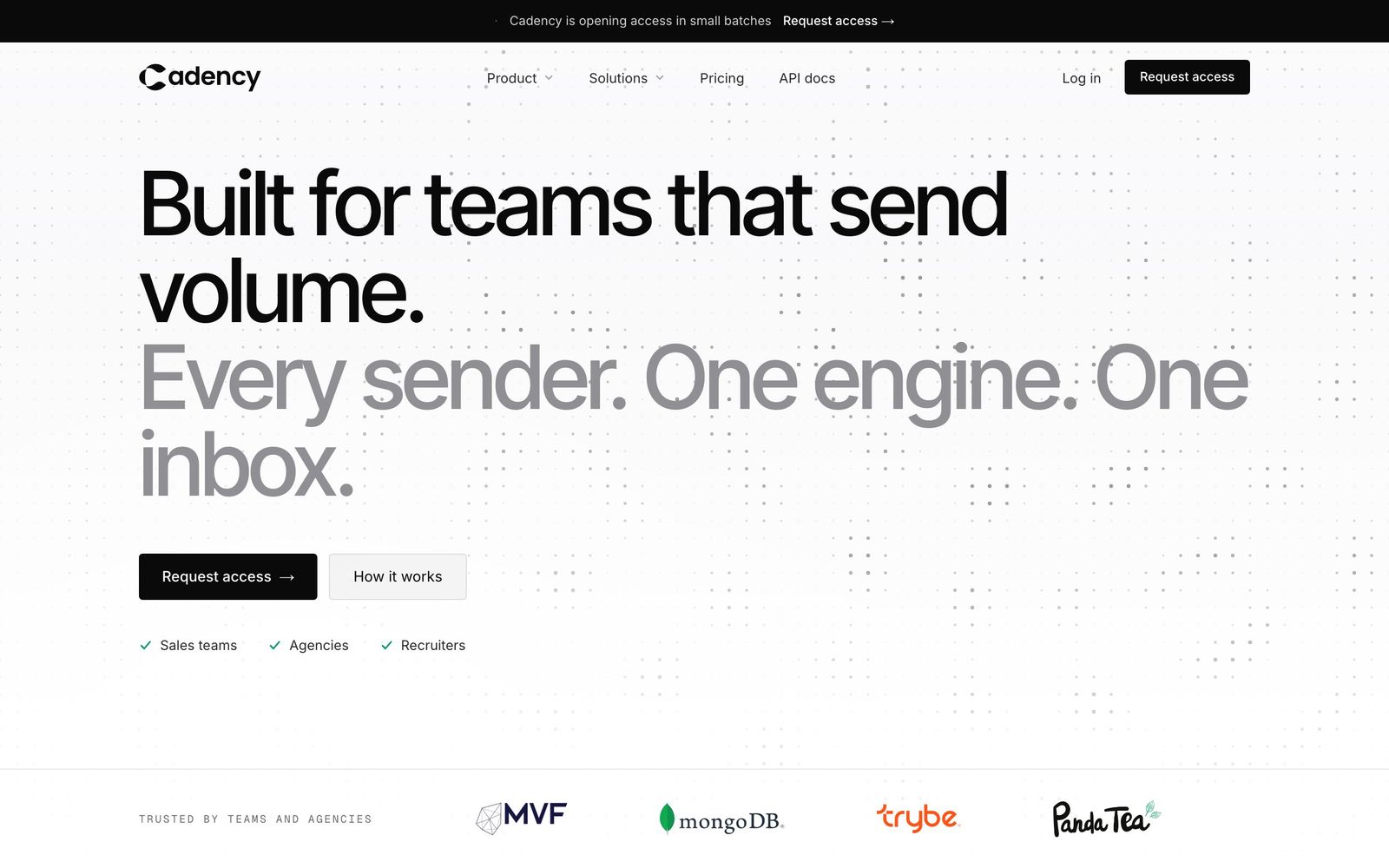
Cadency changes the scaling equation that pushes teams away from Expandi. Expandi bills $99 a month for each connected LinkedIn account ($79 on annual billing), while Cadency sells a plan with a sender pool: Small Team is $199 a month with 5 LinkedIn senders included, about the price of two Expandi seats, and Scale is $699 with 20. Additional senders can be added on both plans, and annual billing takes 30% off ($139 and $489 a month). Expandi’s Shared Campaigns also run one campaign across several accounts, but each account is still a separate seat (checked 30 September 2026). In Cadency one campaign runs across every LinkedIn sender and every mailbox, with one sender per lead, and teams can work in the app or through the API and webhooks included on every plan.
Sender rotation spreads volume across the pool, and every LinkedIn sender gets a dedicated proxy, per-sender ceilings and pacing, and checkpoint handling, all running in the cloud. The step library covers profile visit, connection request, message, InMail, an AI-drafted comment on the lead’s last post that you approve, voice note, like and follow, with branches on connected, replied or email found, plus waits and A/B tests. Google and Microsoft mailboxes with warm-up rotate in the same campaign, with 100k emails a month on Small Team and 500k on Scale, and mailboxes, teammates and workspaces are unlimited on both. Replies land in one inbox thread per lead across LinkedIn and email, and any CRM or ATS connects through the API rather than a native sync. Access is private: teams request it on the Cadency site.
Cadency at a glance
Pros
- Sender pool pricing with unlimited teammates, mailboxes and workspaces
- Dedicated proxy per sender and one inbox for LinkedIn and email
Cons
- At $199 a month, not the cheap option for a single seller
- Access is by request, with no self-serve trial
2. HeyReach
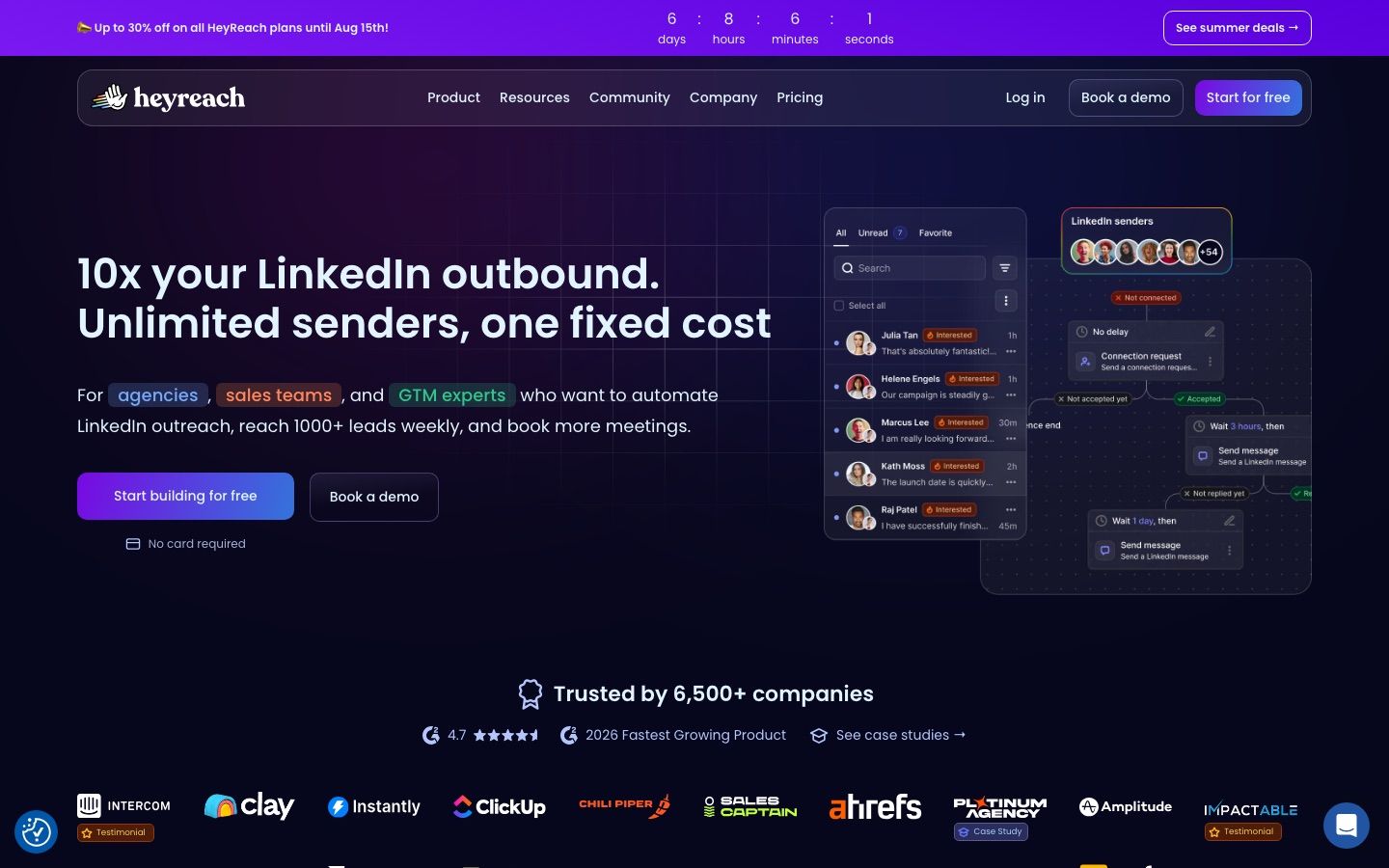
HeyReach is the most familiar replacement for an Expandi agency. Both are cloud-based and built for LinkedIn campaigns, but HeyReach publishes the Growth price and an agency bundle, and includes a unified inbox, API, webhooks and MCP in its standard feature set; Expandi’s Business plan also includes a Global Inbox and webhooks (checked 30 September 2026). The list price per sender is below Expandi, although the agency tier still needs to be evaluated against actual sender volume.
Growth is listed at $79 per sender each month and includes unlimited campaigns, LinkedIn actions, the unified inbox, multichannel outreach through Instantly or Smartlead, integrations, API, webhooks and the MCP server. The Micro Agency tier is $999 a month for 25 senders and adds white-label support and onboarding, and Agency is $1,399 for 50 senders (checked 26 September 2026). A temporary summer discount was visible in August 2026, but these are the standard list prices used here. The current pricing and package details are available on the HeyReach pricing page.
HeyReach at a glance
Pros
- Strong agency workflow and unified inbox
- API, webhooks and MCP included in the Growth feature set
Cons
- Per-sender economics rise quickly for medium teams
- The $999 agency tier is a meaningful step up from Growth
3. Dripify
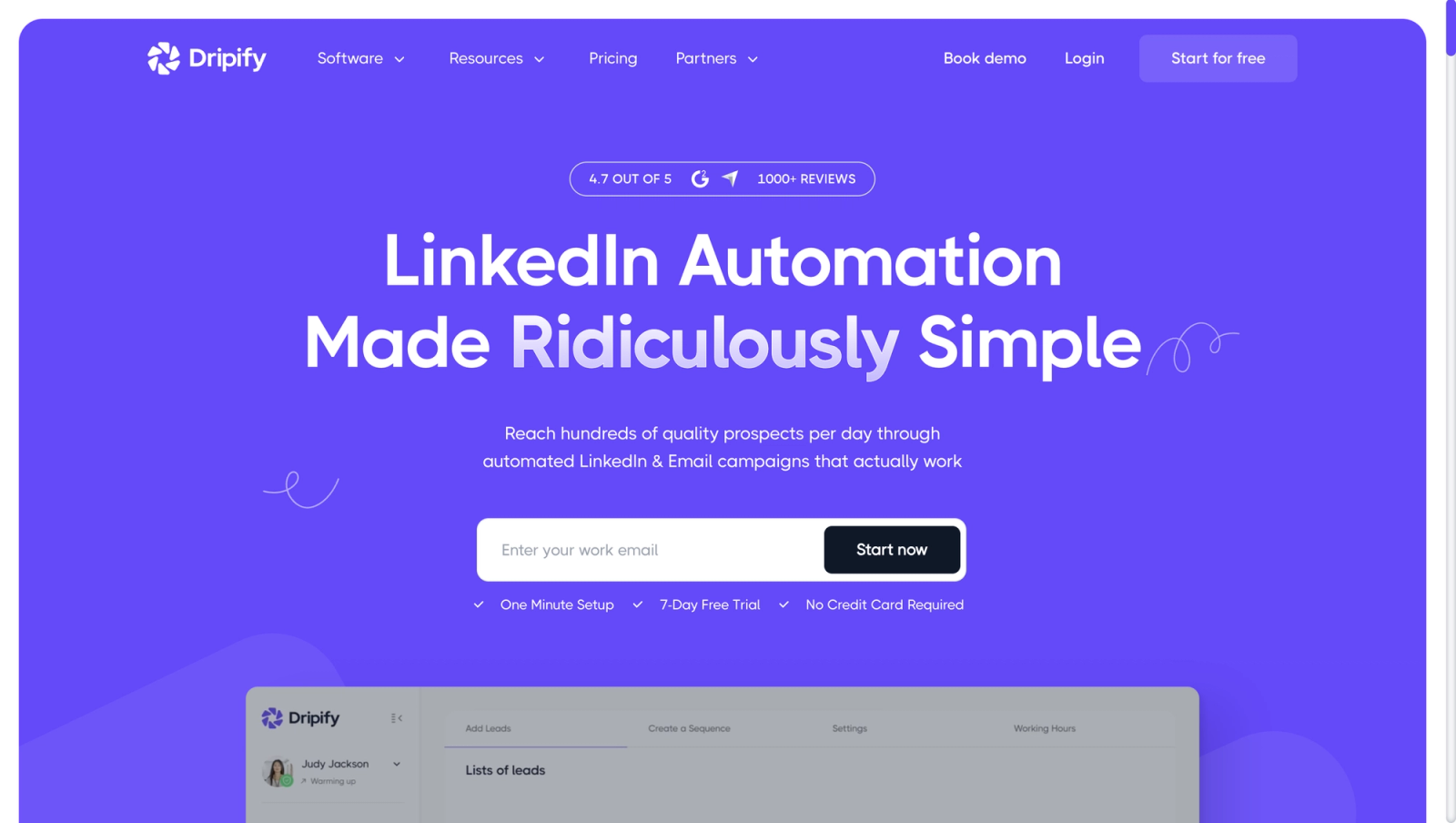
Dripify is a better fit than Expandi for an individual seller who values a guided product; both tools combine LinkedIn and email steps in one sequence (checked 30 September 2026). Annual Basic and Pro can materially reduce the entry price. It is less persuasive when the reason for leaving Expandi is multi-client administration, because Dripify’s strengths remain seller experience and campaign simplicity.
Monthly list prices are $59 for Basic, $79 for Pro and $99 for Advanced per user. Annual billing lowers those figures to $39, $59 and $79. Basic permits one campaign with lighter quotas. Pro unlocks unlimited campaigns, the dedicated inbox, CSV export and webhooks. Advanced adds multi-team management, stronger protection controls, tagging, step analytics and testing. The current pricing and package details are available on the Dripify pricing page.
Dripify at a glance
Pros
- Clear product experience for individual sellers
- LinkedIn and email steps in the same sequence
Cons
- Basic is intentionally limited to one campaign
- Cost remains tied to each user or connected account
4. Dux-Soup

Dux-Soup can cut software cost, especially for users comfortable with local execution. It is now sold as STACKED, powered by Dux-Soup, and the Pro, Turbo and Cloud Chrome extensions are deprecated (checked 30 September 2026), so the $14.99 Pro Dux tier is no longer the entry point. The important comparison is STACKED cloud against $99 Expandi, because cloud execution provides the always-on operation many Expandi users expect. Even then, it offers a clear way to pay only for the operational layer required.
STACKED local is $55 a month per seat and STACKED cloud is $99, as read on 30 September 2026. Annual billing lists effective monthly prices of $41.25 and $74.17. Local is a desktop app for Mac and Windows with unlimited concurrent campaigns, campaign statistics, lead management and native integrations, and it runs from your own machine. Cloud moves execution onto managed cloud infrastructure. The current pricing and package details are available on the Dux-Soup pricing page.
Dux-Soup at a glance
Pros
- A local desktop tier well below Expandi’s price
- Choice between local desktop and managed cloud execution
Cons
- Cloud execution costs $99 a month per seat, level with Expandi
- The cheapest plan is not equivalent to a full cloud outreach platform
5. Waalaxy

Waalaxy replaces Expandi well for teams that want templates, straightforward onboarding and transparent package steps. Its Business plan combines LinkedIn and email at EUR 69 a month on monthly billing (checked 30 September 2026). Advanced includes API and automation modules. It is less focused on sophisticated campaign variation than Expandi, but often easier for a new operator to adopt.
Pro is listed at EUR 19 per user per month on monthly billing with 300 invitations each month. Advanced is EUR 49 with 800 invitations, API access and Make, Zapier and n8n modules. Business is EUR 69 with multichannel LinkedIn and email sequences plus 500 email finder credits. Quarterly billing takes 20 percent off and yearly billing 50 percent, bringing the three tiers to EUR 9.50, EUR 24.50 and EUR 34.50 a month, as read on 30 September 2026. The current pricing and package details are available on the Waalaxy pricing page.
Waalaxy at a glance
Pros
- Accessible templates and onboarding for beginners
- API and workflow modules from Advanced
Cons
- Invitation allowances depend on the selected tier
- The inbox is sold as an add-on
6. Linked Helper

Linked Helper is the control-oriented alternative. Granular actions and broad exports appeal to operators who prefer direct ownership of the workflow. The tradeoff is operational overhead: Expandi’s cloud product is easier to hand to a distributed sales team, while Linked Helper expects someone to understand how actions, devices and storage fit together.
The local storage version is $15 monthly for Standard and $45 for Pro; the cloud storage version is $29.90 and $59.90. Both drop up to 45 percent on 12 month billing. One license maps to one LinkedIn account. Standard limits several advanced actions and webhook exports to 20 each day, while Pro removes those product limits. The current pricing and package details are available on the Linked Helper pricing page.
Linked Helper at a glance
Pros
- Granular campaign actions and strong data controls
- Low published price for local execution
Cons
- Desktop-style operation asks more of the user
- One license cannot operate two accounts simultaneously
7. PhantomBuster
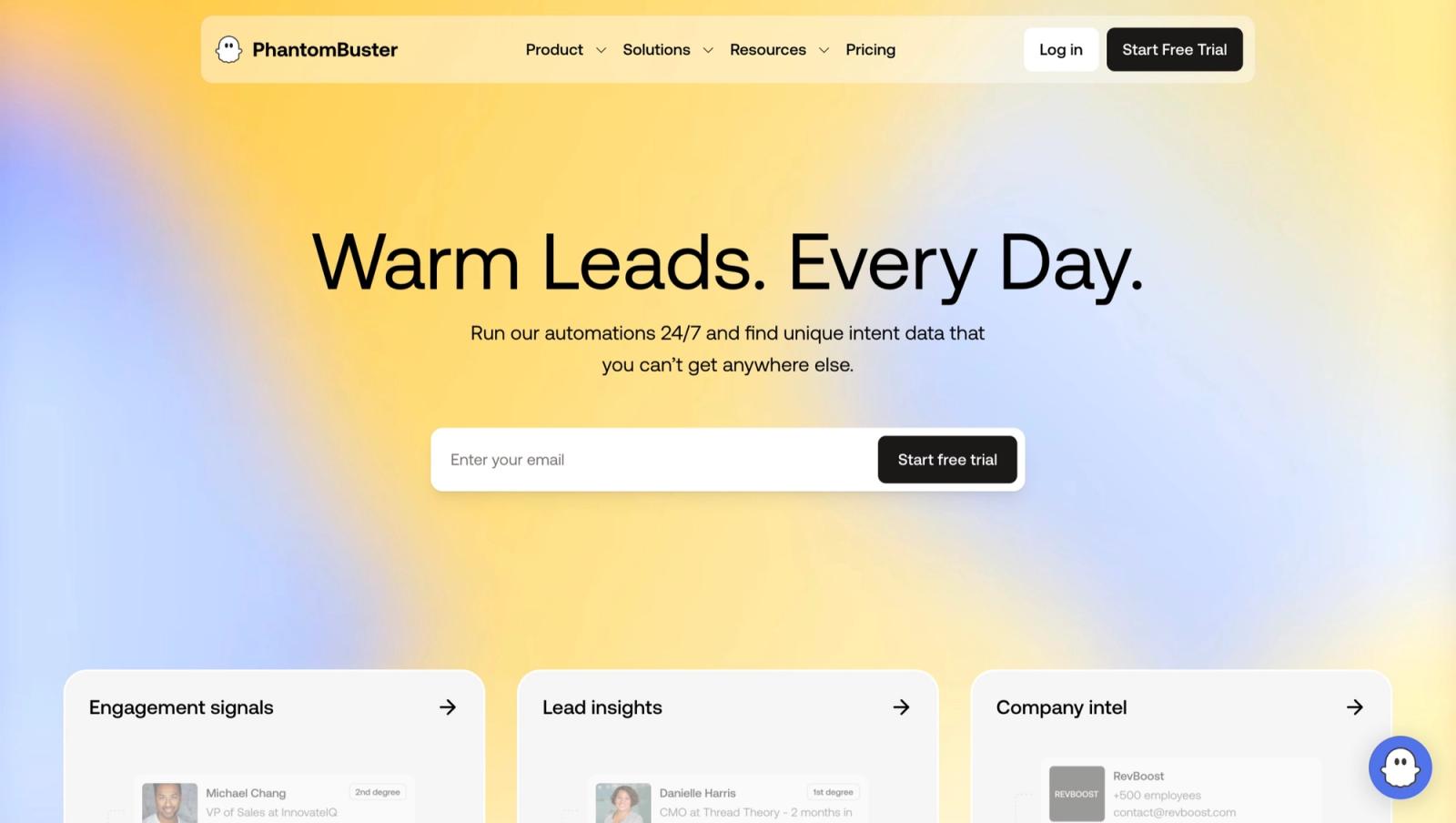
PhantomBuster is worth considering when Expandi is being used as a workaround for data extraction. Its automation library reaches beyond LinkedIn and can feed other systems. It is not the cleanest substitute for a persistent sales inbox or a sender fleet, because the buyer must manage runtime, slots and workflow state.
PhantomBuster is broader than a LinkedIn sequencer. It sells cloud execution time, slots and credits that can be spent across many automations, while exports are not metered (checked 30 September 2026). That makes it flexible for research and enrichment workflows, but forecasting the effective cost of a sustained LinkedIn campaign requires translating the intended workflow into runtime and slot consumption. The current pricing and package details are available on the PhantomBuster pricing page.
PhantomBuster at a glance
Pros
- Broad library of automations beyond LinkedIn
- Useful exports and workflow composition
Cons
- Usage economics are less intuitive than a sender plan
- It is not a unified inbox-first sales platform
How should you test an Expandi alternative?
A free trial is useful only when it reproduces the operating conditions that caused the switch. Use the following evaluation as a controlled comparison, then document the result before committing to annual billing.
Build the trial around the reason Expandi is being replaced. If cost is the issue, test at the expected sender count. If agency workflow is the issue, create two client workspaces and verify permissions, templates, reports and inbox separation. If API access is the issue, complete one real integration path rather than accepting a feature-table checkmark.
Recreate one Expandi campaign with its branching, delays, reply stops and channel transitions. A replacement that supports the same action names may still implement campaign state differently. Observe what happens when a prospect replies between steps, when an account is temporarily unavailable and when a list contains a duplicate.
Review sender infrastructure with the person who will own incidents. Confirm whether IP addresses are dedicated, who selects their geography, how warmup changes action levels and what health data is visible. Expandi includes a country-based IP address, so any cheaper replacement must explain how it handles the same responsibility.
For agency use, test the boring tasks. Duplicate a template without leaking another client’s variables, invite a client viewer, move a sender between workspaces and produce a report that can be understood without platform access. These jobs determine margin more reliably than the number of campaign types on a feature page.
Run the unified inbox through a complete handoff. Route a reply to a teammate, add context, stop automation and verify that another operator cannot restart it accidentally. When the sales team works in a CRM, test the actual API or webhook event and document which system owns the final conversation status.
Calculate the twelve-month cost in three scenarios: current sender count, expected growth and one lost client. Include the annual commitment, white-label fees, additional inbox or enrichment charges, proxy responsibility and implementation time. A custom agency quote should be recorded in writing with the sender band and renewal basis.
Close the evaluation with an exit test. Export leads, campaign results, tags, suppression lists and conversation data where available. Revoke one connection and confirm scheduled actions stop. A platform that is easy to leave is safer to adopt, especially when it will become infrastructure for several client accounts.
How do you migrate away from Expandi?
Start by freezing the source campaign design. Export prospects, account ownership, tags, statuses, suppression lists, positive replies and the exact step sequence. Record which tool owns reply detection. A migration fails when both platforms continue acting on the same prospect or when a suppression rule disappears during import.
Connect one low-risk sender to the replacement and recreate a single representative campaign. Test imports, variables, stop conditions, inbox routing and webhooks before moving additional accounts. Keep the old workspace available for reporting, but pause its active campaigns. Only expand after the new workflow has completed a full reply cycle without duplicate actions.
For agencies, use the operational checklist in our HeyReach alternatives guide and compare the economics in MeetAlfred alternatives and Waalaxy competitors. Developers should review the LinkedIn MCP server guide and the outreach API comparison before choosing an execution layer.
Which Expandi alternative should you choose?
Cadency is the strongest alternative for teams that run several LinkedIn senders and mailboxes as one campaign. HeyReach is the closest agency-oriented product. Dripify offers a polished single-seller experience, Dux-Soup and Linked Helper reduce entry cost, Waalaxy favors guided workflows, and PhantomBuster fits broad automation rather than a dedicated outreach operation.
Run the decision against the next twelve months, not the first month. Count connected accounts, operators, client workspaces, inbox users, integration work and the cost of maintaining safe execution. A product that appears expensive can be cheaper than stitching together proxies, warmup, monitoring and reporting. A cheap product can remain the right answer when one skilled operator owns the complete workflow.
Cadency is designed for sales teams, recruiters and agencies whose sender count keeps growing: new LinkedIn senders join the same rotation, mailboxes, teammates and workspaces stay unlimited, and the API and webhooks come with every plan.
Cadency began as our internal test bed for the Swarmhit engine; it was never meant to be public, and we kept it running for the sales teams, recruiters and agencies who asked for it. If per-account seats are the reason you are leaving Expandi, Cadency is where we would start the comparison. Swarmhit itself is the API for developers who build their own outreach product.
FAQ
What is the best Expandi alternative?
Cadency is the best Expandi alternative for teams that run several LinkedIn senders and mailboxes as one campaign: it prices a sender pool from $199 a month with 5 LinkedIn senders instead of $99 per account, and includes 100k emails a month, mailbox warm-up and API access from the first plan. HeyReach is the closest agency-oriented software alternative. Individual sellers may prefer Dripify, while technical operators may value Linked Helper or Dux-Soup.
Is Expandi worth $99 per month?
Expandi can justify $99 monthly when its campaign flexibility, cloud execution and dedicated country-based IP address are used consistently. It is harder to justify when a team needs many accounts or only basic sequences. Compare the cost at the actual sender count instead of judging one seat in isolation.
Which Expandi alternative is best for agencies?
Cadency and HeyReach deserve the first comparison for agencies because both are built around multi-sender operations. Cadency includes unlimited workspaces, teammates and mailboxes and one shared inbox from $199 a month with 5 LinkedIn senders, but does not offer white label today. Expandi asks larger teams and white-label buyers to request a quote. Compare sender count, workspace isolation, client reporting, inbox access, proxy responsibility and branding before comparing headline subscription prices.
Can Expandi campaigns be exported?
Lead data and results can be exported, but a complete campaign normally needs to be rebuilt in the replacement platform. Document branching rules, delays, stop conditions and suppression lists before moving. Run a small test segment first and prevent both tools from acting on the same prospect at the same time.
Are cheaper Expandi alternatives safe?
Price does not determine safety. A cheaper product can be appropriate if it provides the execution model and controls the team needs. Evaluate dedicated account infrastructure, warmup, health monitoring, caps, reply detection and operator permissions. The customer still remains responsible for how the connected LinkedIn account is used.


