

Clay's pricing changed shape in 2026. The company retired its old named tiers and now prices around two meters, Actions and Data Credits, stacked on top of each plan. Four plans exist today: Free, which costs nothing; Launch, at $185 a month on monthly billing or $167 a month on annual billing; Growth, at $495 a month on monthly billing or $446 a month on annual billing; and Enterprise, which is custom priced with an annual commitment. Clay pricing in 2026 is really a function of how many Actions and Data Credits a team burns each month, not one flat number.
This guide breaks down exactly how those two meters add up to the Launch and Growth prices, recomputes the cost per Data Credit at every published tier, and works through what a small team pulling 10,000 to 50,000 Data Credits a month should actually expect to pay. We also flag which figures still circulating online belong to Clay's retired plan names, and where Clay's job ends and a dedicated LinkedIn outreach tool needs to pick up.
Clay Pricing In 2026: The Four Current Plans
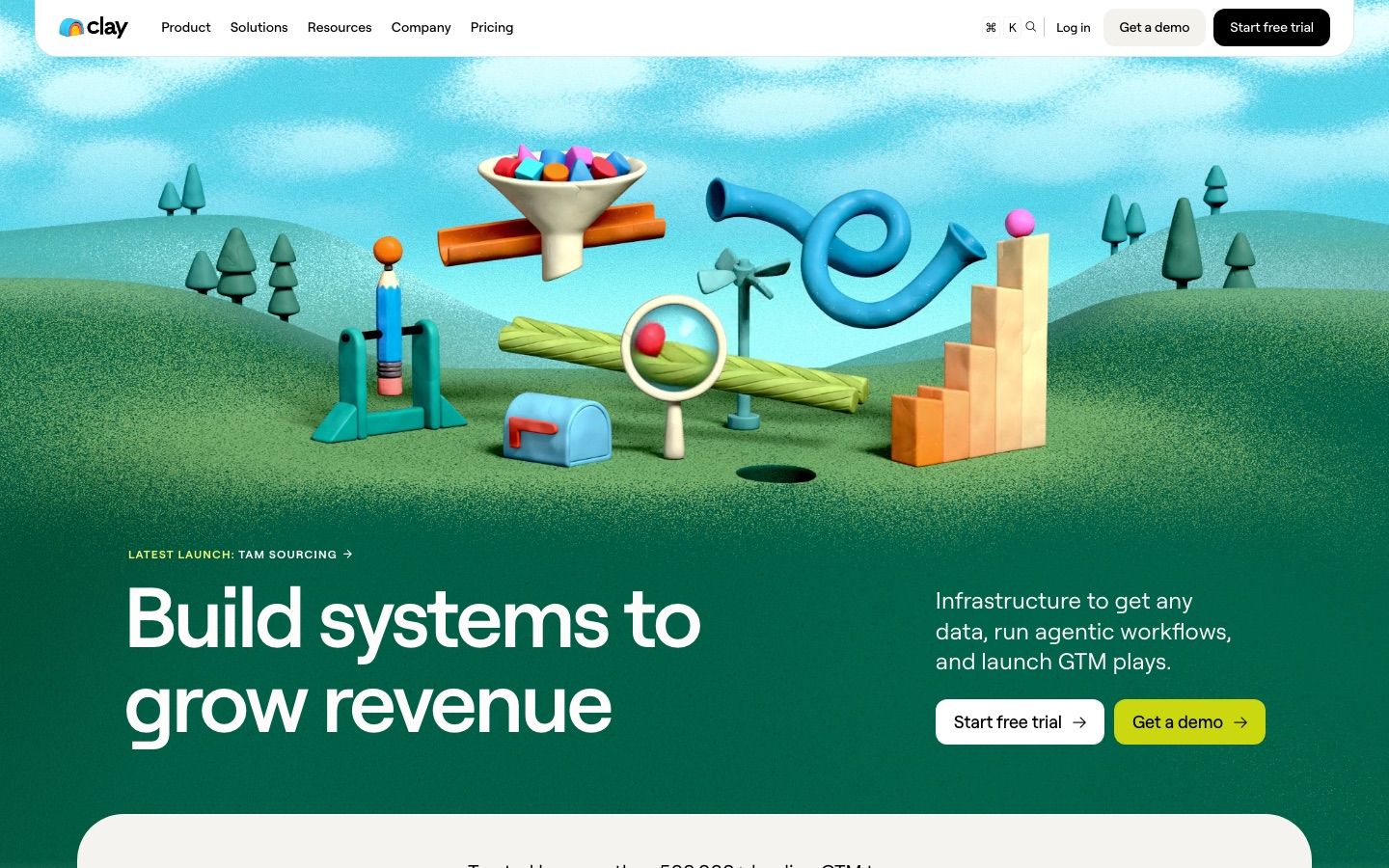
Clay's pricing page, read in September 2026, lists four plans side by side. Free is unlimited on seats and tables, with up to 200 rows per table, multi-provider waterfalls, Claygent enrichment and Clay's own sequencer for sending email, all inside a monthly allowance of 100 Data Credits and 500 Actions. Launch is the first paid plan, described on the page as "starting at $185/mo" on monthly billing and $167 a month on annual billing, and it adds phone number enrichment, job change and signal tracking, email campaign integrations, and tables up to 50,000 rows. Growth is "starting at $495/mo" monthly or $446 a month annual, and it adds CRM auto-sync, HTTP API integrations, webhook automation, web intent signal tracking, audience pushes to ad platforms and priority support. Enterprise has no published number: it is custom, requires an annual commitment, and adds Clay API access, data warehouse syncs, SSO, role-based access control and a dedicated Growth Strategist.
| Plan | Monthly billing | Annual billing | Data Credits included | Actions included |
|---|---|---|---|---|
| Free | $0 | $0 | 100 a month | 500 a month |
| Launch | $185 a month | $167 a month | 2,500 a month | 15,000 a month |
| Growth | $495 a month | $446 a month | 6,000 a month | 40,000 a month |
| Enterprise | Custom | Custom | 100,000+ a month | 200,000+ a month |
The jump from Free to Launch looks steep in absolute dollars, but the included allowances scale with it: Launch's 2,500 Data Credits and 15,000 Actions are 25 times and 30 times Free's allowance. Growth includes about 2.7 times Launch's Actions and 2.4 times its Data Credits, for roughly 2.7 times the price, which only makes sense once you look at what each meter actually costs on its own, covered next.
What Changed On The Clay.com Pricing Page?
Clay's pricing page used to list three named plans, and pages built before the change often still show them: a Starter plan around $149, an Explorer plan around $349, and a Pro plan around $800. If you land on a guide quoting those three names today, that guide has not been updated. Clay retired all three and rebuilt its plans around two separate meters, Actions and Data Credits, that get combined into a single monthly number for each plan.
The practical effect is that a Clay price is no longer a fixed package, it is a starting combination. Launch's $185 and Growth's $495 are each plan's cheapest legal combination of Actions and Data Credits, and a team can move either meter up independently once it needs more of one than the other. That is a real change in how Clay pricing works, not just new labels on old tiers, and it means the useful question is not "what plan should we buy" but "how many Actions and how many Data Credits do we actually burn."
Run your LinkedIn outreach on Swarmhit
Multi-sender campaigns, safe sending limits and a unified inbox, from $29 per sender per month on annual billing.
7-day free trial. Cancel anytime.
What Are Clay Actions And Data Credits?
Clay Actions and Data Credits are two separate meters, and Clay's own FAQ draws the line clearly: Data Credits buy data from "150+ data partners," while Actions cover the automation steps that move rows through a table, whether or not that step pulls in outside data. A Claygent enrichment call, a waterfall lookup that returns a verified email, or a webhook that pushes a row to a CRM can each burn an Action; only the ones that actually purchase third-party data also burn a Data Credit.
The two meters behave differently over time: Actions reset every billing cycle with no cushion, while Data Credits roll over, details on both covered next. That asymmetry is worth planning around: a team that burns through Actions in a busy week has no cushion, but one that under-uses Data Credits one month effectively banks some of it for the next.
How Is The $185 Launch Price Built?
Clay's $185 Launch price is not a single number the company picked, it is a sum of two entry-level tiers. The Actions meter starts at $60 a month for 15,000 Actions, and the Data Credits meter starts at $125 a month for 2,500 Data Credits: $60 + $125 = $185. Annual billing lowers both entry tiers to $54 and $113, and $54 + $113 = $167, which is exactly Launch's advertised annual price.
Growth is built the same way at a higher floor. Its entry-level Actions tier is $205 a month for 40,000 Actions, and its entry-level Data Credits tier is $290 a month for 6,000 Data Credits: $205 + $290 = $495. On annual billing those drop to $185 and $261, and $185 + $261 = $446, matching Growth's advertised annual price. Once you see the plan price as two tiers added together, the rest of Clay's ladder, moving either meter up independently, makes a lot more sense.
Annual billing is a straightforward discount on top of that math: Launch's $185 monthly price against $167 annual saves $18 a month, or $216 a year; Growth's $495 against $446 saves $49 a month, or $588 a year. Both savings come from the same entry-level Actions and Data Credits tiers dropping in price on annual billing, not from a separate discount applied to the total.
| Actions tier | Included Actions | Monthly price | Cost per 1,000 Actions |
|---|---|---|---|
| Launch entry | 15,000 | $60 | $4.00 |
| Launch | 40,000 | $150 | $3.75 |
| Launch | 60,000 | $200 | $3.33 |
| Launch | 100,000 | $290 | $2.90 |
| Launch | 200,000 | $540 | $2.70 |
| Growth entry | 40,000 | $205 | $5.13 |
| Growth | 60,000 | $290 | $4.83 |
Two things jump out. First, Launch's per-Action rate keeps falling as volume rises, from $4.00 per 1,000 at the entry tier down to $2.70 per 1,000 at 200,000 Actions, which is standard volume pricing. Second, Growth's Actions ladder is not a continuation of Launch's, it is a separate, pricier one: 40,000 Actions costs $150 a month inside Launch but $205 a month inside Growth, a $55 premium for the same volume that reflects the CRM sync, webhook automation and other Growth-only features bundled into that plan.
Data Credits follow a steadier curve than Actions do.
| Data Credits tier | Included Data Credits | Monthly price | Cost per Data Credit |
|---|---|---|---|
| Launch entry | 2,500 | $125 | $0.0500 |
| Growth entry | 6,000 | $290 | $0.0483 |
| Above Growth | 10,000 | $460 | $0.0460 |
| Above Growth | 20,000 | $880 | $0.0440 |
| Above Growth | 50,000 | $2,125 | $0.0425 |
Recomputing each figure confirms Clay's own math: $125 divided by 2,500 Data Credits is exactly $0.0500 per credit at the entry tier, falling to $0.0483 at 6,000 credits, $0.0460 at 10,000, $0.0440 at 20,000 and $0.0425 at 50,000. That is roughly a 15 percent discount per credit between the smallest and largest published tier, a steadier curve than the Actions ladder shows.
Do Clay Data Credits Roll Over?
Clay Data Credits roll over, but Clay Actions do not. Clay's own FAQ states that Data Credits carry forward "up to 2x your monthly credit amount" on both Launch and Growth, so a Launch team that buys 2,500 Data Credits a month can bank up to 5,000 unused credits before any roll over is capped. Enterprise customers get a different, smaller allowance: up to 15 percent of the prior year's credits carry into the next year.
Actions get no such cushion. The same FAQ says Actions "reset each billing cycle and don't roll over," so an Actions allowance not used by the end of a billing period is simply gone. That makes the two meters worth planning for separately: over-buying Data Credits one quarter is a soft mistake you can use up later, over-buying Actions is a sunk cost the moment the cycle turns over.
Can You Bring Your Own API Keys To Cut Data Credit Costs?
Clay's FAQ answers this directly: "if you bring your own API keys for third-party data, you skip Data Credit costs entirely and only use Actions." In practice, a team already paying for a separate data provider, say a People Data Labs alternative style database or a Coresignal alternative style firmographic feed, can wire that provider's own API key into Clay's enrichment step and route around the Data Credits meter for that specific source. Actions still apply to every automation step regardless of where the underlying data came from.
This is the lever worth pulling before Clay pricing pushes a team into the next Data Credits tier. A team burning through 20,000 Data Credits a month on one or two heavily used data partners may find it cheaper to license that provider directly and plug in an API key than to buy the next Data Credits tier, especially once volume climbs past the point where a direct contract undercuts Clay's per-credit rate.
What Does Each Clay Plan Actually Include?
Each Clay plan bundles specific features on top of its meters, and the features are what usually decide which plan a team needs, not the raw Actions or Data Credits numbers. Free caps tables at 200 rows, Launch raises that to 50,000 rows, and Growth is the first plan built for a live pipeline, gating CRM auto-sync, HTTP API integrations and webhook automation behind it rather than adding more rows.
| Plan | Row limit per table | Notable features |
|---|---|---|
| Free | 200 rows | Waterfalls, Claygent, email sequencer |
| Launch | 50,000 rows | Phone enrichment, signal tracking, email integrations |
| Growth | Not stated separately on Clay's page | CRM auto-sync, HTTP API, webhooks, audience pushes |
| Enterprise | Custom | Clay API, data warehouse sync, SSO, RBAC |
The HTTP API and webhook automation gated behind Growth matter beyond Clay itself: teams that wire Clay's outputs into a workflow tool like n8n usually need Growth's API access to do it reliably, since Launch's integrations are limited to the email campaign connections listed on its own tier.
Clay at a glance
Pros
- Waterfall enrichment across 150+ data partners in one interface
- A genuinely usable free plan for testing before any bill starts
- Data Credits roll over up to 2x the monthly amount
- HTTP API and webhook automation for teams that need to push data out
Cons
- Two separate meters to track and budget for instead of one number
- Growth's Actions ladder costs more per Action than Launch's at the same volume
- Enterprise pricing is entirely custom, with no published starting point
- No LinkedIn messaging or outreach sequencing listed on its pricing page
How Much Does Clay Cost For A Small Team?
How much does Clay cost once a small team is actually using it, not just testing on Free? The honest answer depends entirely on how many Data Credits and Actions that team burns, so the table below works through three realistic scenarios on Launch's ladder, from a team just starting to scale outbound to one running full waterfalls across a larger list. For an exact combination, Clay's own pricing calculator recalculates the total instantly; the scenarios below show how that math works before you get there.
| Scenario | Data Credits a month | Actions a month | Data Credits cost | Actions cost | Total monthly |
|---|---|---|---|---|---|
| Early-stage team testing outbound | 10,000 | 60,000 | $460 | $200 | $660 |
| Growing team scaling enrichment | 20,000 | 100,000 | $880 | $290 | $1,170 |
| Established team running full waterfalls | 50,000 | 200,000 | $2,125 | $540 | $2,665 |
None of those three totals match a single published plan price, because none of them are meant to. A team that only needs Growth's CRM sync or webhook automation but stays at a lower volume pays Growth's $495 floor regardless of whether it uses the full 40,000 Actions included; a team chasing higher volume on Launch's ladder can end up paying more than Growth's advertised price while never touching a Growth-only feature. Budgeting for Clay pricing means picking the meters first and the plan label second.
Is Clay Worth It In 2026?
Clay is worth it for teams that need waterfall enrichment across many data partners in one place and would otherwise be stitching together several point tools and separate bills to get the same coverage. The free plan alone is enough to validate that fit before spending anything: 500 Actions and 100 Data Credits a month is a real trial, not a locked demo, and it uses the same Claygent and waterfall logic as the paid plans.
Clay is a harder sell for a team with a narrow, predictable enrichment need, one or two data sources, low monthly volume, and no plan to touch CRM sync or webhook automation. That team may find a single-provider subscription, licensed directly through an API key the way Clay's own FAQ describes, cheaper than paying Clay's Data Credit rate for the same handful of fields every month. The decision rule is simple: the more sources and the more ad hoc the enrichment, the more Clay's waterfall model earns its price; the narrower and more predictable the need, the more a direct data contract wins.
Clay Builds The List, Swarmhit Runs The LinkedIn Outreach
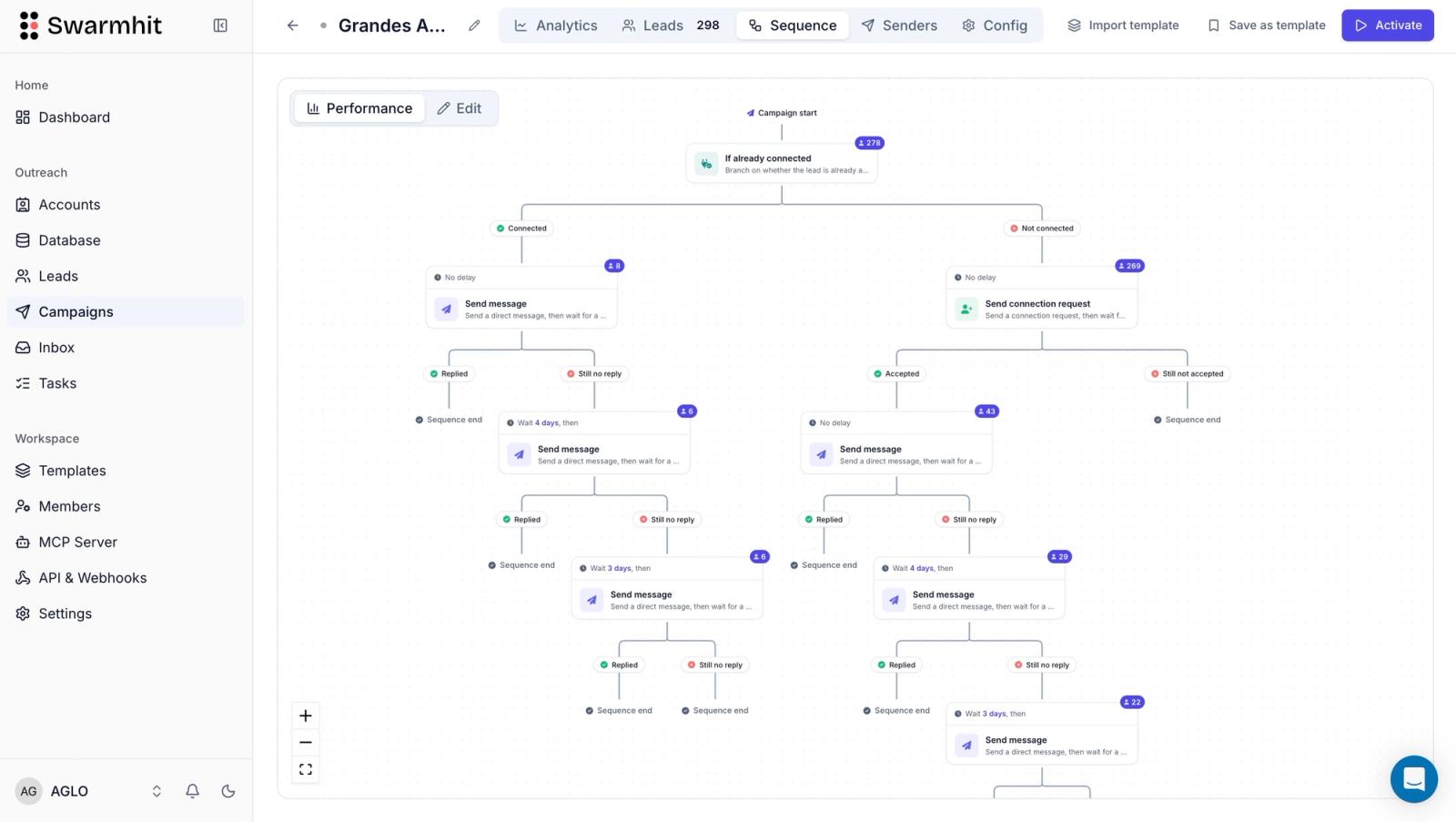
Clay is a data and enrichment tool, not an outreach sender, and its own pricing page does not list one: nothing in Launch's, Growth's or Enterprise's published feature set turns an enriched row into a LinkedIn message. Once a table is scored and enriched inside Clay, sending the actual touches still needs a separate tool built for that job. Swarmhit is where that handoff happens: it runs multi-sender LinkedIn campaigns from a list Clay has already assembled, and it does not compete with Clay's waterfalls, its Actions meter or its Data Credits.
Swarmhit sends from LinkedIn accounts the customer already owns and connects, rotating sends across several senders inside one campaign and routing replies into a unified inbox tagged by interest. Pricing runs from $29 per sender per month on annual billing ($39 monthly), pay as you go, and the per-sender rate drops sharply with volume; larger fleets and white-label agency setups move to custom pricing based on the number of senders, scoped on a call. Every sender carries a dedicated proxy, managed auto-warmup, health checks and smart sending caps, with 250+ safeguards monitored around the clock.
LinkedIn does not publish an exact daily action limit; its invitation and messaging rules warn that automated or excessive activity can get an account restricted, without stating a number. Swarmhit's dedicated proxies, managed warmup and health checks are built to keep sending activity on every connected account well inside that unwritten line, and a separate pair of caps (2,500 profiles a day from Sales Navigator search, 1,000 a day from standard search) limits how many profiles any one connected account can scrape in a day. Our own connection limits breakdown covers what mature accounts actually sustain in practice. That safety layer is the reason to read our take on whether LinkedIn automation is safe before connecting any account to any tool, Swarmhit included. Swarmhit sits inside the broader field of LinkedIn automation tools built to run on a connected account rather than replace one, and it imports Sales Navigator searches directly rather than replacing Sales Navigator's own targeting. CRM connectivity runs through API, webhooks and MCP.
FAQ
Is the Clay free plan enough to get started in 2026?
The Clay free plan is enough to genuinely test the product, not just click through a demo. It includes unlimited seats and tables, multi-provider waterfalls, Claygent enrichment and Clay's own email sequencer, inside a monthly allowance of 100 Data Credits and 500 Actions. Tables are capped at 200 rows, which is the real limit for most teams, not the credit allowance itself.
What is included in Clay's Launch plan?
Clay's Launch plan starts at $185 a month on monthly billing or $167 a month on annual billing, and it includes 2,500 Data Credits and 15,000 Actions a month by default. Beyond the meters, Launch adds phone number enrichment, job change and signal tracking, email campaign integrations, and tables up to 50,000 rows, a big jump from Free's 200-row cap.
What is included in Clay's Growth plan?
Clay's Growth plan starts at $495 a month on monthly billing or $446 a month on annual billing, with 6,000 Data Credits and 40,000 Actions included by default. Growth's distinguishing features are CRM auto-sync, HTTP API integrations, webhook automation, web intent signal tracking, audience pushes to ad platforms and priority support, none of which appear on Launch.
How is Clay's Enterprise pricing quoted?
Clay's Enterprise plan carries no published number: pricing is custom and requires an annual commitment. It adds Clay API access, data warehouse syncs, SSO, role-based access control and a dedicated Growth Strategist, with allowances starting at 100,000 Data Credits and 200,000 Actions a month, both listed as minimums rather than fixed amounts.
What happens if a team runs out of Actions before the billing cycle ends?
Clay Actions simply stop working until the next billing cycle if a team exhausts its allowance early, because Clay's own FAQ confirms Actions "reset each billing cycle and don't roll over." There is no stated overage charge on the pricing page, which means the practical fix mid-cycle is upgrading the Actions tier rather than waiting for a top-up. Clay's own FAQ says "each plan includes enough Actions to cover 90% of customer usage," so running out before renewal is meant to be the exception, not the norm.
How many Clay credits come with each plan, and do they carry over?
Clay credits, meaning Data Credits, come bundled into every plan: 100 a month on Free, 2,500 on Launch, 6,000 on Growth, and 100,000 or more on Enterprise. Launch and Growth both roll unused credits forward up to 2x the monthly allowance, while Enterprise carries over up to 15 percent of the prior year's balance, a smaller cushion relative to its much larger baseline.
Can Clay Data Credits be spent on more than one data partner in the same waterfall?
Clay Data Credits draw from a shared pool that Clay's FAQ describes as covering "150+ data partners," so a single credit allowance is not tied to one specific source. Waterfall enrichment steps can pull from several partners in sequence within one workflow, and every successful match against any of them draws from the same Data Credits balance.
Is Clay cheaper than Apollo for a small sales team?
Clay pricing and Apollo pricing follow different logic, so a direct comparison depends on what a team actually enriches. Clay's Launch plan runs $185 a month for 2,500 Data Credits and 15,000 Actions, while Apollo's entry-level Basic plan runs $49 a seat a month on annual billing for a separate credit allowance; teams weighing both should read our Apollo alternatives comparison for the fuller breakdown.
Does Clay include a way to send LinkedIn messages or emails?
Clay includes its own sequencer for sending email as part of every plan, including Free, but nothing on its pricing page describes native LinkedIn messaging or connection sending. Teams that need to run LinkedIn outreach on the list Clay builds still need a separate tool connected to their own LinkedIn accounts.
Is Clay worth it for a solo founder testing outbound?
Clay is worth trying for a solo founder before it is worth paying for, because the free plan's 500 Actions and 100 Data Credits a month is enough to enrich a first meaningful list and see whether waterfall matching actually beats a single data source. Moving to Launch only makes sense once that founder is burning through Free's allowance regularly, not before.
Conclusion
Clay pricing in 2026 is simpler once you stop looking for one number and start looking at two: an Actions tier and a Data Credits tier that add up to whatever a plan costs that month. Launch ($185 monthly, $167 annual) and Growth ($495 monthly, $446 annual) are each just the cheapest legal combination of those two meters, and a team can move either one independently as its enrichment volume changes. If the two-meter model doesn't fit how your team likes to buy software, our Clay alternatives roundup covers other options built around a single flat price.
Buy Clay for the waterfall enrichment and the free plan's real testing room, not for a fixed monthly bill you can predict a year out. And once the list Clay builds is enriched and scored, remember that Clay's job ends there: running the actual LinkedIn outreach on that list is a separate decision, covered above.


